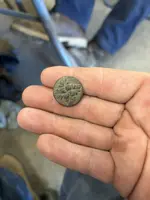
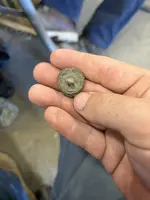
The term ‘ORANGE’ began appearing on British buttons after 1796, arising from a legislative change. From that date, the amount of gold on a button to be called ‘GILT’ was set at 1/96th of an ounce per gross of 1 inch buttons. Manufacturers using less gold than that, who had previously claimed their buttons to be ‘gilt’ took to using the term ‘orange’ to circumvent the legislation. The term was also used by manufacturers using various gold-coloured lacquers and coatings which contained no gold at all.
Many of these coatings were notoriously thin and of poor durability, so better quality coatings were designated by using additional terms such as ‘EXTRA’ (mirroring the claims made by manufacturers of gilt buttons, who used the terms ‘double’ and ‘treble/triple’ for their thicker coatings.)
Note that the backmark is raised, not indented. Raised backmarks began to be replaced by indented ones from around 1810, and are rarely seen after about 1840.