What's new

Help ID English Bow back chair

Copperdragon333

Tenderfoot
Joined
Apr 1, 2024
Messages
8
Reaction score
14
Golden Thread
0
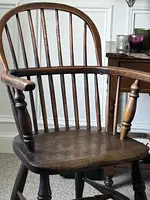
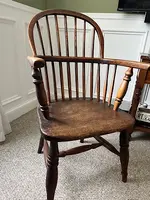
Hi all, I recently acquired this beautiful old bow back chair and need some help identifying it. The woman who owned it previously said the dealer she got it from said it was English. The chair is in a beautiful state of preservation and has great patina and wear. It stands 35” to the top of the back, 16” floor to seat and 20” at arm opening. The entire piece is rather roughly made, with irregular sized pieces and straight saw lines visible. It seems to have quite a bit of age. Can anyone confirm that this is indeed an English piece and give me an approximate idea of when it was made? I’ll try to attach some close up photos of the chair that may be helpful. Any comments would be greatly appreciated!
IMG_1972.webp
IMG_1940.webp
IMG_1952.webp
IMG_1953.webp
IMG_1943.webp
IMG_1950.webp
IMG_1956.webp
IMG_1939.webp
IMG_1957.webp
IMG_1960.webp
IMG_1959.webp
 

Attachments

  • IMG_1946.webp
    IMG_1946.webp
    1.3 MB · Views: 63
  • IMG_1972.webp
    IMG_1972.webp
    51.1 KB · Views: 68
Welcome to Tnet.

That’s a ‘stick-back’ Windsor armchair. It’s a traditional English style, first commercially made c.1720 when it was primarily used outdoors as a garden chair, but later used indoors and at its height of popularity in dining rooms during the mid-19th Century. The bowed back was produced using steam-bending and the first chairs of that type were produced in Windsor, Berkshire in 1724. Yours is not in a style from the earliest period and my guess would be early- to mid-19th Century.

It may well be English, but by about 1730 they began to be produced in Philadelphia and then later elsewhere as English settlers, including woodworking craftsmen, spread to other areas.
 
Last edited:
Thank you for the in-depth information; super helpful! I think I included a picture of some flat spots on the chair, especially on the backside of the front leg turnings. Any idea where they would have come from? It almost looks like wear marks but the backside of a chair leg is an odd spot.
 
Thank you for the in-depth information; super helpful! I think I included a picture of some flat spots on the chair, especially on the backside of the front leg turnings. Any idea where they would have come from? It almost looks like wear marks but the backside of a chair leg is an odd spot.

You're welcome.

My guess about wear and scuffing on the rear side of a chair's front legs would be from stowing under a table when not in use. In the 19th Century, dining tables for ordinary folk were often of a 'refectory' type, like this.

18th Century Refectory Table.webp


The stretchers connecting the legs to give stability meant that when chairs were not in use, the front legs had to be lifted over the stretchers to tuck the chair into the table such that there was wear and tear was on the rear of the legs.

Wear and tear on the rear side of the back legs is usually from the chair being pushed back to a wall.
 
  • Like
Reactions: ARC
Hi all, I recently acquired this beautiful old bow back chair and need some help identifying it...
tn_moved_over.gif
I moved ya from HELP! over to ANTIQUES & COLLECTIBLES for more exposure.
tn_notice.gif
NOTE: Forum HELP! contains guides tutorials on how to use the new TreasureNet.com software.
 
Thanks again Red-Coat, your input is very much appreciated! Something else has been nagging me: the size of the chair seems a tad small for an adult. I’m 6’ tall and 155 lbs, so not what I’d describe as large, and I just fit between the chair arms without them touching my body. The chair measures 35” floor to top of chair back, 18” between the arms (inside dimension), 15” seat depth, 18.5” seat width and seat height is 16” from the floor (apologies: we Yanks still cling to what is commonly called the English system of measurement!). Would this chair still be considered an adult size chair or is it more likely a child’s size chair? Also, what value would you think it has?
 
Thanks again Red-Coat, your input is very much appreciated! Something else has been nagging me: the size of the chair seems a tad small for an adult. I’m 6’ tall and 155 lbs, so not what I’d describe as large, and I just fit between the chair arms without them touching my body. The chair measures 35” floor to top of chair back, 18” between the arms (inside dimension), 15” seat depth, 18.5” seat width and seat height is 16” from the floor (apologies: we Yanks still cling
 
Also, do you think the wood species is elm for the seat and ash for everything else?
 
Thanks again Red-Coat, your input is very much appreciated! Something else has been nagging me: the size of the chair seems a tad small for an adult. I’m 6’ tall and 155 lbs, so not what I’d describe as large, and I just fit between the chair arms without them touching my body. The chair measures 35” floor to top of chair back, 18” between the arms (inside dimension), 15” seat depth, 18.5” seat width and seat height is 16” from the floor (apologies: we Yanks still cling to what is commonly called the English system of measurement!). Would this chair still be considered an adult size chair or is it more likely a child’s size chair? Also, what value would you think it has?

Also, do you think the wood species is elm for the seat and ash for everything else?

Windsor chairs for adults come in a wide variety of sizes depending on intended usage. Seat width generally ranges from about 15 inches for a small side-chair to about 24 inches for a large armchair and seat depth from around 15 to 19 inches.

Traditionally, the seat portion was usually made from elm due to its resistance to splitting but cheaper ones may be from less durable oak, poplar, or even pine. The legs, back spindles and other parts were usually ash or beech but many other wood types were used, including fruitwood, walnut, yew, maple and birch.

Value-wise I don’t know, but I see damage in a number of areas and woodworm attack which would discourage interest from dealers and most personal buyers, except those into restoration who generally don’t want to pay much for anything they’re going to work on.
 

Users who are viewing this thread

Back
Top Bottom