What's new

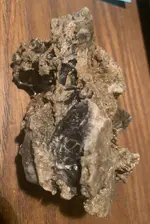
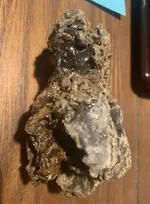
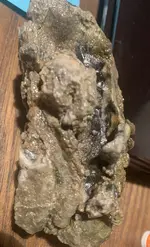
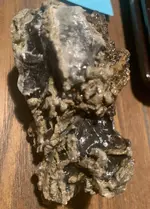
Help me to identify this rock please

currierc

Tenderfoot
Joined
Sep 20, 2020
Messages
2
Reaction score
2
Golden Thread
0
Primary Interest:
All Treasure Hunting
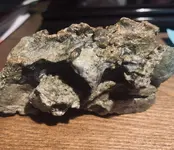
I found this rock in the Willamette River in Oregon. It’s got so much detail and I’m not sure what I’m looking at. I did put a sheen on it so I could really see what the different colors are. Hope I didn’t ruin it by doing so. Any help or advice would be greatly appreciated. 8A9DB52D-7679-465C-B7BA-362B8D58B416.webpF905D3B5-DECC-4B30-A380-F51BE98F3944.webp5F1AD92E-F3AD-4874-B59F-52B404417487.webp4ABFA15F-31F9-46E7-95C3-326E4F9E654D.webp893C497C-97D7-4EDF-BF56-2D198EE00672.webp
 

Attachments

  • 8A9DB52D-7679-465C-B7BA-362B8D58B416.webp
    8A9DB52D-7679-465C-B7BA-362B8D58B416.webp
    511.2 KB · Views: 110
Upvote 2
Cool rock. The region you found the stone in is built with basalt. Geologically violent area with earthquakes, volcanoes, and old basalt flows. I think what you have is shattered basalt, no doubt earthquake damage, that remained in place buried deep underground, and the cracks were infilled by rich volcanic fluids leaving behind all the quartz. It formed in the hot plastic zone, the quartz inclusion have been deformed, bent, post formation. IMO.
 
I find similar rocks on the Calapooia, but most of what I find are light greys. Some with a pinkish hue. Kray gives a reasonable explanation on formation.

Time for more coffee.
 
Cool rock. The region you found the stone in is built with basalt. Geologically violent area with earthquakes, volcanoes, and old basalt flows. I think what you have is shattered basalt, no doubt earthquake damage, that remained in place buried deep underground, and the cracks were infilled by rich volcanic fluids leaving behind all the quartz. It formed in the hot plastic zone, the quartz inclusion have been deformed, bent, post formation. IMO.

Thank you! I will keep it as a conversation starter on my coffee table. 😊 it’s definitely worth keeping since it’s unique with all the different formations.

Quote: “ River stones remain, while water flows away.” ...
 
I found a rock in the Willamette Valley It is some kind of metal, very hard, heavy and non magnetic. My MXT was screaming about it. I kept looking for a coin or jewelry, only seeing rocks until the pointer distinguished it from others in the hard dirt. Is it worth looking into? Should I take it to the geology dept at the University?

BTW, new here, just started MDing..... A lot of nice folks on this forum.
 
I found a rock in the Willamette Valley It is some kind of metal, very hard, heavy and non magnetic. My MXT was screaming about it. I kept looking for a coin or jewelry, only seeing rocks until the pointer distinguished it from others in the hard dirt. Is it worth looking into? Should I take it to the geology dept at the University?

BTW, new here, just started MDing..... A lot of nice folks on this forum.

Welcome to this forum... and to the metal detecting hobby, also from Oregon (the east side). Yes, take it to the geology dept.!
 
Thank you, I will have to do that. Sure is surprising to pick up a stone so heavy yet the same color as the rest of them...... this greenhorn checked 5 times with the pointer. :laughing7:
 
Very cool rock-- that looks wild with the sheen. It's hard to see what the actual minerals are there. Are there any actual crystal forms visible, or is it all cryptocrystalline? Is the black-looking part actual volcanic glass, or does it just look like that from the added sheen? Is it pretty dense, or does it seem lighter than most other rocks that size? What part of the river was it found in? My first observation was that it sure doesn't look very weathered for being in the Willamette river-- in other words, since has very rough edges and hasn't been rounded through thousands or millions of years of transport, it's probably a very "immature", and not that far from it's source.

The thing with the basalt hypothesis is that most of our basalt in the Willamette basin is from the tributaries from the south part of the valley, on the order of 20-50 million years old (much much older than the Columbia River Basalt group that is so visible in eastern OR and WA), and from what I've seen most of it is so banged up and weathered that it doesn't even show any glassy texture like that. It's generally pretty non-descript, very weathered, aphanitic dull brown matrix with some plagioclase crystals. Moreover, by the time this has made its way down its tributary and into the actual Willamette, it's usually totally broken down or a very rounded river cobble.

The reason I ask about texture and density is that I suspect your find could be some sort of industrial waste byproduct, like from a mill or smelting place or refinery or something. I've found stuff like that before and discovered that there was some sort of industrial site upriver in the 20th century, so it could be a cool project to research a bit of that. That being said, Gelder mentioned, you can get some really crazy rocks formed in fault zones and hydrothermal vents.
 
Can someone please help ? How do I post a picture of my rock?
 

Users who are viewing this thread

Back
Top Bottom