What's new

Possible William IV Copper Coin – Britannia Reverse, ID Help Please

Kunal22

Greenie
Joined
Jan 13, 2025
Messages
14
Reaction score
176
Golden Thread
0
Hi everyone,

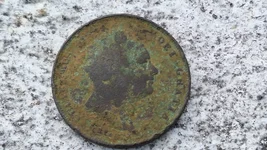
I found this copper coin while metal detecting and would appreciate some help confirming the identification.
From the visible details, I believe it may be a William IV coin, pre-Queen Victoria. The obverse appears to show the legend “GULIELMUS IIII DEI GRATIA”, although the centre is quite worn and partly covered by corrosion. The reverse seems to show seated Britannia with shield and trident.

The coin has a green patina/corrosion layer, so I have not cleaned it aggressively. I would rather preserve the remaining detail than risk damaging it.

Could anyone help confirm:

Whether this is definitely William IV
The exact denomination — penny, halfpenny, or farthing
The likely date, as it is difficult to read clearly
The best safe conservation approach for a copper coin in this condition


Any help or opinions would be much appreciated.
Thanks in advance.


20260705_101746.webp
20260705_101756.webp
20260705_101810.webp
20260705_101819.webp
20260705_101828.webp
20260705_101842.webp
 
Upvote 7

This is a very rare and great find!
 
King George IV 1825 and 1827.

No. George IV faces left, not right.


It’s definitely William IV, but essentially the same design was used for pennies, halfpennies and farthings with no indication of denomination on the coin itself, and distinguished by diameter and weight. The date will be below the portrait bust, but it’s unreadable.

Pennies were 34mm with dates of 1831, 1834 and 1837
Halfpennies were 28mm with dates of 1831, 1834 and 1837
Farthings were 22mm with dates of 1831, 1834, 1835, 1836, and 1837

There were also fractional farthings with the same design for colonial use: Half-Farthing at 18mm, dated 1837; and Third-Farthing at 16mm, dated 1834. Those would be unlikely finds.
 
Last edited:
Great find - congrats !
 
No. George IV faces left, not right.


It’s definitely William IV, but essentially the same design was used for pennies, halfpennies and farthings with no indication of denomination on the coin itself, and distinguished by diameter and weight. The date will be below the portrait bust, but it’s unreadable.

Pennies were 34mm with dates of 1831, 1834 and 1837
Halfpennies were 28mm with dates of 1831, 1834 and 1837
Farthings were 22mm with dates of 1831, 1834, 1835, 1836, and 1837

There were also fractional farthings with the same design for colonial use: Half-Farthing at 18mm, dated 1837; and Third-Farthing at 16mm, dated 1834. Those would be unlikely finds.
DAMN AI-
Please check with @Red-Coat prior to hitting Post reply.
Not consuming daily requirement of morning :coffee2: :coffee2: :coffee2: can result in human errors.
Thanks for the fix
 
What a great, rare coin. It is of particular interest to me because of my interest in the period around the Revolution. I have found many halfpennies from that time and treasure them.
Some of my British halfpennies were corroded similarly to yours. The lighter-colored corrosion looks like "bronze disease". If so, it will be soft enough to remove with a hardwood toothpick or similar. I believe the corrosion remains slightly active on the coin even in the air. Removing it, in my experience, does not reduce the coins legibility and it often enhances it. The date may be revealed beneath it. I have found helpful information on coin conservation in the archeological literature.
 
Looks like you should be able to get a lot of that crud off if you really want to know the date!
 
Looks like you should be able to get a lot of that crud off if you really want to know the date!
I agree - seems to be enough detail where you might be able to read the date.
Looks like a good candidate for Andre Pencils.
Good Luck !
 
There were also fractional farthings with the same design for colonial use: Half-Farthing at 18mm, dated 1837; and Third-Farthing at 16mm, dated 1834. Those would be unlikely finds.

I just remembered from previous posts that @Kunal22 lives in a “a small island nation in the vicinity of India and Sri-Lanka”, so a half-farthing is not a compelety unlikely find.

Britain minted these coins under William IV in 1837 specifically for use in Ceylon (now Sri-Lanka) to help with local trade since living costs were much lower and there was a need for smaller denominations. The coins also circulated in the general vicinity (and to a very limited extent in Britain) and were tied to Ceylonese currency at a value of 1/12th of a fanam.

What it is depends crucially on the diameter, which the OP still hasn’t provided.
 

Users who are viewing this thread

Back
Top Bottom