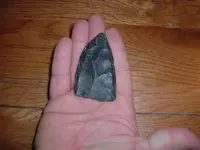
I'm assuming (above) your piece is a uniface.
By the same token, it might conceiveably be a removal from a platter-like bifacial core. But if so, why the high-angle edging around it ? The only paleo analogue to that re-sharpening strategy I can recall is what you find on Ohio Lanceolates and some points Hothem illustrated (in First Hunters) as late Paleo that I suspect were woodland.
It's an interesting artifact, whenever it was made. Thanks for showing it !