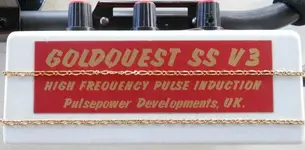
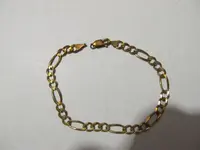
This, I know, is going to be controversial, but I have actually spent some time just hunting for chains on my local beaches. In the end I found quite a few, some in the 1 gram class. What I learned was that unless they are fairly heavy/chunky chains then will seldom offer clear returns, quite often just broken chirps or barely noticeable threshold breaks. Now here comes the controversial portions of this post.
The three biggest things that came into play in finding these chains was A) how they were positioned in the matrix, and B) the machine settings and the size of the coil being used, and last C) where we hunt. Our ability to find anything but the heavier gold chains is largely dependent on these three factors.
Chains are different, in total mass they are very heavy/dense, but when stretched out over a “larger surface area” they are easily lost within the makeup of salt/sand matrix, the machine then filtering them out right along with the mineralization, the conductivity of both being too similar without a noticeable difference in mass. The other issue is that these smaller links, due to their density value, can't produce strong enough return signals, especially when competing with a matrix that is so similar in conductivity and mass. Simply put, chains that are balled up have a much better chance of generating stronger returns, but even this is dependent on a few factors.
You're not going to find these smaller chains unless they are shallow, say within the first few inches of the matrix, just no way for them to be isolated from the larger amount of surrounding matrix and no way for them to produce a strong enough return. But these shallower chains can be found with some frequency if one really wishes to specifically target them, but this can come at the cost of finding better targets.
Chains are dense in total weight, but relatively light when spread out over a larger surface area, meaning that they will move much easier in the force of the sand and currents VS a dense gold ring of the same weight, the ring being very compact, dense, and providing very little surface area. For this reason these chains will often be found in those areas where the currents are pushing soft sand, the same places where you would expect to find can slaw, sunglasses, pull tabs, and other lighter debris. These are not the same places you would expect to find denser gold rings unless these areas have been created by considerably more force, enough force to move heavy/dense fishing weights, chunks of iron, etc. So here is the potential tradeoff when specifically hunting these smaller chains, and this is why I no longer bother to hunt for them. You can spend endless hours and days on end hunting for one small gold chain that isn't worth a fraction of the value of one average gold band. I don't ever recall having found a gold ring while hunting for these chains. But if you are so inclined, as I once was, then lets go find some of these wash areas.
Basically, you will need the hottest settings you can hunt with, right at that point just below instability. You will need to focus “on any possible response” that you think you may have heard, even the tiniest whisper, the smaller your coil the better your odds due to the lower amount of matrix the chain has to compete against. The more matrix being processed and filtered the greater the variance the chain has to produce in order for it to be recognized, this being the challenge of an item whose conductivity and mass are already too similar to that of the surrounding mineralization being filtered out, even with the hottest of settings. So, how do we find these chains?
It all begins with “anything and everything”...any suspected response at all, these chains simply not able to produce a strong enough return signal to provide anything else unless they contain larger clasp or a form of denser mass, such as a small pendent, etc., if they are balled up, which is typical, this will sometimes create the same effect, but even then these responses will usually be abnormal, intermittent, and broken. “Tics, whispers, breaks, etc.” Whenever you suspect you've just heard one of these, and here comes the really controversial part, you need to impart a very rapid and swift whipping action over the suspected target, this action producing stronger send signals and likewise stronger returns. It is a means of further separating the mass of the gold chain from the surrounding matrix, and it almost always works to the point that you will get some type of a repeatable tone. Think of it as bouncing a basketball on the ground, the more force you apply on the ball the faster and the more forcibly it will return to the hand. Same general principle being applied here. It provides a very small edge when trying to generate a response from a suspected target and it's a very useful edge when hunting these smaller chains.
While I was hunting these chains, nearly a full year of it, the Excal with the 8” coil ruled, it was the only machine I used that could still detect these small chains even in flushing currents that created an unstable turbulence of sand/saltwater. And this is all I know about hunting these smaller gold chains on my area beaches. Hope it helps.