1st - Welcome Aboard! You didn't list your state (or country) in your profile. So, you might consider jumping over to Sub-Forum: Select Your Area.... and selecting location information (i.e., clubs, hunts, finds, legends, maps, etc.) directly related to your state (or country)...
2nd - I moved ya from HELP! over to WHAT IS IT? for more exposure.
NOTE: Forum HELP! contains guides tutorials on how to use the new TreasureNet.com software.
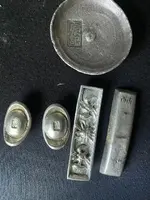
The two pieces at the left are commonly referred to by the term ‘sycee’, but also ‘yuanbao’ and ‘jyutping’ among other names. They were a form of currency produced in silver and gold, used from the beginning of the Qin dynasty in 221 BC until the fall of the Qing dynasty in 1912, but produced by individual goldsmiths and silversmiths for local exchange. The exact value for the pieces was determined from a combination of weight and purity. They were (and still are) also produced as symbols of wealth, prosperity or good fortune and frequently given as gifts… particularly during the Chinese New Year (in which case they aren’t necessarily silver or gold).
I can’t help with the characters, but perhaps our esteemed member @Yang Hao may be able to translate if he sees this thread. I suspect they’re 20th Century good luck pieces, not currency items, although they may be silver.
The top ingot has the marking 康記 (康记 in simplified) kangji. If authentic it would have been made during the Qing dynasty more than likely during the time of the emperor Kangxi 康熙. The character 康 Kang would represent the emperor and 记 記 ji means to record or make record of.
Below is a link to an auction of a Qing Dynasty gold and silver ingot with the sale price of 10350 RMB. ( around $1450 US dollars)