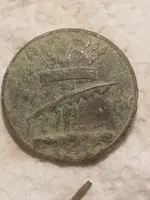
Very nice and unusual livery button. It’s not depicted in that very handy “Livery Buttons Identified” site that Crusader linked you to, which contains only a tiny fraction of the possibilities (although the collection is growing all the time), but I’m sure it’s for the Merry family of Herringfleet Hall. In fact I could only find one image where an early version of the crest is depicted on the rim of a porcelain plate from c1725, which is in the Musée National des Beaux-Arts du Québec. The plate also has the full armorial of the Foster Family:
Fairburn (incorrectly stating that Herringfleet Hall is in Norfolk, whereas it’s in Suffolk but close to the Norfolk border… and that error is perpetuated by the Musée National) details the crest as follows:
"The mast of a ship rompu and erect, thereto a yard with the sail furled in bend sinister, above it a round top, three arrows issuing therefrom on each side in saltier, points upward, all ppr."
“rompu” is the heraldic term for “broken” or “cut off”.
“in bend sinister” means tilted from upper right to lower left (although that early crest I showed has the yardarm tilting in the other direction).
“in saltier” means “arranged as a diagonal cross: X
“ppr” is the abbreviation for “proper”, meaning the heraldic elements are depicted in their naturally-expected colours.
Here’s the “Historic England” listing for Herringfleet Hall:
https://historicengland.org.uk/listing/the-list/list-entry/1031949
If you’re interested, it might be worth doing a bit of genealogical research to see if you find a family connection to the area where it was found. Unless it was actually near the Suffolk/Norfolk border of course.
The presumption that it’s “circa 1830s” isn’t necessarily correct. The “golden age” of livery buttons was between about 1830-1850 but such buttons were commonly made from the late 1790s through to the end of the 19th Century. Is there a backmark to help in dating?