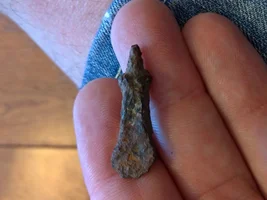
Coprolites are fossilized feces, or animal dung. They form an important class of objects studied in the field of paleontology.
The name is derived from the Greek words kopros meaning "dung" and lithos meaning "stone".
Coprolites are also trace fossils and vary in size from the small fecal pellets of a sea-snail to the large droppings of crocodiles, dinosaurs, or mammals. Typical sizes vary from less than 5 mm (0.2") to 5 cm (2"), although they may exceed 30 cm (12") in length. There is a large variety of shapes: cigar-shaped, lens-shaped, kidney-shaped, cone-shaped, round, oval, cylindrical, or spiral-shaped, depending upon the type of animal which produced them, although as with other trace fossils, the specific animal is usually not known.