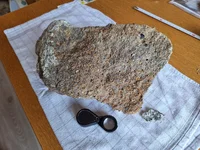
Might I politely suggest that when posting your finds, you give us all the information with your best pictures at the same time. Not in dribs and drabs. It’s really unhelpful when, as here, you post a rock fragment with a very distinct geology and then later reveal it to be part of a larger rock with pictures that show an obviously different geology.
I can only tell you what I see, rather than what it is, and speculate on likely identification consistent with the appearance from pictures that you post.
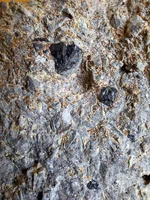
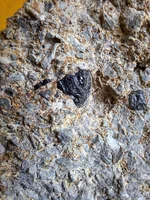
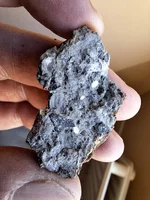
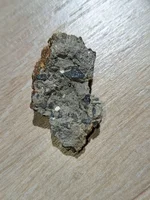
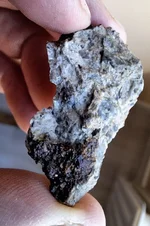
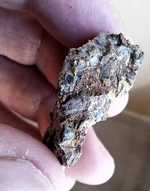
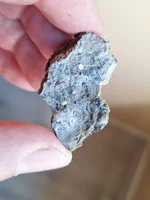
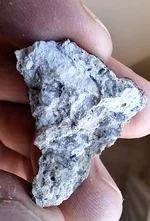
What I see in the first pictures is a volcanic rock with brecciation of an essentially monomict nature with a dark matrix that has sparse vesicles, some of which appear to be filled with a white mineral.
The appearance is consistent with a ‘tuff breccia’ composed of tephra and the dark matrix would suggest basaltic rather than andesitic. Such rocks are usually formed from the pyroclastic ejection of hot ash and small debris which then consolidate and solidify after settlement. White minerals filling voids or vesicles are often calcite, subsequently deposited from groundwater, or quartz.
True pyroclastic breccias arising from magmatic flow are geologically characterised by having large clasts (75% measuring 65mm or greater). When the clasts are small, as in your rock, and arising from explosive ejection, the resultant consolidated ejecta are classified as tuff-breccias or lapilli tuffs.
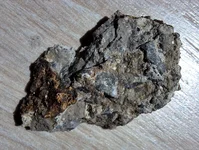
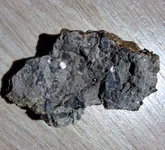
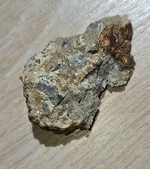
By contrast, the larger rock of which it is part is clearly not a basalt. It actually looks more like a pegmatite with phenocrysts of schorl (black tourmaline). However, since the fragment is intimately associated with the larger rock, that’s unlikely because basalts and pegmatites don’t form together under the same kinds of conditions and have different mineralogies.
I think it much more likely that it’s andesitic, within which black phenocrysts of minerals such as hornblende, augite, or biotite are commonly seen. Basaltic magma is also the parent melt for andesites. Fractional crystallisation as the magma rises through the Earth changes its chemistry, converting it to andesite. A volcanic field will often contain co-mingled basalt and andesite lavas representing different eruptive phases, as well as consolidated ejecta that’s a mixture of the two. Both will frequently exhibit attraction to a magnet, usually arising from small amounts of magnetite or titanomagnetite.
That’s my best guess.
If you found this rock locally, as I’m sure you know, volcanic rocks like this are not native to your region of the Netherlands but have been commonly imported in bulk for uses such as reinforcement of dikes and riverbanks. Most imports are from the Eifel and Siebengebirge regions of Germany, or the Rogaland region of Norway, with smaller quantities from other countries.

 20260621_115929.webp1,000.9 KB · Views: 66
 20260621_122637.webp472.4 KB · Views: 39
 20260621_122613.webp527.2 KB · Views: 34
 20260621_122511.webp572.9 KB · Views: 30
 20260621_122530.webp1,000.8 KB · Views: 28
 20260621_115911.webp346.2 KB · Views: 29
 20260621_115900.webp330.9 KB · Views: 31
 20260621_115834.webp443.7 KB · Views: 27
 20260621_120042.webp428.4 KB · Views: 32