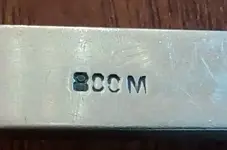
I can't cite my source without breaking forum rules, but what I find is that it's likely German, 1884 or later--not earlier.
Thanks for the links you sent me. The second link gives nothing helpful about dating, .800 silver apart from saying: “
Historically, it was commonplace in Germany…”
In the first link, someone says; “
Whatever country, 800 means late 19th century. Millesimal fineness expressed in units of silver parts per 1,000 was not used before last decades of 19th century.”
With that I would agree. The earliest reference I can find for ‘800M’ marking is from c.1869 as I said above.
That link you provided relates to a discussion about a piece from Martin Mayer of Mainz, Germany, which has an ‘800’ mark (but
not ‘800M’) in addition to Mayer’s own mark, but no national mark. Someone responded with an ID of: “
Martin Mayer from Mainz, Germany. 1884 or later, not earlier.” It’s not clear if he bases that date on the ‘800’ mark, the Mayer mark, or a combination of the two. Another responder provides a link to another silver website which incorrectly says Mayer was founded in 1888 (in fact they were founded in 1838). As far as I know they never used an ‘800M’ mark:
My understanding of the chronology for silver marking in Germany is as follows:
- Prior to 1884, German silver usually had town mark symbols and the silver fineness was usually indicated in "Loth." Pure silver was 16 Loth and various standards were in use such as 12 loth (corresponding to .750 fine), 13 loth (corresponding to .812 fine), 14 loth (corresponding to .875 fine and 15 loth (corresponding to .937 fine.)
- I don’t think this was the
only type of marking for German silver in the second half of the 1800s, and particularly not on items for export to other countries where Loth represented an unfamiliar standard (ie outside Germany/Austria).
- In 1884 a law was enacted in Germany, making .800 fine the minimum national standard for silver.
- In 1886 the use of individual city marks was abolished and replaced by the national mark of a "Crescent and Crown" (Halbmond und Reichskrone) for a unified hallmarking system.
- There was a transition period before the national mark became compulsory in 1888, accompanied by a millesimal fineness mark and a maker mark.
What we have here, is an ‘800’ mark with an ‘M’ but no national mark and no maker mark. I would still contest that it can’t be after 1888 and probably relates to the period immediately before that when Germany was flooding other countries with imports (notably Belgium) or possibly (but less likely) from a Belgian maker at the time they were fending off imports from Germany.
JMO