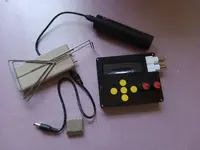
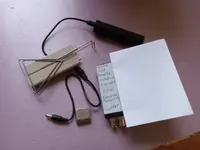
I've been using long range locators for years. I have two of them. They are different brands, but both work the same. One is a big one and the other is a small one. The big one has a pretty good range. The small one has a range of about a mile. The small one has a circuit for finding buried objects that have false signals. You are supposed to flip a switch and it will come round to the true signal line.
I will say this about whether they work. I can get signals no problem. The rods will open and close according to whether I am on a signal. Finding anything that has been buried for a long time, however, is not easy. Despite the tuning circuit on the small machine, it doesn't find targets that have been buried for a while very well. It will find naturally occurring ore veins and ore bodies without false signals. It won't find things like buried treasure, unless the treasure hasn't been buried for long.
There is no mistaking crossing a signal line. The rods cross on their own. They also open on their own when I am not on a signal line. When the machine is turned on it emits a signal that will cause the rods to open. They will open without me having to make them open. They will stay open indefinitely. The rods cross when I am standing with my heels on a signal line. The rods cross for a period of time when I cross a signal line. This is called a 'lock time.' After the lock time is over, the rods will open again. They will remain unlocked for a while as well, then close again. When they close again, they will close for that same amount of lock time as before. They will repeat this all day.
You know what, you do have to be compatible with the device for it to work! I heard about those people in Iraq trying to use it to detect bombs. You can't just hand these things over to anybody and expect them to work. I have never run across anybody else they will work for besides myself and the guy who sold my dad the first machine years ago. It did not work for my dad. It did work for me. I became the operator in our operation. It made my dad sad that he couldn't run the rods. Nothing he ever tried made the rods work either. He wasn't dehydrated. He didn't need to gain some weight. He didn't need to spend time with it. It just worked for me, and not for him. If it doesn't work for you, don't buy it. It never will.
As for testing whether the thing works, I have tried all sorts of things. You can hide gold under an upside down paper cup, among a bunch of cups, and I can find it. It has to be in a place where I can go behind the row of cups, so that I can tell if there are signals coming from behind them. Once I know there aren't, I only have to walk in front of the row of cups and see which one has a signal. Like I said, it only has trouble narrowing down on buried objects. And those have to be buried for a while. What happens with buried stuff is that the earth that surrounds the object seems to get charged up somehow. I have dug dirt up from around buried objects and tested it for a lock. It will lock just like the thing you are looking for should lock. The dirt doesn't have any gold in it, but it will lock. It will do this for days, maybe weeks. Finally, it will stop doing that, but it has to be away from the buried thing that has caused that for a while. You can see how this might cause problems out in the field. You do get some of this behavior around ore, but it isn't the distraction there as it is when trying to find treasure. The worst thing then is that you can't use your device to see if a pan will have color in it. You will have to pan it to see. But it doesn't seem to blur the edge of ore bodies.
As long as I am giving away the store, there is another thing I can tell people. You can have multiple devices working at once, virtually. You don't have to buy a second device to do this. You only need a wad of aluminum foil and a brass rod. You don't really need the brass rod, but it helps to keep the foil in place. The ball of foil will act like a second generator. It will send a signal out from the ball that is tuned to the same frequency the machine is tuned to. Near as I can figure, the signal reflects off of the uneven crumpled surface of the foil and that's how it is sent out from the foil in imitation of the machine.
Also, the rods crossing and uncrossing is probably due to whether I am in a positive or negative signal environment. I think the positive signal results in open rods and the negative signal results in crossed rods. When the rods are open they are effectively averse to pointing at each other. When they are closed they are completing a circuit. So, when they are open they are phobic and when they are closed they are philic. It is probably just electromagnetism. The signal lines are most likely some version of light that isn't visible, but can be traced out with the rod technique.