A chart telling the precise diameter and weight of lead pistolballs and musketballs does exist. It is on page 57 of the book "Cicil War Projectiles II - Small Arms & Field Artillery" by W. Reid McKee and M.E. Mason. Similar info is given on various pages of the "Handbook Of Civil War Bullets & Cartridges" by Dean S. Thomas and James E. Thomas.
Important note:
The weight of cast lead balls can vary a ittle bit from the weight-info given in those books, due to presence of airbubbles trapped inside the lead during the casting process.
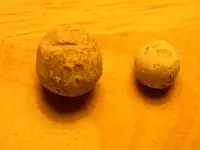
Old Dude, the weight of the smaller ball in your photo indicates it is indeed a .44-caliber pistol ball. Rifling-marks on the ball account for why it is a bit larger than .44-inch in diameter.
There SEEMS to be a semi-flattened area encircling both of the balls, which indicates they have been fired.
The larger ball's weight (390 grains) is extremely close to the weight of a .640-inch diameter musketball (392 grains) mentioned in the list on page 67 of the McKee-&-Mason book. Perhaps the semi-flattened area encirccling your larger ball reduced its diameter to the .611-inch diameter you reported.
The flat spot on the smaller ball was made by the pistol's rammer. You say there is a "ring" on the larger ball, but I can't quite make it out in the photo. Are you talking about the semi-flattened area encircling the ball? Or did you mean there is an indented circle on it? If that's what you meant, it was made by a rifle's ramrod.