What's new

Need help in dating early axe head

Possumguts

Jr. Member
Joined
May 4, 2008
Messages
98
Reaction score
10
Golden Thread
0
Location
Western NYS
Detector(s) used
Whites XLT
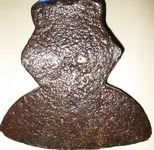
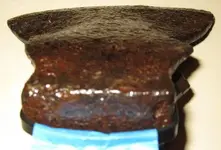
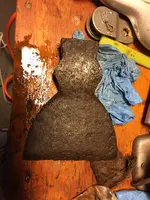
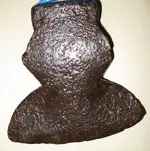
This axe head was found by a distinguished member of our Club. We don't know the method of manufacture or date of the item, but it appears to be pretty old. Any information on the item would be appreciated. It was cleaned up with a wire brush and laquered.
 

Attachments

  • Louies axe head 1.webp
    Louies axe head 1.webp
    40.2 KB · Views: 827
  • Louies axe head 2.webp
    Louies axe head 2.webp
    48 KB · Views: 892
  • Louies axe head 3.webp
    Louies axe head 3.webp
    15.5 KB · Views: 731
I would put the age of the piece easily in the 1700's. It is a Broad Axe. Google the name for more stuff but here is a quote from Wise Geek. Your item cleary fits the description of, "having one beveled edge and one straight. "

"A broad axe is an axe with an extremely broad blade and a very heavy head. This design is intended for use in squaring timbers. Using a broad axe requires a great deal of skill and physical strength, and the necessary skills are growing uncommon, due to the proliferation of mechanized logging equipment which does the same job. It is still sometimes possible to purchase broad axes from logging supply companies and hardware stores.

A typical broad axe has two distinct sides. On one side, the blade of the axe is flat, making it easy to create a smooth edge. On the other, the blade is beveled, allowing the user to wedge it into the wood. When squaring timber, the flat side is faced against the side of the timber, while the bevel side faces the scrap edge, allowing the user to create a smooth edge with one stroke. Because broad axes have two distinct sides, there are right and left hand versions with handles to match.

The most classical use of a broad axe was for creating square timbers such as those used to brace homes and make railroad ties. Once a tree had been felled, a lightweight axe was used to lightly score the timber in a straight line, creating a mark to follow with a broad axe. The user stood on the log to wield the broad axe, and brought it down in powerful blows which were designed to split the timber along the line, creating a squared edge. Once one edge had been made, the log could be flipped to begin on the next edge.

If you ever enter a structure which was constructed in the era when logging was accomplished by hand, you will probably be able to see the strokes of a broad axe on the timbers. Someone who was experienced with the broad axe and in peak physical condition could churn out scores of timbers a day, ensuring the the production line was not clogged by timber waiting to be processed.

In addition to being used to create square timber, a broad axe can also be used to make octagonal timbers, such as those classically used as the masts for ships. A skilled user could also utilize a broad axe to make flooring planks.


Very Nice!!!!

DaChief!

"
 
Upvote 0
I know it looks very old and intact and intriguing, so I will linger here for a definitive ID. :icon_thumleft:
Meanwhile, I'm interested to know:
What size is it?
What is the blue 'cable ID' type thingy?
and what do you have to do, to become distinguished? ;D

Cheers, Mike

Oh Yes and, your Link to the info please, DaChief :icon_pirat:
 
Upvote 0
Dachief, I would like to commend you on that complete ID. For those of us that not only enjoy finding out what we find but, also the history that goes with it means a lot! We have kids (7-11 years old) That love this site and huddle around the computer every day to see what people find and what the items were used for. This is the only forum I frequent, and we have enlightened many children for fun and educational purposes. To see ID's like this are refreshing! Keep up the fine work! Sincerely, Staff and Kids
Swannanoa 4-h child education center and camps


:hello2:
 
Upvote 0
trikikiwi said:
I know it looks very old and intact and intriguing, so I will linger here for a definitive ID. :icon_thumleft:
Meanwhile, I'm interested to know:
What size is it?
What is the blue 'cable ID' type thingy?
and what do you have to do, to become distinguished? ;D

Cheers, Mike

Oh Yes and, your Link to the info please, DaChief :icon_pirat:

Mike,
I would estimate that the axe head is about 6 inches in length and about 4 inches wide, or perhaps just a little larger. The blue cable ID thing is just that, it was put on display as one of our club finds by the finder at a club meeting and was attached for display purposes with some information on it. As far as becoming "distinguished"?? Louie is one of our club Officers who has taken his responsibilities very seriously and whose hard work is appreciated by our members.

I'll tell you one thing, I am impressed with the knowledge imparted by DaChief. THANK YOU!!!
 
Upvote 0
I dont think you can know the age with no marks on it as these are still made and sold today.
At around 4" it is a broad hatchet, broad axes are around 10"- 12'' wide.
 
Upvote 0
That axe is not of modern manufacture, it is absolutely hand forged, the eye area is convex and is unevenly tapered to the business end. If factory made all planes would be flat tapers. I would date it 1850 at the latest and is probably much older.


 
Upvote 0
I gotta side with TAZ420 a bit on this one.....by DaChief's own description of a Broad Ax.......its not an ax. Its a Broad....or Hewing Hatchet. For fast rough shaping, dimensioning & smoothing of wood, this hewing hatchet is the traditional tool of choice. One face is ground flat to the cutting edge, enabling the tool to be swung flush along a surface. It's made for right-handed use, convertible to left-hand by remounting the head on a new handle. I have a collection of vintage Broad Axes....this is about 1/3-1/2 the size of one.
I'm not saying it isn't old (it certainly looks as though it is) but as stated hand forge quality examples are still being made today by Gransfors Bruks Tool. Its a tough item to nail down to a date without the manufacturers name or mark.

TiredIron
 
Upvote 0
Given the size, I would correct the description to that of a hatchet also. I would still hold with the age estimation based on the patina and pitting. I have worked many Colonial sites for years and also some more modern sites and I have never pulled anything from a more recent site that had the pitting and patina that these old Colonial Pieces have.

One way to help also would be to have the finder give the history of the location where it was found. If it was a Colonial site or near that time period that has been rediscovered or it was found on an old Colonial type home place, that could help to date it. I would bet that when that information is given, it will tie the date to an older time.

DaChief
 

Attachments

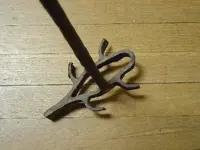
  • Branding Iron.webp
    Branding Iron.webp
    57.6 KB · Views: 517
Upvote 0
OMG that is a 17th century axe head
 
Upvote 0
I found one just like this yesterday in an old farmstead that is in an area that was not open to settlement until 1836. Nice 2nd find for my new T2
 
Upvote 0
From what a member (who's Father is an ax collector expert) says that it is useless trying to date an ax head that isn't marked or stamped. The history of the site that you are hunting and other finds that you uncover may give you an idea but it won't be definitive.
 
Upvote 0
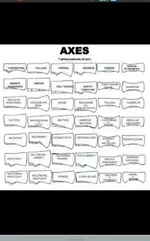
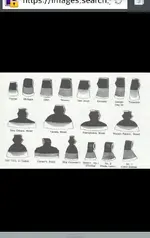
These 2 photos are screen captures from yahoo images:

2015-10-18-16-13-36-1.webp

2015-10-18-16-14-01-1.webp
 
Upvote 0
IMG_0978.webpIMG_0977.webpI found a very similar head here in Georgia this weekend. The only marking I have been able to read thus far into the cleaning process is the word "service." Ring any bells? Thanks in advance for any responses.
 
Last edited:
Upvote 0
1700S BROAD AXE , A DAMN NICE ONE ..
 
Upvote 0

Users who are viewing this thread

Back
Top Bottom