What's new

Need help with ID of CW bullet

Bill D. (VA)

Silver Member
Joined
Oct 7, 2008
Messages
4,715
Reaction score
6,221
Golden Thread
6
Location
SE Virginia
🥇 Banner finds
6
Detector(s) used
F75 SE (land); CZ-21 (saltwater)
Primary Interest:
Other
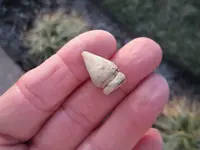
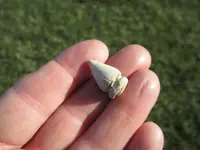
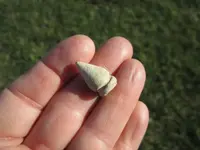
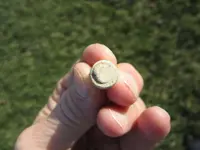
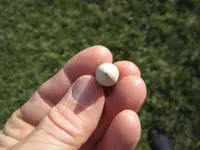
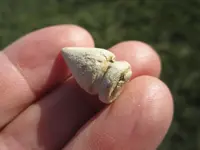
Dug this at a Union camp yesterday that yielded 20 bullets and 10 buttons. My friend thinks it may be a variant of a Maynard, or it could be carved. Any opinions?
 

Attachments

  • 122713d.webp
    122713d.webp
    49.8 KB · Views: 113
I'm gonna say a carved game piece. Maybe a bishop or pawn for chess?
 
Upvote 0
Bill....I answered you on another forum but I think your bullet is a Hanoverian....rare find and congrats!
 
Upvote 0
Should measure about 4/10ths inch across. About 6/10ths inch in length. Congratulations. Great save.
 
Upvote 0
Upvote 0
Bill, please use a digital Caliper to provide precise measurement of your mystery-bullet's diameter at the widest area. Additional photos would be helpful too.

Does it have a flat solid base, or is there a cavity in the base?

It does not match the profile of a Hanoverian/Saxon bullet, although it does "resemble" one. See the McKee-&-Mason civil war bullets book, page 26, bullet #63 for the actual Hanoverian/Saxon bullet. Another bullet shown in that book as bullet #74 is quite similar to yours... but that book says it is a .54 Maynard, and there was no civil war era .54 Maynard Rifle.

Precise diameter measurement, in hundredths-of-an-inch, is needed for narrowing down the possibilities for your bullet's ID.
 
Upvote 0
Bill, please use a digital Caliper to provide precise measurement of your mystery-bullet's diameter at the widest area. Additional photos would be helpful too.

Does it have a flat solid base, or is there a cavity in the base?

It does not match the profile of a Hanoverian/Saxon bullet, although it does "resemble" one. See the McKee-&-Mason civil war bullets book, page 26, bullet #63 for the actual Hanoverian/Saxon bullet. Another bullet shown in that book as bullet #74 is quite similar to yours... but that book says it is a .54 Maynard, and there was no civil war era .54 Maynard Rifle.

Precise diameter measurement, in hundredths-of-an-inch, is needed for narrowing down the possibilities for your bullet's ID.

Here's some additional info on the bullet as requested:

- Weight: 0.483 oz
- Length: 20.80 mm
- Width at widest point: 11.43 mm
- Wide of base rim: 10.94 mm
- Width of protrusion on bottom: 7.37 mm

I'm also attaching several new pics below. Appreciate any help with the ID.

bullet5a.webp

bullet5b.webp

bullet5c.webp

bullet5d.webp

bullet5e.webp
 
Upvote 0
Thank you for making the extra-precise measurements of your mystery-bullet's diameter, length, and weight... which are crucially needed for excluding various possible IDs (such as a Hanoverian/Saxon bullet). Thanks also for providing additional photos -- especially the second of the new ones.

There is no EXACT match-up for your bullet in any of the books on civil war bullets. So, I'm going to do some LOGIC-BASED guesswork based on the following observations.

I've converted your millimeters and ounce measurements.
body-diameter = .450-inch
base-ring diameter = .430-inch
diameter of projection on base = .290-inch
length = .818-inch
weight = 211 grains (the bullet-ID books use grains, not grams or ounces)

My observations:
1- It's .450-inch diameter and 211-grains weight proves it is a .44-caliber revolver bullet.
2- That diameter excludes any Hanoverian/Saxon bullets, and Maynard bullets.
3- The wide groove in its body excludes it from being any of the Dimmick bullets, all of which have a much narrower groove. Also, all Dimmick bullets have a base-cavity, and yours doesn't.
4- The very most important ID-clue is that the second "new" photo shows your bullet's nose is lopsided/tilted in relation to its lower body. It absolutely was not manufactured that way. Therefore, the nose's shape was altered AFTER it was cast. That explains why there is no exact match-up for it in any of the bullet-books. Because your bullet shows no evidence at all of being a fired bullet, the most-probable cause of its lopsided nose is carving.

Regarding the very-short circular projection on your bullet's base:
Many diggers have never heard of a "short-pour" cast lead bullet. The term "short-pour" means that not quite enough of the molten lead was poured into the bulletmold. Revolver bullets are cast upside-down. Short-pouring causes the bullet's base to be incompletely formed. The diameter of the very-short projection on your bullet's base is .290-inch, which is too narrow to be the remnant of a carved-off lower ring... so I think it is the result of short-pouring. (See related note about your bullet's comparatively light weight, below.)

So, what type of .44 revolver bullet could it be? The "best guess" match I can come up with is a .44 Bartholow bullet (#479 in the McKee-&-Mason book), that was short-poured and whose nose was lopsidedly carved to a very-sharp point. The short-pouring and carving explain why your bullet is a bit lighter than a typical .44 Bartholow.

Please note, I said "guess" -- it's not a definitive declaration.

I expect some people will disagree with various points in my logical reasoning in the statements above... and that's okay. But for me, the number-one issue is the lopsidedness/tiltedness of your bullet's nose in relation to its lower body. (Please study new-photo #2 closely.) I'm 100%-certain it didn't come out of the bulletmold that way... and since it shows no evidence of having been fired, the nose's shape MUST have been altered by a soldier after it was cast.
 
Last edited:
Upvote 0
Outstanding analysis! Thank you very much for taking the time to provide all that informative and educational info. Interesting conclusion as well.
 
Upvote 0
nice looking bullet none the less
 
Upvote 0

Users who are viewing this thread

Back
Top Bottom