

Bill D. (VA)
Silver Member
- Joined
- Oct 7, 2008
- Messages
- 4,715
- Reaction score
- 6,220
- Golden Thread
- 6
- Location
- SE Virginia
- 🥇 Banner finds
- 6
- Detector(s) used
- F75 SE (land); CZ-21 (saltwater)
- Primary Interest:
- Other
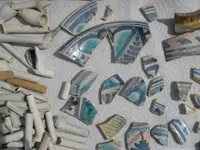
I found these shards in a trash pit along with quite a few other artifacts at the site where I found the 2 scattered hammered silver caches here in SE Virginia 3 years ago. Been trying to get an ID on these early shards. Are they a form of delftware? To what time period do they date? Based on a Binford regression analysis I performed on 100+ pipe stems found in the same pit, I calculated an average date of occupancy for the site of 1640. I was thinking the ceramics dated to the mid-1600s which would be in line with the other finds. Also, the lastest date on any of the 27 hammered coins was about 1640. Can anyone verify that the shards date to about the same time period, and what type they are? Thanks for any help ..... Bill


 Somtimes I think it must be invisible type.
  Anyway gonna give ya every site I have that is related to old colonial shards.I'm in the process of packing & will be turning my computer off for awhile in the next couple days.Don't know for sure when I'll be back up running so thought I'd give these sites to ya to look through.

 Reminds me of 21st century dixie paper plates.
  I'm sure I've seen that design but I'm not digging it all out til I get moved.Eitherway it could be Portuguese majolica or english delft but no matter what it was tin glazed & polychome was used in his pieces.Blue- cobalt oxide enamel, which fired blue,Polychrome decorations are also known, particularly on early 17th century vessels and again after ca. 1690, and were made with other metallic oxides including iron, which made red; copper, which made green; and antimony, which made yellow.

















