Tall Square Short-necked Spirits bottles: Once two-piece full sized molds came into common use in the early 19th century, the "case gin" shape above evolved (but of course did not disappear) into vertically straight sided multi-purpose bottles like that pictured to the left. Square bottles were of course used for a wide assortment of different products and came in an array of different sizes and shape variations, though all share the feature that they have four equal sides to the body, little difference in diameter from shoulder to heel, with the corners (where the flat sides met) usually beveled like the pictured examples.
This general style and size of square bottle with a tall body and short neck was used primarily for various spirits and high alcohol medicinal products like bitters and sarsaparilla. In fact, this general shape was undoubtedly more commonly used for bitters, sarsaparilla, and other medicinal "tonic" products than for purely spirits - especially by the last quarter of the 19th century. Finishes on these type bottles range widely but the most common were the oil (like pictured) and mineral finishes, with the double ring, brandy, and others used less commonly. Earlier versions (1870s and before) will have deeply domed bases and often various types of pontil scars; later versions (1880s and after) will have smooth (non-pontiled scarred) bases and are usually less domed (i.e., pushed-up) than the earlier ones.
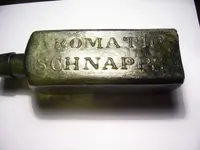
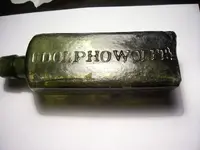
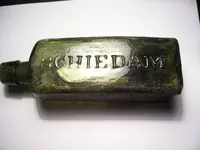
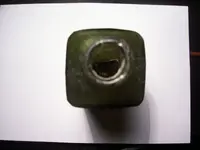
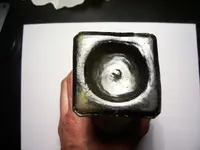
The pictured example is embossed on three sides: UDOLPHO WOLFE'S - SCHIEDAM - AROMATIC / SCHNAPPS. Schiedam is a city in Holland near Rotterdam and was apparently just part of the proprietary name since this product was originally produced in New York and the bottles made in the U.S. However, Wolfe's Aromatic Schnapps became a very popular "medicated gin" that was produced from the late 1840s until well into the 20th century. Due to its popularity it was produced in various parts of the world with the bottles by at least the late 1800s being blown overseas in addition to the U.S. Wolfe's bottles were produced in a wide variety of colors and sizes, though always apparently square. The pictured bottle is typical of square spirits bottles produced in the mid 19th century and has a crudely applied oil finish and a large grayish iron pontil mark on the base dating it to around 1855-1865. Click on the following links to view more pictures of this bottle: base with iron pontil; close-up of shoulder, neck, and finish; side view of Schiedam embossing; side view of Aromatic Schnapps. This product is an example of the crossover between spirits and medicine as it claimed to be a "Superlative Diuretic, Anti-dyspeptic, and Invigorating Cordial " and though the alcohol content is unknown, it was undoubtedly high (Wilson & Wilson 1971; Fike 1987).