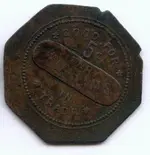
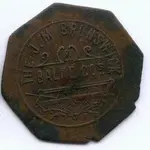
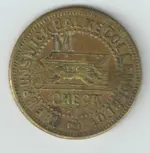
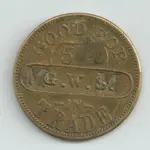
Here's some info on the company, as well as one that I dug as well. Haven't found it's location either, thinking Nebraska.
Brunswick was founded by John Moses Brunswick who came to the United States from Switzerland at the age of 15. The J.M. Brunswick Manufacturing Company opened for business on September 15, 1845, in Cincinnati, Ohio. Originally J. M. Brunswick intended his company to be mainly in the business of making carriages, but soon after opening his machine shop, he became fascinated with billiards and decided that making billiard tables would be more lucrative, as the better tables then in use in the United States were imported from England. Brunswick billiard tables were a commercial success, and the business expanded and opened up the first of what would become many branch offices in Chicago, Illinois in 1848.
In 1873, the Brunswick Company merged with competitor Great Western Billiard Manufactory owned by Julius Balke to become the Brunswick & Balke Company, incorporated with a capital stock of $275,000. In 1884, another competitor, H.W. Collender Company of New York (founded by Hugh W. Collender), was absorbed to form the Brunswick-Balke-Collender Company (or B.B.C. Company for short[2]) with capital of $1.5 million.
The company expanded into making a number of other products. Large ornate neo-classical style bars for saloons were a popular product. Bowling balls, pins, and equipment led a growing line of sporting equipment. It popularized bowling balls of manufactured materials, vulcanized rubber at first; earlier bowling balls had been solid wood.
Also.....
1873
Demand for Brunswick tables continues to increase. Brunswick merges with rival Julius Balke’s Great Western Billiard Table Manufactory to become The J. M. Brunswick and Balke Company. Pamphlets published two years after the great Chicago fire describe the company as manufacturing 700 tables annually, with 350 Brunswick tables in play in the city of Chicago, and selling from Canada to Mexico, with tables in every principal city in the west.
1884
Brunswick joins with another rival to become “The Brunswick-Balke-Collender Company,” the largest billiard equipment operation in the world, larger than all its competitors combined. Expansion of the product line now includes elaborate and ornate front and back bars made of rich woods, flawless mirrors, and stained glass. Originally offered as special order items, demand from taverns grew so great that a new factory in Dubuque, Iowa manufactured and shipped the bars around the world. The bars began to gather design awards at international exhibitions. Many of them are still in use today, becoming focal points in popular bars and restaurants around the country
And even more info....
God, do I love Google.
Billiard and Pool Hall tokens were used in much the same way as Saloon tokens. Players would "rent" the table for a time, receiving tokens in exchange for the amount paid. Losers would pay the winner with a token, which supposedly was good only for merchandise in a disguised attempt to circumvent gaming laws, but would often be redeemed for cash by the bartender.
In some of the larger Billiard and Pool Halls an operator would "rack" the cue balls and he would then be paid a token for the game. This guaranteed the owner payment as the tokens were merely turned in at the end of the day. I some cases a token or coin box was installed on the tables to drop the cue balls at the start of a new game.