What's new

Parker's Hair Balsam

robertk

Gold Member
🥇 Charter Member
Joined
May 16, 2023
Messages
6,970
Reaction score
33,866
Golden Thread
0
Detector(s) used
XP Deus II
White's Spectra v3i
Garrett Ultra GTA 1000
Whites Coinmaster
Primary Interest:
All Treasure Hunting

IMG_0873.webp

Bottle Vitals


DateColorShapeSize (Height x Diameter)Value*
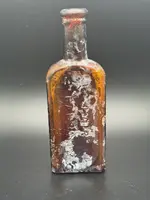
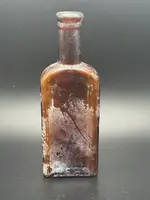
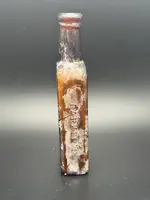
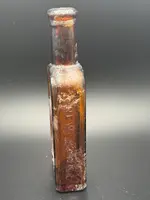
Parker's Hair Balsam1880sBrownRectangular7" x 2.5" x 1.25"$10.00

Bottle Views (click to enlarge):
FrontBackSideSideBottom
IMG_0873.webpIMG_0874.webpIMG_0875.webpIMG_0876.webpIMG_0877.webp
Hair BalsamParker'sNew York11

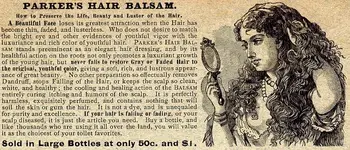
This brown bottle contained a patent medicine called Parker's Hair Balsam. Despite the name, it was not made by someone named Parker, but by Hiscox & Co, of Patchogue, New York. The firm was started by David Hiscox in 1875, and produced patent medicines, with the two most prominent both being named Parker's -- a hair balsam and a ginger tonic. They were advertised as a cure for dandruff and a hair restorer.

Lancaster_Teller_1885_05_14_2.webp


The_Weekly_Jeffersonian_1882_10_05_4.webp


It was advertised as being of high quality and purity and containing only "harmless" ingredients, though apparently one of the ingredients was lead (in the form of lead acetate), along with sulfur, glycerin, and sassafras oil.

The_Lake_Geneva_Herald_1882_06_16_8.webp


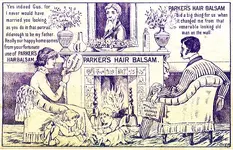
It was advertised not only in newspapers and but also on trade cards, which were a popular advertising medium at the time. Here are a couple of examples. Click to enlarge. I thought the second one was particularly amusing.
PARKER_1879.webp PARKER_TC3F.webp

Apparently it helped men get married. Apparently kept them from getting old before their time, too. Gotta keep their wives happy.

The_Fulton_Gazette_1886_02_05_4.webp


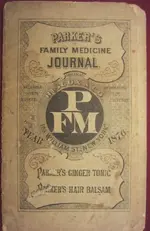
They even had their own "family medical journal", which was something like an almanac with calendars, recipes, household hints, and of course, advertising for their products. Click to enlarge.
1876-parkers-family-medicine-hiscox_1_6c3013003d801bf972adc2e39cbc29e4.webp

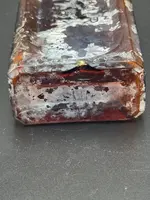
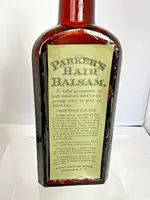
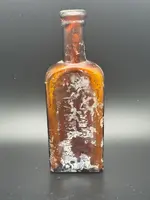
Unfortunately this bottle didn't really change much when cleaned, and would require some time in a tumbler to remove the "sick glass" surface damage. None the less, here is the before and after, along with a shot of what the original bottle would have looked like back in the day, with the label still attached. Click to enlarge any of them.
IMG_0834.webp IMG_0873.webp s-l1600.webp
 
Another great post Robert. At this rate your going to become a "bottle doctor" for ID'ing ANY old bottle...! And I agree that lead just doesn't seem right to use an an ingredient...? I wonder what leached into the glass that makes it hard to clean up...? I'd hate to guess how many hours of research has gone in to what you've done already...! And I know what's left.... a lot.

I look forward to you researching the little Constantine MI. pharmacy clear bottle. I tried once but it quickly became a "hair puller" for me...!
 
Another great post Robert. At this rate your going to become a "bottle doctor" for ID'ing ANY old bottle...! And I agree that lead just doesn't seem right to use an an ingredient...? I wonder what leached into the glass that makes it hard to clean up...? I'd hate to guess how many hours of research has gone in to what you've done already...! And I know what's left.... a lot.

I look forward to you researching the little Constantine MI. pharmacy clear bottle. I tried once but it quickly became a "hair puller" for me...!
Lead in paint offered strength of flexibility. Works(ed) as a mordant. But in the case of hair maybe it's drying use in paints and vanishes came into play?

But yes it's the naughty type lead.
Multiple sources (none of who I'd swear allegiance to) suggest lead acetate being made first in 1944.
Seemingly late for this bottle?
Lead Acetate is also known as lead(II) acetate, is a white crystalline chemical compound with the formula Pb(C2H3O2)2.
]Lead Acetate is poisonous in nature. It is used in making white lead in medicines and as a mordant in dyeing. Lead acetate was first produced in the United States in 1944. Lead belongs to the group IV A elements and most of the compounds of lead have +2 state. Lead acetate is stable under ordinary conditions of use and storage.

Lead acetate, also known as sugar of lead, is a white crystal made by the action of acetic acid on litharge. Lead acetate is used in gold toning baths to modify the pH.]
 
Nice write up....and I have dug several of these and they all have the same sickness where others in the same pit had none.
 
Multiple sources (none of who I'd swear allegiance to) suggest lead acetate being made first in 1944.
Seemingly late for this bottle?
Perhaps it was an imported ingredient? Or perhaps some other form of lead changed to acetate once added to the formula? The reference I have for the formula are still later than 1880, but well before 1944.

107t.webp
 
I look forward to you researching the little Constantine MI. pharmacy clear bottle. I tried once but it quickly became a "hair puller" for me...!
Oh, it's coming. :icon_thumright:
 
Perhaps it was an imported ingredient? Or perhaps some other form of lead changed to acetate once added to the formula? The reference I have for the formula are still later than 1880, but well before 1944.

View attachment 2213823

The art world and paints were no strangers to it overseas.

[Lead acetate had apparently been widely available in Britain since the 18th century. In 1758, Robert Dossie (1:152) provided instructions for making lead acetate from vinegar and metallic lead but noted, “It is to be had so constantly, and at so much less expence [sic] at the shops of chemists and druggists, than it can be made in small quantities, that is is needless to give any more particular recipe.”]


Users who are viewing this thread

Back
Top Bottom