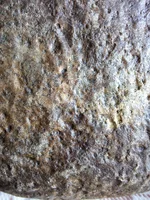
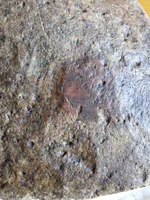
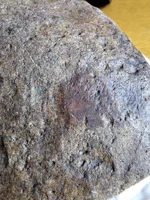
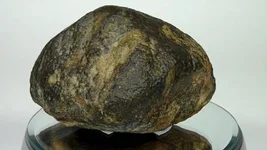
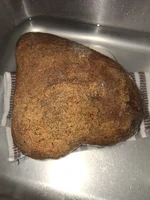
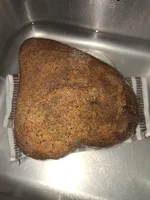
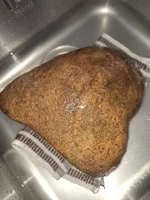
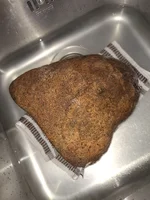
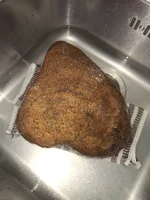
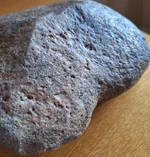
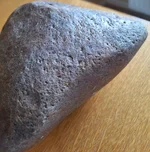
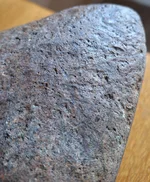
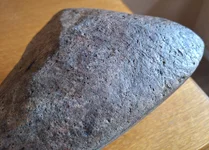
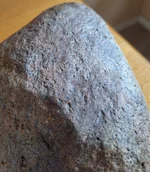
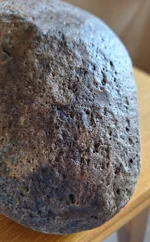
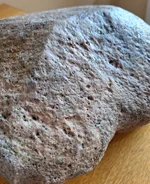
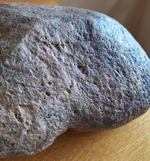
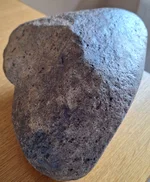
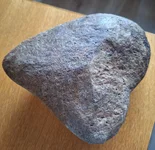
Yes, of course melt features can be seen in the interior of meteorites after the exterior fusion crust has weathered away.
In the early solar nebula, the floating cloud of dust that represented the building blocks of our solar system flash-melted and rapidly cooled to form the small spherical balls of rock we call chondrules. Those solidified chondritic droplets gradually accreted, mainly by gravity, to form primitive asteroidal bodies, and further accretion formed larger planetary bodies.
Stony meteorites classify into two groups: unmelted (chondrites); and melted (achondrites). It’s the melting that destroyed the chondrules. What distinguishes the two groups is that achondrites are from asteroidal bodies that became large enough to differentiate by melting, forming a core rich in iron and nickel, with a stony outer mantle containing little or none of those metals. That’s why we don’t see chondrules in rocks from our own large differentiated planet, and why native iron is a rarely found material.
There is a sub-category of chondritic meteorites which have undergone partial melting from nebular shockwaves, planetesimal collisions, or metamorphism of their parent bodies by heat generated from internal radioactive decay. This can result in thermal alteration of the edges of already-formed chondrules without entirely melting them.
Yes, some achondrites have a highly translucent or even fully transparent glassy fusion crust rather than the more typical opaque black or dark grey crust usually seen on chondrites. Notably lunar meteorites and some howardites (for which the parent body is almost certainly the Asteroid 4 Vesta).
Again, this is the result of differentiation which depletes the iron and nickel minerals responsible for dark and opaque fusion crusts. The residual minerals are rich in magnesian silicates such as pyroxene and calcium-rich plagioclase which melt to form a lighter coloured or colourless fusion crust that can be translucent or transparent. In lunar material, it’s usually calcium-rich anorthite, which melts into a slightly olive-green glass.
However, these finds of fusion crusts are extremely fragile and highly prone to erosional weathering. They’re almost exclusively seen on freshly-fallen meteorites, or those which have been preserved in dry deserts.
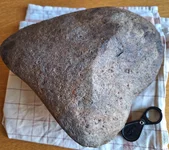
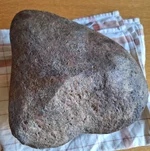
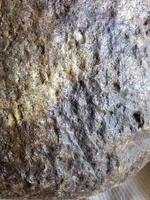
Your new pictures do not advance your cause. I see nothing which is inconsistent with terrestrial igneous/volcanic rocks.