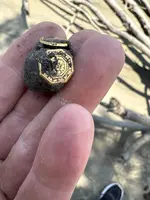
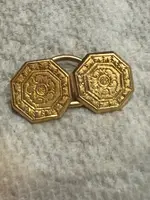
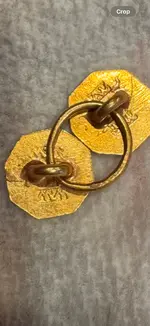
You've probably already seen the following info, but just in case, I'm posting it for all to see. The links's below might be helpful, but what struck me was this: "his other professional activities as a judge and state senator." Well, if he was a State Senator & Judge, It is very possible that he crafted them for himself. Some more research as to why he would be in Pennsylvania (Continental Congress maybe?) & who owned the land where you found the cufflinks might yield some clues & be fruitful. Congrats on your stellar find !!! (
Forget the Pennsylvania angle. I now know the cufflinks were found in South Carolina)
FROM A GOOGLE SEARCH:
The available information indicates that a silversmith named William Bradford Whiting (1731-1796) worked in Norwich, Connecticut around the 1750s
. However, his work as a silversmith is debated by historians. Some sources suggest that his son, also named William Bradford Whiting, may have been the silversmith. The son worked in Savannah, Georgia around 1780 and may have apprenticed under his uncle, Ebenezer Whiting.
Therefore, it is possible that William Bradford Whiting, a silversmith working in Connecticut during the 1750s, might have crafted gold cufflinks. However, the sources provided do not confirm any specific instance of him crafting gold cufflinks. The focus is primarily on his potential work as a silversmith and his other professional activities as a judge and state senator.
If you're interested in learning more about gold cufflinks from 18th-century England, the following resources might be helpful:
- Larsdatter.com's "18th Century Sleeve Links" page: This page describes various types of cuff links from the period, including examples from England.
- Berganza's "Antique Vintage Cufflinks" page: This resource mentions the history and design of antique cufflinks, including the use of various materials and gemstones during different periods.
- Nigel Norman's "Antique Cufflinks London" page: This page showcases antique cufflinks, including some from the 18th and 19th centuries.