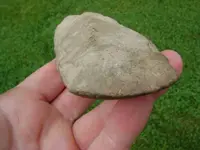
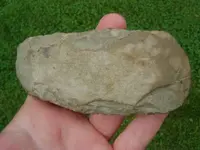
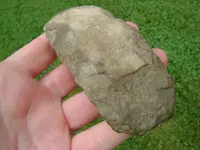
Very interesting piece. I would say it is an unfinished tool. Never halfed. There has definitely been some percussion shaping done along the sides, and from the rear of the Celt. This shaping was done to reduce the amount of pecking and grinding needed to shape the tool. On the third picture down, you can see a high ridge that runs down the the face (side) of the Celt. This ridge would make it very difficult to half the Celt. A finished Celt "has" to have only the top and bottom of the Celt contacting the hole that is burn & chiseled into the handle. The impact of using the tool compresses the tool tighter and tighter into the hole for a snog fit. If the Celt contacts the sides of the handle it will split the handle, as a result of continued impact and shock. The fit is often so precise that a "marker" is abraded onto the bottom of the tool to insure that it is returned to the hole in the same direction each time. The very first thing that would have been done in preparing that Celt to half, would have been to start to peck and grinding that high ridge. The initial effort would have been very productive, to "flatten" that high ridge, yet it appears that no effort was put into pecking that area at all. So, I would say unfinished tool. It may go back to my initial suggestion that the maker may have felt the stone was never going to "hold and edge" that was worth finishing the tool.
Just my opinion. I often find "stopped in production" pieces the most intresting. It often gives some incite into the decision making process.
Thanks for sharing, and posting more pictures. Tell me what you think.
3creeks