Riffle height is only one part of the equation. The taller the riffle the greater the water flow needs to be to keep the material moving down the sluice without building up between the riffles no matter what size the material is classified to. Of course larger gravels are going to need even more flow than sand sized material but all things being equal taller riffles need more flow to work properly than shorter riffles.
The shorter the riffle height the smaller the material should be classified to, and the smaller the material is the slower the flow needs to be and the flatter the angle of the sluice needs to be.
For best results run all the same size material at a time. An example would be to run all 1/2" material by itself, then all -1/2" to +3/8" then all - 3/8" to +1/4" and so on. The reason why is because when the sizes of the material being run are all close to the same it's easy for the sluice to sort out and retain the heavies.
For example, if you run all 1/2" and smaller material at the same time and if a 1/2" rock weighs the same as a small flake of gold and the flow and angle of your sluice are set up to wash 1/2" gravels out then it's also likely to wash out the same weight flakes of gold. (not to mention that larger gravels can also dislodge small pieces of gold as they travel down the sluice) But if you are setup to run all 1/2" material and nothing smaller, then no way is a 1/2" nugget of gold going to get dislodged or washed out by those lighter 1/2" gravels. Same thing when you are setup to run all 1/4" material and so on down the line.
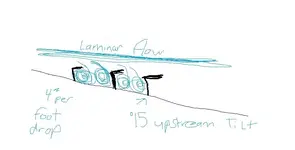
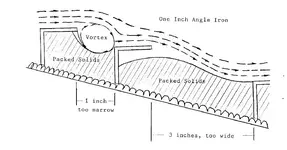
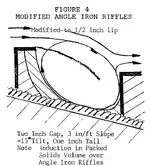
Proper spacing between the riffles is often overlooked by the manufactures due to cost cutting priorities. According to scientific studies, to create the most efficient sorting vortex between the riffles, the distance between the riffles should be no more than twice the height of a riffle. Examples would be: 1" tall riffles should be 2" apart. 3/4" tall riffles should be 1-1/2" apart and 1/2" tall riffles should only be 1" apart.
Studies have shown that a sluice with riffles spaced too far apart prevents a vortex from forming between them causing too much scouring of material resulting in fine gold losses. Conversely, riffles spaced too close together will result in too much buildup of material between them also causing gold loss.
Everything must work hand in hand for the most efficient gold recovery to take place. You must have the proper water flow and angle for whatever height and style riffles your equipment has, and run material that is properly classified for that system.
Ok, no one is going to take the time to do all that classifying as in my examples above, but hopefully those who are new to this will gain some insight as to why classifying is an important part of recovering the smallest flakes and specks of gold that really can add up over a season.
For most prospectors it's usually a trade off, save time by not classifying and run material as fast as possible and accept the loss of some fine gold by making up for it by running a greater volume of material. That's fine when you're on some good gold but where I'm from you need all the specks you can get.

Go for the Gold
GG~