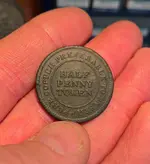
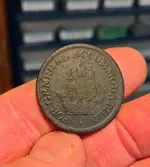
1860s Rock Art
The glyphs in your pic appear to be Native American, post-arrival of the horse north of the Rio Grande (1600 or so)..and probably later than 1700 after horses stolen from the Spaniard settlements made their way across most of the rest of North America.. assuming those animals are horses, which they appear to be. (Sorry, Frenchman.) My gut feel is the horizontal wavy line is probably horizon, though it might be a trail. If that's a human figure (and not just a flaw in the rock face) to the left of the horses, I'd guess you're seeing a hunt in progress... folks trying to get these beasties for food, rather than transportation.
I've never made much sense of most NA rock art, though I've examined a few thousand of them.
The exceptions are rare, but usually spectacular. There's one under a cliff overhang east of Socorro that clearly depicts a running fight between retreating Spaniards after the Revolt of 1680 and maybe the southernmost skirmish with some stragglers. There's one in a canyon bottom south of Zuni that depicts an Indian holding a Spaniard upside-down by the ankles over a cliff preparatory to dropping him.
One located about 60 miles south of Grants, NM, shows several mounted horses, one of which seems to be an NA man with a sort of yoke tied over his shoulders being led by a rope from the man on horseback. That one's on a promontory with a lot of other rock art above a large ruin that was destroyed by fire, probably during the Anasazi Civil War of 1150 or so... a long time predating the arrival of the horse. My thinking is that the drawing is probably a lot later and depicts the excitement the NAs felt over the arrival of Spaniards on horseback and the results they witnessed.
There's a nice one in Frijole Canyon that depicts some poor guy with a broken spear on the working end of a grizzly bear paw swat and two other guys with spears hassling the bear from the sides and behind.
I can't offer any insights into the one you found, except that someone wanted to show some horses. Awfully nice artwork, however... better than a lot I've seen. But most NA rock art depicts bugs, lizards, maybe a supernova that happened to appear in the sky, or a comet, mountain sheep, shaggies, sometimes hunts and a lot of symbols I've never been able to interprete. My impression is they don't have much to do with gold or mineral of any sort.
http://www.amazon.com/exec/obidos/t...itle/102-6135919-8202548?tag=treasurenet01-20 is a fairly decent field guide to rock art of this sort if you're interested in that type of thing. My review of the book tells my own experiences of trying to use it in the field, however. A person really needs a quick and dirty reference for the kind of thing you're doing in the pic, along with this one when you're pondering it later.
********************************************************
I spent a couple of years trying to figure out some rock carvings I found on a mountain face... it's still a mystery to me. One was a map chiseled on the face of a 350 pound boulder... it was evident enough what it was.. almost an exact overlay of a topo of that channel and two adjacent ones..but I never found what the guy was excited enough to draw a map on a rock 600 feet vertical from anywhere you could see the canyon the way it was depicted on the map. It was one of a dozen or so rock carvings we found on the face.
http://www.jackpurcellbooks.us/pages/book pages/1998 search.htm is some of the pics from the summer 1998 search we made for the Lost Adams Diggings... a few of the rock carvings we found that we never made sense of; the burned cabin ruin/arrastra/longtom was 150 yards downstream from where the boulder is located. At the on-the-ground depression lower center on the next channel to the south (on the rock) we found a marker... a sort of buried cairn, but nothing to allow us to make sense of why it was there or what it was intended to convey.
At the depression just to the right of center on the upper part of the boulder we found a number of other carvings on rocks including what appeared to be a bird or an angel and a large X on the face of a boulder, lots of quartz, but still no help. There's a depression on the right end of the boulder you can't easily see in the pic, and there we found the one we called the Horus Eye, which we also never figured out, but thought it to be fairly spectacular.
The depression downstream/left on the boulder is the location of a large Anasazi/Mogollon ruin. You figure it out.
The depression at the center of the boulder represents the location of the burned cabin/arrastra/sluicebox.
Best to you,
Jack


 ops:
ops:


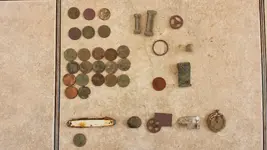
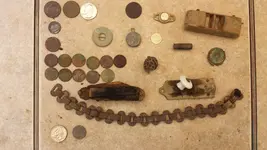
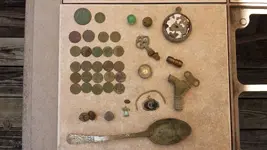
![20150405_164728[1].webp](/data/attachments/1060/1060831-0fe0231789ebfbb96a27037ddd48c7c0.jpg?hash=U07ENPpqny)
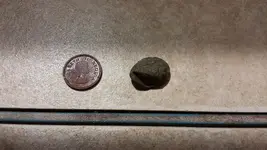
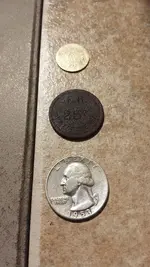
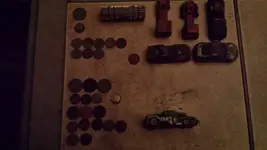
![20150405_164654[1].webp](/data/attachments/1060/1060792-8c4fb4a698f5d424bec110af6c3126b1.jpg?hash=Xabts6CjSs)
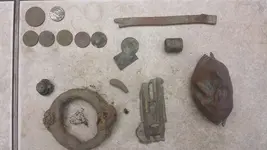
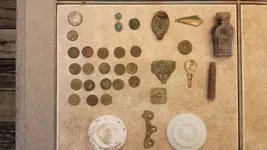
![20150404_172922[1].webp](/data/attachments/1060/1060732-ec7a1f8cbbabdccd2db48b2208cff17f.jpg?hash=NWjg9MZXW7)
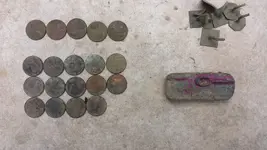
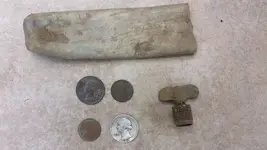
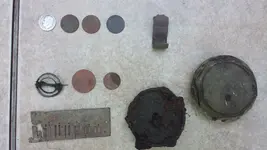
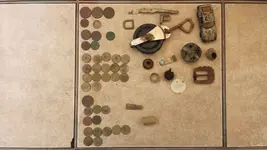
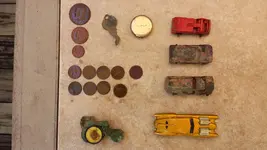
![20150516_173655[1].webp](/data/attachments/1071/1071591-0e9044b4976c947104ea981b4fe874cc.jpg?hash=efq2PV5KN9)
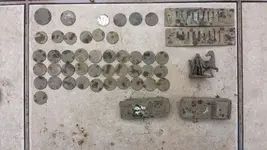
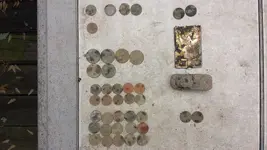
![20151022_183017[1].webp](/data/attachments/1133/1133333-eddc5f4ee4c081b16d927c065d07566a.jpg?hash=KeilT13J6t)

 I saw the other photo and WOW you are gorgeous