Re: I think I found SAMBO
Before answering your other remaining questions, I feel an obligation to point out that the "downside" of using a car battery charger is that it puts out enough electrical amperage to kill a human being. Therefore, no part of the setup (including the water and the relic) should be touched while the charger is plugged in. Also, great care must be taken to absolutely prevent any kids or pets from having access to the setup.
Breezie wrote:
> I was also wondering about the size of the container and the amount of water.
> Since the cap gun is only 4 1/2 inches long, I'm using a plastic 'shoe box' like you buy at Walmart for storage.
> The anode is a Victorian iron door lock plate and it's about 3 to 4 inches away from the cap gun. There is about
> 4 inches of water in the container, with the top edge of the door plate sticking out as not to corrode the +end of my charger.
> The cap gun is completely submerged.
My only experience is with a steel container (which, as previously mentioned, serves as the anode). Even so, based on that experience, I believe what is MOST relevant in your setup isn't the size of the plastic container or the amount of water ...it's the "positioning" of the relic relative to the anode you are using (an iron doorlock plate). You said the doorlock plate's top is out of the water, so I assume the plate is standing up against one of the plastic shoebox's walls. Is your Sambo pistol laying flat on the bottom of the shoebox, or standing up against the shoebox's wall? You want to have as much of the pistol's body "facing" the anode as possible.
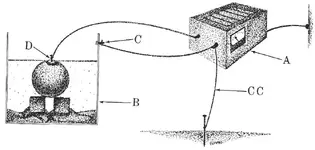
Your photo shows that not much "progress" has occurred after 10 hours in your current Electrolysis setup. You have the choice of continuing the cleaning with your current setup, or switching to using a steel/iron container. My opinion (which may vary from other forum-readers and Electrolysis-users here): If the Sambo pistol was mine, I'd replace the plastic shoebox with a "tin can" large enough to hold the pistol ...preferrably, a 33-ounce coffee can or other "large" food-can, for use in the setup shown in the illustration I posted.
Important note: Some "tin cans" (and steel buckets) have a nearly-invisible plastic coating on their inside, to prevent the food from reacting with the can/bucket's steel. A simple way of removing that interior coating is to run the Electrolysis process "in reverse" ...meaning, put a clean long iron/steel object (such as a silverware knife) standing up in the center of the can, and then switch the battery charger's clamps to the opposite from the way you connect them in regular Electrolysis. Meaning, instead of positive/red-clamp-to-can/bucket, you put the red clamp on the clean iron/steel object in the can/bucket. Reversing the charger's connections will remove the plastic coating from the can/bucket's interior in a short period of time.
Note: To "stand" the dinnerknife in the CENTER of the can, lay a narrow wooden stick (or a plastic ruler) across the can's top, and use a clothespin to clasp the knife's blade-end onto the ruler. Don't forget, the knife's base must NOT touch the can's metal bottom. If necessary, put a saucer or other non-conductive object in the bottom of the can.
All of that being said... there is a problem with using a typical thin-walled can or bucket. After several uses, you'll begin to get pinhole leaks in the can/bucket. The solution is to place the can/bucket inside a slightly larger PLASTIC container (such as a plastic trashcan). Then the leaky steel iron can/bucket won't matter -- and it will still function just fine as an anode.
I should also mention, the amount of cleaning time depends on three factors:
1- the size of the relic
2- the metal the relic is made of -- coins clean in minutes, iron relics can take 12-to-36 hours,
2- the amount of electrical current -- the higher the current (in Amps), the faster the cleaning gets done.
However, fastest isn't always best ...and can even be destructive. I've found that low amperage (1-to-2 amps) is gentler on the relic, and thus tends to give me a better result.
Sidenote: As Chukers posts indicate, an electrical-device charger, which operates in MilliAmps, works fine for coins.
http://forum.treasurenet.com/index.php/topic,407784.msg2901821.html#msg2901821
For relics larger than coins, especially iron relics (like gunparts, bayonets, and cannonballs), I recommend a car battery charger. I "run" my cannonballs for 24-to-36 hours, at 2 amps or less, and get excellent results.
All of that being said... Electrolysis will not remove quite every last bit of rust-concretion from a relic. You'll need to do a little "finishing-work" by hand to remove those last little bits. Then scrub the relic with a toothbrush thoroughly under running water, then PAT it dry (with a towel, and let it sit for about 24 hours before you apply spray-on Polyurethane. I recommend "Minwax Fast-drying Polyurethane, SATIN Finish" (not glossy), which you can buy in a spray-can for about $6 at Wal-Mart.


 Breezie



 You might want to do a copy/paste and also post it under the cleaning relics forum. I know it will be beneficial to me as well as others.


 Seriously though I hope you and yours are all OK and everything gets back to normal for you soon, take care.
 Breezie