Ledav17752
Tenderfoot
- #1
Thread Owner
Hello everyone,
I would like to share this exploration target and get an honest technical opinion from people with experience in gold exploration, particularly structurally controlled and quartz-vein-hosted mineralization.
The area is located within the Reguibat Shield, in a geological setting where structural features, faults/shear zones, quartz veins, and hydrothermal alteration are important exploration criteria.
I initially collected several surface samples before disturbing the area. The gold values were relatively low, generally around:
0.10–0.19 g/t Au.
After examining the area more closely, I found a small quartz vein where one sample returned approximately:
0.50 g/t Au.
However, the vein is small and appears to terminate or become discontinuous.
I also found another nearby quartz vein, but it appears weaker, with a sample returning approximately:
0.15 g/t Au.
So far, the picture is therefore one of low and somewhat discontinuous gold values, with a localized increase to 0.50 g/t Au, rather than a clearly continuous high-grade vein.
What interests me is the geological setting rather than any single assay result.
The area contains structural features, fractures/shear-related structures and quartz veining, with a spatial relationship between some of these structures and intrusive rocks. This is relevant because exploration models used by USGS and JICA in the Reguibat Shield consider the combination of host rock, structure, quartz veining, hydrothermal alteration, geochemistry and geophysics, rather than relying on surface gold values alone.
I would appreciate expert opinions on the following:
Could surface values of 0.10–0.19 g/t Au, followed by a localized 0.50 g/t Au value in a quartz vein, represent a geochemical halo around a larger mineralized system, or is this more likely to be weak and discontinuous mineralization?
How significant is it when the best sample comes from a small quartz vein that appears to terminate? Would it make more sense to trace the vein and its structural continuation rather than simply drill deeper?
Could this small vein represent only a minor exposed part of a larger structure, particularly if it is associated with a shear zone or fracture system?
What should I look for in the surrounding rocks: silicification, sulfides, iron oxides, hydrothermal alteration, arsenic, antimony, or other pathfinder elements?
Would you recommend systematic sampling across the vein, on both sides of it, and along its strike, rather than relying on isolated samples?
Based on this type of geological setting and the current results, what additional evidence would you want to see before deciding whether deeper or lateral exploration is justified?
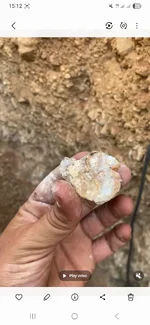
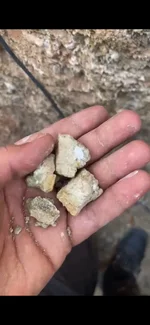
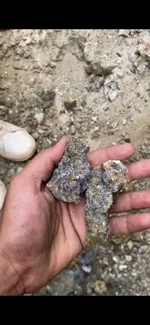
I will attach photographs of the site, exposed rocks, quartz veins, sampling locations and excavation so that the geological context can be assessed rather than looking only at the assay numbers.
I am particularly interested in frank technical opinions, whether positive or negative, especially from people experienced in exploring structurally controlled gold systems in Precambrian terrains.
Note: I understand that 0.50 g/t Au by itself does not demonstrate an economic deposit, and low surface grades do not by themselves rule out stronger mineralization elsewhere in the system. My main objective at this stage is to understand the continuity and geological significance of the mineralization before deciding how to proceed with exploration.
I would like to share this exploration target and get an honest technical opinion from people with experience in gold exploration, particularly structurally controlled and quartz-vein-hosted mineralization.
The area is located within the Reguibat Shield, in a geological setting where structural features, faults/shear zones, quartz veins, and hydrothermal alteration are important exploration criteria.
I initially collected several surface samples before disturbing the area. The gold values were relatively low, generally around:
0.10–0.19 g/t Au.
After examining the area more closely, I found a small quartz vein where one sample returned approximately:
0.50 g/t Au.
However, the vein is small and appears to terminate or become discontinuous.
I also found another nearby quartz vein, but it appears weaker, with a sample returning approximately:
0.15 g/t Au.
So far, the picture is therefore one of low and somewhat discontinuous gold values, with a localized increase to 0.50 g/t Au, rather than a clearly continuous high-grade vein.
What interests me is the geological setting rather than any single assay result.
The area contains structural features, fractures/shear-related structures and quartz veining, with a spatial relationship between some of these structures and intrusive rocks. This is relevant because exploration models used by USGS and JICA in the Reguibat Shield consider the combination of host rock, structure, quartz veining, hydrothermal alteration, geochemistry and geophysics, rather than relying on surface gold values alone.
I would appreciate expert opinions on the following:
Could surface values of 0.10–0.19 g/t Au, followed by a localized 0.50 g/t Au value in a quartz vein, represent a geochemical halo around a larger mineralized system, or is this more likely to be weak and discontinuous mineralization?
How significant is it when the best sample comes from a small quartz vein that appears to terminate? Would it make more sense to trace the vein and its structural continuation rather than simply drill deeper?
Could this small vein represent only a minor exposed part of a larger structure, particularly if it is associated with a shear zone or fracture system?
What should I look for in the surrounding rocks: silicification, sulfides, iron oxides, hydrothermal alteration, arsenic, antimony, or other pathfinder elements?
Would you recommend systematic sampling across the vein, on both sides of it, and along its strike, rather than relying on isolated samples?
Based on this type of geological setting and the current results, what additional evidence would you want to see before deciding whether deeper or lateral exploration is justified?
I will attach photographs of the site, exposed rocks, quartz veins, sampling locations and excavation so that the geological context can be assessed rather than looking only at the assay numbers.
I am particularly interested in frank technical opinions, whether positive or negative, especially from people experienced in exploring structurally controlled gold systems in Precambrian terrains.
Note: I understand that 0.50 g/t Au by itself does not demonstrate an economic deposit, and low surface grades do not by themselves rule out stronger mineralization elsewhere in the system. My main objective at this stage is to understand the continuity and geological significance of the mineralization before deciding how to proceed with exploration.