What's new

🔎 UNIDENTIFIED Seeking Meteorite / Space expert

FS

Greenie
Joined
May 28, 2026
Messages
16
Reaction score
8
Golden Thread
0
Location
Hawaii
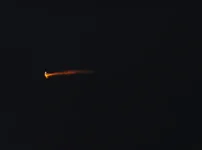
This discovery is from a 1940s WW2 era photo collection from Hawaii. The 35mm film could go into the 1950s, experts couldn't identify the object. The tail trail has a perpendicular line, indicating it had crossed the Karman line (seen overexposed or by eye). The mid trail has clear patterns indicating the image is in focus and not a camera blur, shake, or long exposure. While in forward motion, the head shows a perpendicular white line and 2 detached objects not connected to the main body. Kodachrome technology no longer exists and cannot be replicated or edited.

Thoughts?
 

Attachments

  • 1.webp
    1.webp
    9.2 KB · Views: 167
In summary, since 3rd party slides were available, it is possible dating back to the 1940s, they were just not mounted at the Kodak lab.

The 1000mm focal length lenses were sold in Germany and Japan in the 1940s. Based on how close up this is, I think a telescope was used, not a camera mount lens. On a telescope, home made mounts were created to attach the camera. This is also the reason the film's full frame became a half frame to eliminate outside the telescope view.

You could of course also shoot 35mm Kodachrome in a half-frame camera (18×24mm), in which case Kodak would return the shots either as uncut strips in long glassine sleeves or mounted in pairs in their standard 35mm mounts.

Users could then choose to mount or remount them in whatever they liked. If your slide was subsequently self-mounted, it’s not possible to say when the actual picture was taken.
 
Upvote 0
Nope, not wrong. The 1935 launch of Kodachrome was for 16mm cine film stock only. Stock for 35mm slides didn’t appear until 1936, as stated on Kodak’s own website:

1935
KODACHROME Film was introduced and became the first commercially successful amateur color film initially in 16 mm for motion pictures. Then 35 mm slides and 8 mm home movies followed in 1936.
https://www.kodak.com/en/motion/page/chronology-of-film/
I had a few Kodachrome dated late 1935 from professional photographers, the date you are referring to is possibly retail outlets (general public).
 
Upvote 0
You could of course also shoot 35mm Kodachrome in a half-frame camera (18×24mm), in which case Kodak would return the shots either as uncut strips in long glassine sleeves or mounted in pairs in their standard 35mm mounts.

Users could then choose to mount or remount them in whatever they liked. If your slide was subsequently self-mounted, it’s not possible to say when the actual picture was taken.
The photographer collection was mainly 1940s Kodachrome red border
 
Upvote 0
As said, it was my wife's picture. She was using a Panasonic Lumix with a 16X digital zoom. The quality isn't as good as you would get from optical zoom lenses.
Even with a 1000mm lens you wont achieve good close up image with the distance in space.
 
Upvote 0
I had a few Kodachrome dated late 1935 from professional photographers, the date you are referring to is possibly retail outlets (general public).

Kodak did conduct pre-production field testing of Kodachrome slide film in 1935, but only a handful of professional photogrpahers and Kodak researchers were given access to the film.
 
Upvote 0
Kodak did conduct pre-production field testing of Kodachrome slide film in 1935, but only a handful of professional photogrpahers and Kodak researchers were given access to the film.
If you understood early film, they never released a new process to the stores first. They had industry professionals test out the stabilization. The recorded years are when it hit the stores after trial, in this case it was used 1 year prior.
 
Upvote 0
I guess I’m not sure what the date has to do with the value or determining what the object is?

Is the claimed value that it is the earliest color photo of a space object entering the earths atmosphere?

I don’t understand the significance of the notations about the trajectory and lines.

Is there some insinuation that it is an alien spaceship or something?
 
Upvote 0
If you zoom in at the trail, mid section there is a bump. I believe that is caused when it crossed over atmosphere. If it is light, the trajectory would be a straight line, light doesn't bend like that or arc.
 
Upvote 0

Users who are viewing this thread

Back
Top Bottom