What's new

Some Notes Re: Construction of the Money Pit

Agreed.
Got carried away.

Most likely it really IS a sewer system.

It is possible for the military to detect from the air or orbit changes in vegetation or heat sources of tunnel which is close enough to the surface (like 30 ft). This is followed up by an on-the-site investigation. It would probably be a upgraded infrared photography system.
(What we are looking at is only the first part.)

However, sewer systems have heat and would be considered "live" - much different from a dead tunnel from 200 years ago at 100+ ft.

So, not depositor tunnels.
 
Agreed.
Got carried away.

Most likely it really IS a sewer system.

It is possible for the military to detect from the air or orbit changes in vegetation or heat sources of tunnel which is close enough to the surface (like 30 ft). This is followed up by an on-the-site investigation. It would probably be a upgraded infrared photography system.
(What we are looking at is only the first part.)

However, sewer systems have heat and would be considered "live" - much different from a dead tunnel from 200 years ago at 100+ ft.

So, not depositor tunnels.
Still waiting to see ACTUAL proof of the tunnels you mention.
 
Back to cribbing, although this ship may have already sunk.

Have noticed on COOL when there is deep digging, the rim of the hole shelves off and tumbles down the side, so I was wondering if you lined the rim of the hole with flagstones, would that hold it?

I mention this because there is a variation of the legend where flagstones were encountered at three feet by the original three, and it would be a convenient explanation why no cribbing was found.
Still waiting to see ACTUAL proof of the tunnels you mention.
Won't be able to provide any, sorry. If you got on the island, there should be manhole covers every X feet, though.
Maybe some day someone will get a real closeup picture with a drone.
 
Back to cribbing, although this ship may have already sunk.

Have noticed on COOL when there is deep digging, the rim of the hole shelves off and tumbles down the side, so I was wondering if you lined the rim of the hole with flagstones, would that hold it?

I mention this because there is a variation of the legend where flagstones were encountered at three feet by the original three, and it would be a convenient explanation why no cribbing was found.

Won't be able to provide any, sorry. If you got on the island, there should be manhole covers every X feet, though.
Maybe some day someone will get a real closeup picture with a drone.
I didn't understand "shelves off and tumble down the side"

Here is AIs explanation...
Historical shaft construction techniques in the 1700s
  • Incremental progress: Shaft sinking in the 17th and 18th centuries was a cyclic process of drilling, blasting, and mucking out excavated material. After each cycle, a new timber frame was installed and wedged into place. The ground was only exposed for a few feet at a time before the next timber set was added.
  • Framing methods: The process was highly skilled and specialized. A "collar" was first built at the surface to serve as an anchor. As excavation proceeded, the timber frames (called "sets") were suspended from above and lowered into place. Each set was blocked and wedged securely against the walls before the next level was dug.
  • Role of experience: By the 1700s, shaft sinking was a respected and separate occupation from general mining due to its inherent risks. Master sinkers used their experience to read the rock, manage explosives, and add the necessary support as they descended. The idea of leaving a 90-foot unsupported section would have been seen as a fatal act of ignorance.
 
I didn't understand "shelves off and tumble down the side"

Here is AIs explanation...
Historical shaft construction techniques in the 1700s
  • Incremental progress: Shaft sinking in the 17th and 18th centuries was a cyclic process of drilling, blasting, and mucking out excavated material. After each cycle, a new timber frame was installed and wedged into place. The ground was only exposed for a few feet at a time before the next timber set was added.
  • Framing methods: The process was highly skilled and specialized. A "collar" was first built at the surface to serve as an anchor. As excavation proceeded, the timber frames (called "sets") were suspended from above and lowered into place. Each set was blocked and wedged securely against the walls before the next level was dug.
  • Role of experience: By the 1700s, shaft sinking was a respected and separate occupation from general mining due to its inherent risks. Master sinkers used their experience to read the rock, manage explosives, and add the necessary support as they descended. The idea of leaving a 90-foot unsupported section would have been seen as a fatal act of ignorance.
AI also said this...No, it is extremely unsafe and virtually impossible to dig a 90-foot vertical shaft before stacking timber frames. Timber frames, or sets, are installed incrementally as the excavation progresses downward to prevent the shaft walls from collapsing.
 
You're right - a poor choice of word. Substitute "calve" for "shelve" - it will make more sense.

The question still stands - would lining the rim of a shaft with flagstones prevent the rim from caving in? I assume they would be placed before any digging took place. (Worst case rain water erosion)
 
You're right - a poor choice of word. Substitute "calve" for "shelve" - it will make more sense.

The question still stands - would lining the rim of a shaft with flagstones prevent the rim from caving in? I assume they would be placed before any digging took place. (Worst case rain water erosion)

You're right - a poor choice of word. Substitute "calve" for "shelve" - it will make more sense.

The question still stands - would lining the rim of a shaft with flagstones prevent the rim from caving in? I assume they would be placed before any digging took place. (Worst case rain water erosion)
I asked Google AI...
Using flagstone at the surface of the Oak Island money pit would not be sufficient to prevent cave-ins without cribbing or another robust internal support system.

I think the destabilization would come from securing the log platforms to the shaft walls followed by repeated climbing up and down.
 
Last edited:
It's the blue clay man, it's the blue clay holding it all together!!
 
It's the blue clay man, it's the blue clay holding it all together!!
I considered that. Blue clay was considered to be very valuable for creating blue pigment. It was only found at the time in South America. So one theory i pursued was someone was digging a well, found the blue clay and knowing its value continued digging down to mine the clay. However, the clay was reported to be in layers indicating they would have mined horizontally and not down.

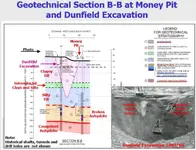
In the attached Dunfield drawing, he calls it clayey till. But if you look at the picture, the till seems much more dirt than clay. Clay would be clumpier... wouldn't it?
Throughout his dig the walls kept caving in so he had to make the top of the dig wider and wider in order to go deeper.

Granted, digging with the large crane would disturb more till than if using hand shovels but I doubt any one could dig beyond 30ft before they would have to widen the opening to go deeper without cribbing. I would contend that's why the boys stopped at 30ft in 1795 returning in 1803 with funding from Truro to go deeper using cribbing.

In the picture you can also see the cribbing of the Chapel shaft. Had the boys discovered a 90 ft treasure site, they would have found a similar structure but they didn't.

So the question isn't why would someone bury a treasure 90ft deep but why bury it 90ft deep and remove all the cribbing knowing they would needed to retrieve it.
 

Attachments

  • Dunfield Illustration.webp
    Dunfield Illustration.webp
    165.7 KB · Views: 63
Sorta related issue, but different.

There are 3 versions of people who claim to actually touched the target - " poked it with a stick". They give some description of what you will have if you find what you seek.

The original Oak Island Mysterious Money Pit story in Readers Digest 1965 by David McDonald ( Google it for exact dimensions).

There is also the letter of J.D. McCully (copy shown on Tnet thread "Did a Sawpit...", post 93.
(View it for HIS exact dimensions).

And there is the Chappell Vault story.

Are there any others?
 
Found this on the thread "WHERE WAS ROBERT DUNFIELD'S BIG DIG ON OAK ISLAND?" Post #18 (Thank you Freeman).

' Today Mr Fullerton, the superintendent of the dig, arrived from Chester. He reports that not long since the sea was shut out and yesterday a huge box was found at the pit's bottom.
The shareholders of the company are getting together to witness the opening of the box this week. '

Holy cow !!

If this is the box I've been prattling on about, then what's left to find??

Game over ? ? ?
 
' Today Mr Fullerton, the superintendent of the dig

Looking through my notes, I find no reference to Fullerton, so I can't even place which syndicate this was, and in the past I've had no success getting freeman to elaborate on his sources for these incomplete scans. Maybe you will have better luck.

But if I had to guess, I'd say this sensationalist snippet was another example in a tradition of somewhat gullible reportage in response to a press-release or its era equivalent. The search syndicate of the day probably made a highly anticipatory announcement that simply didn't pan out the way they hoped.

--GT
 
Last edited:
It may be impossible for Freeman to come up with dates.

A lot of stuff is posted on Tnet and other places that you assume would continue to be there. When you go back to confirm, the site is gone.
(http //www.oakislandcompendium was anif interesting source, but has changed)

Also there appear to be gaps in old newspaper coverage covering critical years. My suspicion is that someone grabbed the papers and is sitting on them.

But the item itself looks true. With the year, OTHER papers not Nova Scotian should clearly trumpet "Treasure Finally Found" within a few days of this published date.

If the box wasn't empty, of course.
 
Sorta related issue, but different.

There are 3 versions of people who claim to actually touched the target - " poked it with a stick". They give some description of what you will have if you find what you seek.

The original Oak Island Mysterious Money Pit story in Readers Digest 1965 by David McDonald ( Google it for exact dimensions).

There is also the letter of J.D. McCully (copy shown on Tnet thread "Did a Sawpit...", post 93.
(View it for HIS exact dimensions).

And there is the Chappell Vault story.

Are there any others?
“Claimed” is the key lie here.
 
Nova Scotia Archives lists 459 Fullertons in birth, marriage, and death notices 1762 to present, approx half are women.

Yikes.
 
There's a couple of clues that may narrow it down very slightly. There are two references to Pennsylvania (Allegheny and "Pittsburg" [sic]) so this may be from a Pennsylvania newspaper. Allegheny was absorbed into Pittsburgh in 1907 [ wiki ], so listing it as a separate place name for the business location in that ad might place this story before then. Also the spelling of Pittsburgh without its final "h" largely took place between 1891 and 1911 (or 1921 for one specific newspaper) [ wiki ], perhaps giving us a bracket time of 1891 to 1907.

The syndicates active near that bracket, I believe, were Oak Island Treasure Co. 1893-1899 (?), and Old Gold Salvage Company 1909-1911 (?). OITCo. discovered the so-called Chappell Vault in 1897, I think, found with a drilling pattern from a platform at 100 feet deep in the Money Pit, right after pumping out the latest flood-to-tide-level ... so that would adequately match the description. Fullerton perhaps replaced Adams Tupper after the New England faction took over the syndicate. Oh and what do you know, oakislandmystery includes a Fullerton amongst the OITCo personnel who found a southern side flood tunnel. I think we are on the right track. The news item's reference to a "huge box" may be describing the Chappell Vault, and as we know, further attempts to get at it failed.

--GT
 
Last edited:
It may be impossible for Freeman to come up with dates.

A lot of stuff is posted on Tnet and other places that you assume would continue to be there. When you go back to confirm, the site is gone.
(http //www.oakislandcompendium was anif interesting source, but has changed)

Also there appear to be gaps in old newspaper coverage covering critical years. My suspicion is that someone grabbed the papers and is sitting on them.

But the item itself looks true. With the year, OTHER papers not Nova Scotian should clearly trumpet "Treasure Finally Found" within a few days of this published date.

If the box wasn't empty, of course.

Yes, the oakislandcompendium site was highly modified with much factual content deleted after folks started using its information to debunk the claims by the laginas and others and disproving their hoax.
 

Users who are viewing this thread

Back
Top Bottom












