chalkoutline
Hero Member
- #1
Thread Owner
Hello,
The topic of flood tunnels comes up followed by alot of back and forth so i decided to see if the theory of flood tunnels is possible using my new knowledge of boyles law to calculate hydrostatic pressure.
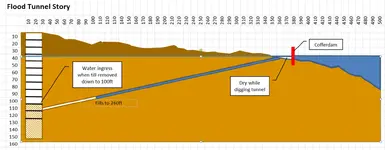
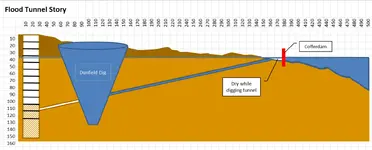
Using the attached diagram, here is what ive found...
1. From a previous thread, a ship arriving in May would have time to dig a 100ft vertical shaft during the dry season using half log platforms and no wall support.
2. A cofferdam could be built in Smith's Cove where a 2.5ftx4ft tunnel 360ft in length is dug using cribbing to intersect the shaft at about 100ft.
3. The shaft could then be filled by adding logs to make the half platforms full platforms and fill the entire shaft with till to the top.
4. Once filled, the cofferdam would be removed to allow seawater to rush down the 2.5ftx4ft tunnel. The water will compress the air in the tunnel and stop at 260ft creating an airlock between the water and the filled vertical shaft which has more than enough weight to hold back the hydrostatic pressure of the seawater. Only 20ft of till is needed.
5. They leave the island by September before the rainy season and still good sailing weather.
6. In 1803, the Onslow company digs to 93 ft before stopping for the night. At 90ft, there is no longer enough weight in the shaft to hold back the seawater causing the shaft to flood to sea level.
After analyzing all this, the money pit story seems quite possible; however, is it probable?
I personally don't believe it is...
if someone knowingly comes to OI to bury something 100ft down they would have planned on using cribbing throughout the dig (not just the tunnel) since they wouldn't know if the till would be stable for the entire 100ft and the possibility of bad weather.
If someone unknowingly came to bury something would not have dug that deep since they would have to retrieve it later.
-CO
The topic of flood tunnels comes up followed by alot of back and forth so i decided to see if the theory of flood tunnels is possible using my new knowledge of boyles law to calculate hydrostatic pressure.
Using the attached diagram, here is what ive found...
1. From a previous thread, a ship arriving in May would have time to dig a 100ft vertical shaft during the dry season using half log platforms and no wall support.
2. A cofferdam could be built in Smith's Cove where a 2.5ftx4ft tunnel 360ft in length is dug using cribbing to intersect the shaft at about 100ft.
3. The shaft could then be filled by adding logs to make the half platforms full platforms and fill the entire shaft with till to the top.
4. Once filled, the cofferdam would be removed to allow seawater to rush down the 2.5ftx4ft tunnel. The water will compress the air in the tunnel and stop at 260ft creating an airlock between the water and the filled vertical shaft which has more than enough weight to hold back the hydrostatic pressure of the seawater. Only 20ft of till is needed.
5. They leave the island by September before the rainy season and still good sailing weather.
6. In 1803, the Onslow company digs to 93 ft before stopping for the night. At 90ft, there is no longer enough weight in the shaft to hold back the seawater causing the shaft to flood to sea level.
After analyzing all this, the money pit story seems quite possible; however, is it probable?
I personally don't believe it is...
if someone knowingly comes to OI to bury something 100ft down they would have planned on using cribbing throughout the dig (not just the tunnel) since they wouldn't know if the till would be stable for the entire 100ft and the possibility of bad weather.
If someone unknowingly came to bury something would not have dug that deep since they would have to retrieve it later.
-CO