
I am a Beale Codes truther. I believe they are 100% real and the story is not completely accurate because it’s a retrospective allegory. Probably written sometime between 1832-1843. I love the talk about the potatoes. That’s one of the most incredibly intelligent nuggets within the story. On the surface, it sounds like a random detail. It becomes a lot more meaningful when you study which state’s caves could house sweet potatoes and which ones can’t. Furthermore, I’ve found one historical party that historically lines up to every part of this timeline. It’s why the timeline doesn’t make sense for the back and forth from Virginia to Santa Fe and back, but when looked at through the lens of this group, it lines up to something else they were doing at the time they were doing it. But if you are a firm believer that it’s a hoax and unless you see the treasure with the name Beale on it, you won’t believe it, then there’s really nothing to be said or done until it’s pulled out of the ground.I'm only proven wrong if any treasure actually surfaces... and, of course, nothing has ever been found.
You are using an out of date browser. It may not display this or other websites correctly.
You should upgrade or use an alternative browser.
You should upgrade or use an alternative browser.
Some say True and some say false...
- Thread starter treasure1822
- Start date
treasure1822
Hero Member
- #22
Thread Owner
Oh I agree the "story" is a fallacy but have you asked yourself why it exists in the first place? Have you not noticed the oddities in the story itself. Everything was put there for a reason.
I do but not sure if we are tracking the exact same thing. Every detail in the letter is not put there by accident. Everything was done purposefully. After realizing this, I was able to answer the 5 W’s and the how. I’ve seen too many data points align for me to say it’s a hoax. By saying it’s a hoax, it never addresses the very distinct details that the letter gives. Those who believe it’s truly a western hunting party that struck gold and buried it in Virginia, doesn’t address all of the implausible or impossible statements made in the letter (I.e. found gold in the cleft of rocks or have the logistical infrastructure for an ad hoc group to haul 8100lbs of metal across hostile Spanish and Indian Nations, plus American land with out generating a single toll receipt, tax, etc.).

chalkoutline
Hero Member
I might point out that the story does mention there were receipts in the locked box so i don't think you can say there is no proof of their travel west unless you can prove the receipts mentioned were for something other than travel.
chalkoutline
Hero Member
BTW, has anyone researched or speculated as to what receipts could be important enough to include with ciphers?
I have and I’ve often wondered what the receipts were. Frustrating that it’s only casually mentioned. Anything mentioned about them from our angle is purely speculative. We may never know what those receipts were. I like to think it was the receipts for the silver/jewels exchange and had their quality/cut verified.BTW, has anyone researched or speculated as to what receipts could be important enough to include with ciphers?
Travel west, from the Virginian perspective, could be receipts from St. Louis.I might point out that the story does mention there were receipts in the locked box so i don't think you can say there is no proof of their travel west unless you can prove the receipts mentioned were for something other than travel.
treasure1822
Hero Member
- #28
Thread Owner
The retainer for Wards servicesBTW, has anyone researched or speculated as to what receipts could be important enough to include with ciphers?
What do you all think about this passage?
About the first of December we reached our destination, Santa Fe, and prepared for a long and welcome rest from the fatigues of our journey. Nothing of interest occurred during the winter, and of this little Mexican town we soon became heartily tired. We longed for the advent of weather which would enable us to resume our wanderings and our exhilerating pursuits.
I believe these letters were backdated. That it’s a retrospective tale. The fact that during pre 1821, Santa Fe was a Spanish Colony and was referred to as such. Referring to it as a “little Mexican town” seems out of order considering it wasn’t a Mexican town during the time Beale was referring to it as such.
About the first of December we reached our destination, Santa Fe, and prepared for a long and welcome rest from the fatigues of our journey. Nothing of interest occurred during the winter, and of this little Mexican town we soon became heartily tired. We longed for the advent of weather which would enable us to resume our wanderings and our exhilerating pursuits.
I believe these letters were backdated. That it’s a retrospective tale. The fact that during pre 1821, Santa Fe was a Spanish Colony and was referred to as such. Referring to it as a “little Mexican town” seems out of order considering it wasn’t a Mexican town during the time Beale was referring to it as such.
chalkoutline
Hero Member
Have you traced the route from virginia to st. louis in enough detail to determine what receipts there should be?Travel west, from the Virginian perspective, could be receipts from St. Louis.
The Beale party would have used the Wiggins ferry to cross the Mississippi but im pretty certain this would have been a cash transaction.
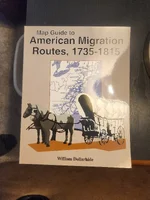
I used the attached book to research the route and based on my conclusion, the transactions were all cash.
I doubt that if there was a receipt, it wouldn't have warranted to be placed in the locked box.
I think the receipts were between party members that needed to be settled up before Robert Morriss distributed the cache to the heirs.
Attachments
Last edited:
chalkoutline
Hero Member
Mexico won their independence from spain in 1821. The treaty was signed on August 24, 1821.“little Mexican town”
Beale buried the second cache in December 1821.
Beale gave the locked box to Robert Morriss in the Spring of 1822.
So the papers in the locked paper most certainly referred to santa fe as a Mexican town since was no longer a Spanish colony.
That would’ve been cutting edge terminology. So the question is, does the terminology fit better because it was retrospectively written (my point) or because the letter was written January 4th 1822. Three and a half months after the formal signature, Beale is already in Virginia. While traveling back to Virginia he somehow receives word that Mexico had won independence from Spain?Mexico won their independence from spain in 1821. The treaty was signed on August 24, 1821.
Beale buried the second cache in December 1821.
Beale gave the locked box to Robert Morriss in the Spring of 1822.
So the papers in the locked paper most certainly referred to santa fe as a Mexican town since was no longer a Spanish colony.
For context, the letter describes the town as a “little Mexican town” while they were wintering there in late 1818 to early 1819, by which it was very much, still a Spanish colony and known to be a Spanish colony.
chalkoutline
Hero Member
The news of Mexico's independence would not have come via land route but by merchant ships. Vera Cruz, Mexico was was the largest port i 1821 and traded goods with New Orleans. It to 7 to 14 days to make this voyage.
That meant the news would have traveled up the Mississippi to St. Louis which took 10 to 20 days by steamboat.
Best case...news would have reached st louis by Sept 10th
Worse case...Sept 27th
For TB to be in Lynchburg in December, he would have had to leave st louis by October 31st.
So the news of Mexico's independence would have been well know by the time his parry reached STL.
You are right that the letter/ciphers were written after December 1821 and retold the story of their first trip when they found gold. But since it was written after the Mexico's independence, he most certainly could have used Mexican town in the retelling of the account.
That meant the news would have traveled up the Mississippi to St. Louis which took 10 to 20 days by steamboat.
Best case...news would have reached st louis by Sept 10th
Worse case...Sept 27th
For TB to be in Lynchburg in December, he would have had to leave st louis by October 31st.
So the news of Mexico's independence would have been well know by the time his parry reached STL.
You are right that the letter/ciphers were written after December 1821 and retold the story of their first trip when they found gold. But since it was written after the Mexico's independence, he most certainly could have used Mexican town in the retelling of the account.
Last edited:
The news of Mexico's independence would not have come via land route but by merchant ships. Vera Cruz, Mexico was was the largest port i 1821 and traded goods with New Orleans. It to 7 to 14 days to make this voyage.
That meant the news would have traveled up the Mississippi to St. Louis which took 10 to 20 days by steamboat.
Best case...news would have reached st louis by Sept 10th
Worse case...Sept 27th
For TB to be in Lynchburg in December, he would have had to leave st louis i October 31st.
So the news of Mexico's independence would have been well know by the time his parry reached STL.
You are right that the letter/ciphers were written after December 1821 and retold the story of their first trip when they found gold. But since it was written after the Mexico's independence, he most certainly could have used Mexican town in the retelling of the account.
That is possible but requires so much to go perfectly right. Historical records show that the Spanish never truly conceded (The Spanish Crown) until December of 1836. William Becknell who was on the Santa Fe trail didn’t learn of Mexican declared independence until November/December of 1821. News didn’t reach St. Louis until then as well. The letter states that it was written from Lynchburg on January 4th, 1822. So from St. Louis to Lynchburg, it would take roughly 3-5 weeks to reach Beale in Lynchburg. This would be travel during the winter and they would need to deal with crossing major rivers and the Appalachian mountains during rough conditions. It would also be quite odd to receive this news and Immediately then refer to his time in Santa Fe in 1818-1819 as a Mexican town when it was Spanish at the time, that’s not typically how people remember and recount past events.
So both are possible, but I believe the most likely case is this is a retrospective tale that left another anachronism slip from a future time period.
chalkoutline
Hero Member
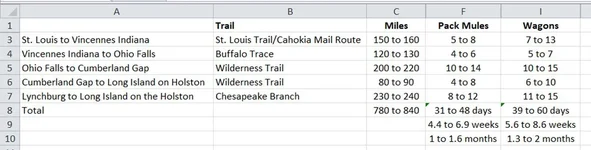
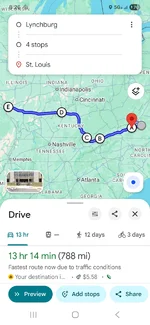
I took an hour this morning to detail the trip from St Louis to Lynchburg in 1820. I attached the detailed calculations and a plotted the trip using google maps.St. Louis to Lynchburg, it would take roughly 3-5 weeks to reach Beale in Lynchburg. This would be travel during the winter and they
Summary:
To make the trip using horses and pack mules would take 4.4 to 6.9 weeks.
To make the trip using horses and wagons would take 5.6 to 8.6 weeks.
Therefore,
In order for TB to reach Lynchburg by December 1st 1821...
he would have needed to leave STL between October 14th to October 31st by horse and pack mule.
OR
Between October 2nd to October 23rd to by horse and wagon.
Google AI says...
In 1820, a horse and pack mule was a more reliable and consistent mode of travel than a horse and wagon over difficult terrain.
Pack mules navigated narrow mountain paths, muddy tracks, and unbridled streams where heavy wheeled wagons broke down or got stuck in the mud.
I have already stated my case why TB would have used pack mules coming from the rugged terrain out west and the advantage of breaking into smaller groups when necessary to avoid drawing attention upon returning to Lynchburg.
Attachments
Prairie Gazingfox
Sr. Member
- Joined
- Feb 18, 2025
- Messages
- 358
- Reaction score
- 409
- Golden Thread
- 0
- Location
- North Illinois
- Detector(s) used
- Pendulum
- Primary Interest:
- All Treasure Hunting
You guys are talking about the Historical figure having packing mules, horses at his disposal, Provisions to travel and live on for weeks. That means he had the resources to plan ahead where and how to bury the gold in question!
My conclusion is therefore, no one is able to find his gold!
My conclusion is therefore, no one is able to find his gold!
chalkoutline
Hero Member
I have tried to prove the trip described in the story was impossible using timelines and facts rather than opinion and hyperbole but as of today, i haven't been successful.You guys are talking about the Historical figure having packing mules, horses at his disposal, Provisions to travel and live on for weeks. That means he had the resources to plan ahead where and how to bury the gold in question!
My conclusion is therefore, no one is able to find his gold!
As improbable as some contend, the trip as described is possible.
Prairie Gazingfox
Sr. Member
- Joined
- Feb 18, 2025
- Messages
- 358
- Reaction score
- 409
- Golden Thread
- 0
- Location
- North Illinois
- Detector(s) used
- Pendulum
- Primary Interest:
- All Treasure Hunting
I am leaning toward a lot of the details to have been added later ( later generations of people ) BUT I didn't read everything here discussed.I have tried to prove the trip described in the story was impossible using timelines and facts rather than opinion and hyperbole but as of today, i haven't been successful.
As improbable as some contend, the trip as described is possible.
I also do think the trip was possible !
In later 1800s Bulgaria history if i remember correctly when the Serbs attacked Bulgaria from the West without announcing, in the textbook was written that Bulls with wagons and loaded with ( small ?? ) Cannons were able in 3 days time to be moved from Eastern Bulgaria to the West regions. That's about 500 km.
But let's just assume most Bulls and troops came from NOT QUITE AS FAR East. Still, that's 250- 300 km in 3 days time!
And even if it took them 5 days, still that's a long distance! I believe it was the year 1885.
chalkoutline
Hero Member
Currently, im researching buffalo expeditions near santa fe.
Every year after the harvest santa fe conducted buffalo expeditions for tallow, meat and furs for the winter.
An average misourian and Virginian would not know about these expeditions since in 1818, santa fe was still Spanish rule and Americans were not allowed.
This all changed in 1821 when William Becknell opened the santa fe trail. Then it became buffalo hunting became common knowledge.
However, Zebulon Pike wrote about his 1810 expedition and the abundance of game in the western frontier.
This would be the.most likely way the TB party learned about santa fe buffalo hunting.
Every year after the harvest santa fe conducted buffalo expeditions for tallow, meat and furs for the winter.
An average misourian and Virginian would not know about these expeditions since in 1818, santa fe was still Spanish rule and Americans were not allowed.
This all changed in 1821 when William Becknell opened the santa fe trail. Then it became buffalo hunting became common knowledge.
However, Zebulon Pike wrote about his 1810 expedition and the abundance of game in the western frontier.
This would be the.most likely way the TB party learned about santa fe buffalo hunting.
chalkoutline
Hero Member
During his 1806–1807 southwestern expedition, Zebulon Pike traveled west into the Rocky Mountains of present-day Colorado and south into Spanish-controlled New Mexico.
Santa Fe & Chihuahua (New Spain/Mexico): Arrested by Spanish cavalry, he was escorted south to Santa Fe, New Mexico, and then deep into Chihuahua (in present-day northern Mexico) for interrogation before being marched back through Texas to the U.S. border.
Zebulon Pike’s published journal—An Account of Expeditions to the Sources of the Mississippi and through the Western Parts of Louisiana, was not readily available but a special order from eastern publishing hubs like Philadelphia or Washington.
in 1818, getting a copy of Zeublon Pikes journal was heavily depended on a person's wealth and education, as books were expensive luxury commodities and reading required functional literacy.
Once again my attempt to find a flaw in the Beale story failed since TB is said to be wealthy and well educated.
So as improbable as it might be, TB could have read Pikes journal/book and known about santa fe buffalo hunting.
Santa Fe & Chihuahua (New Spain/Mexico): Arrested by Spanish cavalry, he was escorted south to Santa Fe, New Mexico, and then deep into Chihuahua (in present-day northern Mexico) for interrogation before being marched back through Texas to the U.S. border.
Zebulon Pike’s published journal—An Account of Expeditions to the Sources of the Mississippi and through the Western Parts of Louisiana, was not readily available but a special order from eastern publishing hubs like Philadelphia or Washington.
in 1818, getting a copy of Zeublon Pikes journal was heavily depended on a person's wealth and education, as books were expensive luxury commodities and reading required functional literacy.
Once again my attempt to find a flaw in the Beale story failed since TB is said to be wealthy and well educated.
So as improbable as it might be, TB could have read Pikes journal/book and known about santa fe buffalo hunting.


Featured Treasure Finds
Featured Treasure Finds
Similar threads

- Replies
- 218
- Views
- 20K

Users who are viewing this thread
Total: 1 (members: 0, guests: 1)















