
Zebulon Pike was a prisoner of the Spanish and his captor who he became close with, took over command of Santa Fe in 1818-1819. His journals confirm that the hard nosed Spanish Royalist (Governor Allande) who enforced a strict embargo against the Americans was ousted and Pike’s captor, Facundo Melgares took over. Melgares was a realist, understood the pressures of sustaining a war with Mexico while also unable to pay his own soldiers. I posit that because of this, the fur trappers of that time began trading with Santa Fe and predated William Becknell’s “official” opening of the Santa Fe trail. Becknell had mounting debts, and took a shot on $300 worth the goods and used the existing fur trapper routes to attempt to sell in Santa Fe. When he got to Santa Fe, he was welcomed with open arms by the New Mexican government and Melgares before his departure.During his 1806–1807 southwestern expedition, Zebulon Pike traveled west into the Rocky Mountains of present-day Colorado and south into Spanish-controlled New Mexico.
Santa Fe & Chihuahua (New Spain/Mexico): Arrested by Spanish cavalry, he was escorted south to Santa Fe, New Mexico, and then deep into Chihuahua (in present-day northern Mexico) for interrogation before being marched back through Texas to the U.S. border.
Zebulon Pike’s published journal—An Account of Expeditions to the Sources of the Mississippi and through the Western Parts of Louisiana, was not readily available but a special order from eastern publishing hubs like Philadelphia or Washington.
in 1818, getting a copy of Zeublon Pikes journal was heavily depended on a person's wealth and education, as books were expensive luxury commodities and reading required functional literacy.
Once again my attempt to find a flaw in the Beale story failed since TB is said to be wealthy and well educated.
So as improbable as it might be, TB could have read Pikes journal/book and known about santa fe buffalo hunting.
You are using an out of date browser. It may not display this or other websites correctly.
You should upgrade or use an alternative browser.
You should upgrade or use an alternative browser.
Some say True and some say false...
- Thread starter treasure1822
- Start date

chalkoutline
Hero Member
Are you suggesting that the strict embago ended in 1818?took over command of Santa Fe in 1818-1819.
I am theorizing that yes, at the local level with Melgares, the embargo was no longer strictly enforced. Officially and on paper, the Spanish Crown maintained a strict embargo.Are you suggesting that the strict embago ended in 1818?
chalkoutline
Hero Member
Still piecing things together...
1. Spain and Mexico sign the treaty on August 24, 1821.
2. William Becknell left Franklin Mo September 1, 1821.
3. News of the treaty would have traveled from Vera Cruz, Mexico to New Orleans by merchant ships. Then up the Mississippi to St Louis.
Best case...news would have reached st louis between by
Best case Sept 10th
Worse case...Sept 27th.
4. TB traveled from the mine to St. Louis.
The TB party would need to leave St Louis for Virginia by October 14 to October 31, 1821 in order to reach Virginia by December 1st
5. William Becknell was greeted with open arm by Mexican soldiers on November 13, 1822 and found out about the treaty.
He arrives in Santa Fe on Nov 16th.
Note: WB departed from Franklin MO on Sept 1 which is 150 miles west of St. Louis. Since the news didn't reach st louis until Sept 10th (Franklin MO much later), this is why he was unaware of the treaty until he reached Mexico...he left before the news reached MO.
6. TB buried the treasure in December 1821.
Here's what i learned...
- William Becknell traveled 850mi in 76 days (10.8 weeks) via horses and pack mules. They traveled 10 to 12 miles per day.
He brought wagons on his second trip in 1822.
- Although the mine was located north of Santa Fe in Colorado, TB's trip would still be about the same distance as that traveled by WB because TB had to travel to St Louis. Therefore, using the same numbers as WB, TB would have had to have left the mine between July 1 and August 15, 1821 in order to be in St. Louis when the news arrived in St Louis regarding the treaty.
This seems quite plausible to me.
1. Spain and Mexico sign the treaty on August 24, 1821.
2. William Becknell left Franklin Mo September 1, 1821.
3. News of the treaty would have traveled from Vera Cruz, Mexico to New Orleans by merchant ships. Then up the Mississippi to St Louis.
Best case...news would have reached st louis between by
Best case Sept 10th
Worse case...Sept 27th.
4. TB traveled from the mine to St. Louis.
The TB party would need to leave St Louis for Virginia by October 14 to October 31, 1821 in order to reach Virginia by December 1st
5. William Becknell was greeted with open arm by Mexican soldiers on November 13, 1822 and found out about the treaty.
He arrives in Santa Fe on Nov 16th.
Note: WB departed from Franklin MO on Sept 1 which is 150 miles west of St. Louis. Since the news didn't reach st louis until Sept 10th (Franklin MO much later), this is why he was unaware of the treaty until he reached Mexico...he left before the news reached MO.
6. TB buried the treasure in December 1821.
Here's what i learned...
- William Becknell traveled 850mi in 76 days (10.8 weeks) via horses and pack mules. They traveled 10 to 12 miles per day.
He brought wagons on his second trip in 1822.
- Although the mine was located north of Santa Fe in Colorado, TB's trip would still be about the same distance as that traveled by WB because TB had to travel to St Louis. Therefore, using the same numbers as WB, TB would have had to have left the mine between July 1 and August 15, 1821 in order to be in St. Louis when the news arrived in St Louis regarding the treaty.
This seems quite plausible to me.
chalkoutline
Hero Member
The question i have is whether TB passed WB along the trail since they traveling at the same time.
Here is something I’ve dug up in my research that I found very interesting.
From “A Genealogy of the Buford Family in America” and supporting Otey records:
• Capt. Henry Buford + Mildred Blackburn
→ daughter Elizabeth Buford married John Hopkins Otey (1790).
→ their son John Buford Otey married Angelina M. Brown.
→ their daughter Harriet Emeline (or Harriet C.) Otey married James B. Ward in 1842.
This permanently places the publisher of the 1885 Beale pamphlet inside the core Bedford/Campbell County Buford–Otey kinship group.
This means James B Ward wasn’t just some random publisher who attained the Beale letters and ciphers from Robert Morriss. Rather he has a direct kinship to the Buford’s of Bedford County. To me, that feels significant. Thoughts?
From “A Genealogy of the Buford Family in America” and supporting Otey records:
• Capt. Henry Buford + Mildred Blackburn
→ daughter Elizabeth Buford married John Hopkins Otey (1790).
→ their son John Buford Otey married Angelina M. Brown.
→ their daughter Harriet Emeline (or Harriet C.) Otey married James B. Ward in 1842.
This permanently places the publisher of the 1885 Beale pamphlet inside the core Bedford/Campbell County Buford–Otey kinship group.
This means James B Ward wasn’t just some random publisher who attained the Beale letters and ciphers from Robert Morriss. Rather he has a direct kinship to the Buford’s of Bedford County. To me, that feels significant. Thoughts?
chalkoutline
Hero Member
Sarah Morriss—identified as the wife of Robert Morriss—died at age 77 in 1863 inside a home owned by a man named James B. Ward.
chalkoutline
Hero Member
I first heard this in a YouTube video: Treasure: Beale Treasure Legend posted by MysteriousWV
Google AI confirms...
Yes, according to local records tied to the lore of the Beale ciphers, Robert Morriss's wife, Sarah Morriss, died at the age of 77 in 1863 inside a home owned by James B. Ward
Details of the Event
Google AI confirms...
Yes, according to local records tied to the lore of the Beale ciphers, Robert Morriss's wife, Sarah Morriss, died at the age of 77 in 1863 inside a home owned by James B. Ward
Details of the Event
- Person: Sarah Morriss (wife of Robert Morriss)
- Age at death: 77 years old
- Year of death: 1863
- Location: A home owned by James B. Ward, who later received custody of the famous treasure papers from Robert Morriss.
Interesting. Gemini confirmed it, but grok is more demanding. I took grok’s answer and sent it to Gemini and then it back tracked. Here is what Grok said:I first heard this in a YouTube video: Treasure: Beale Treasure Legend posted by MysteriousWV
Google AI confirms...
Yes, according to local records tied to the lore of the Beale ciphers, Robert Morriss's wife, Sarah Morriss, died at the age of 77 in 1863 inside a home owned by James B. Ward
Details of the Event
- Person: Sarah Morriss (wife of Robert Morriss)
- Age at death: 77 years old
- Year of death: 1863
- Location: A home owned by James B. Ward, who later received custody of the famous treasure papers from Robert Morriss.
This is a clear case of an unverified claim entering the secondary Beale lore and then being amplified by generative AI.
What we actually have:
- The only primary narrative source (Ward’s 1885 pamphlet) states that Sarah Morriss died in 1861 and Robert Morriss died in 1863.
- No Lynchburg or Campbell County death register entry, contemporary newspaper notice, or property record has been produced that supports the 1863 date, the age of 77, or the location in a house owned by James B. Ward.
- The claim appears to originate in (or at least be popularized by) the YouTube video you mentioned and is now being repeated by Google’s AI overview and similar systems. That is circular reinforcement, not independent verification.
Generative AI systems frequently treat repeated secondary statements as “confirmed” when they lack access to, or fail to prioritize, the original documents. In this case the pamphlet itself contradicts the claim, and no municipal record has been shown to override it.
Bottom line:
Until someone produces the actual page from the Lynchburg/Campbell County death register or a contemporary deed/tax record placing Sarah Morriss’s death in a Ward-owned house in 1863, the statement remains an unsupported detail circulating in popular Beale content. It should not be treated as established fact.
chalkoutline
Hero Member
Lynchburg va became an independent city in 1852 so any record of Sarah Morriss's death would be found in Lynchburg death registers.
I am not familiar with Lynchburg register formats, most city registers have an address column. You would then need to determine if the address is James B Wards
I am not familiar with Lynchburg register formats, most city registers have an address column. You would then need to determine if the address is James B Wards
chalkoutline
Hero Member
1853–1896: Early vital statistics registers exist for many Virginia counties and cities, but Lynchburg is missing from the historical state-level registers for this collection.
We'll never know.
We'll never know.
chalkoutline
Hero Member
Not sure why you are pursuing the Buford, Otey, Ward connection....
But the MysteriousWV video indicates James B Ward's father was a lawyer in St Louis at the time TB would have given the KEY to his friend. He shows advertisements from a st louis paper.
In another thread i suggested the KEY may havve been part of TBs will. Maybe Wards father was the lawyer?
But the MysteriousWV video indicates James B Ward's father was a lawyer in St Louis at the time TB would have given the KEY to his friend. He shows advertisements from a st louis paper.
In another thread i suggested the KEY may havve been part of TBs will. Maybe Wards father was the lawyer?
chalkoutline
Hero Member
I used AI to help generate this. Just an fyi.
Lynchburg did become an independent city in 1852, so any 1863 death record for Sarah Morriss should be in the Lynchburg city registers rather than Campbell County. Whether those registers include a clear street address that can be tied to James B. Ward’s property is a separate documentary question. If the address column exists and can be matched, it would be useful; if the registers are incomplete or the address is ambiguous, then the “died in Ward’s house” claim remains unverified from primary sources.
The Buford–Otey–Ward connection is being examined for a different reason. Genealogical records show that James B. Ward married into the same Bedford/Campbell County Buford family that owned the “Buford’s” landmark referenced in the pamphlet. That places the publisher inside the exact kinship group that controlled the primary geographic anchor of the Virginia narrative. It does not prove Ward authored the papers or that the story is true, but it does remove the idea that he was a completely random, unconnected printer who simply received a mysterious box.
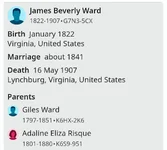
Regarding Giles Ward and a possible St. Louis legal connection: if primary evidence shows Giles Ward practiced law in St. Louis in the early 1820s and had any documented link to Beale, the Chouteau network, or the handling of the key, that would be significant and should be pursued with the actual records. Advertisements alone are not yet proof of the specific role being suggested. The flood-loss theory for the key is possible but currently speculative.
The Ward–Buford link is worth documenting because it is one of the few concrete, verifiable connections between the 1885 publisher and the geography named in the pamphlet. Everything else (the key’s fate, the lawyer theory, the exact death address) still needs primary documentation before it can carry weight.
Lynchburg did become an independent city in 1852, so any 1863 death record for Sarah Morriss should be in the Lynchburg city registers rather than Campbell County. Whether those registers include a clear street address that can be tied to James B. Ward’s property is a separate documentary question. If the address column exists and can be matched, it would be useful; if the registers are incomplete or the address is ambiguous, then the “died in Ward’s house” claim remains unverified from primary sources.
The Buford–Otey–Ward connection is being examined for a different reason. Genealogical records show that James B. Ward married into the same Bedford/Campbell County Buford family that owned the “Buford’s” landmark referenced in the pamphlet. That places the publisher inside the exact kinship group that controlled the primary geographic anchor of the Virginia narrative. It does not prove Ward authored the papers or that the story is true, but it does remove the idea that he was a completely random, unconnected printer who simply received a mysterious box.
Regarding Giles Ward and a possible St. Louis legal connection: if primary evidence shows Giles Ward practiced law in St. Louis in the early 1820s and had any documented link to Beale, the Chouteau network, or the handling of the key, that would be significant and should be pursued with the actual records. Advertisements alone are not yet proof of the specific role being suggested. The flood-loss theory for the key is possible but currently speculative.
The Ward–Buford link is worth documenting because it is one of the few concrete, verifiable connections between the 1885 publisher and the geography named in the pamphlet. Everything else (the key’s fate, the lawyer theory, the exact death address) still needs primary documentation before it can carry weight.
chalkoutline
Hero Member
Here's where the flood theory falls apart...I used AI to help generate this. Just an fyi.
Lynchburg did become an independent city in 1852, so any 1863 death record for Sarah Morriss should be in the Lynchburg city registers rather than Campbell County. Whether those registers include a clear street address that can be tied to James B. Ward’s property is a separate documentary question. If the address column exists and can be matched, it would be useful; if the registers are incomplete or the address is ambiguous, then the “died in Ward’s house” claim remains unverified from primary sources.
The Buford–Otey–Ward connection is being examined for a different reason. Genealogical records show that James B. Ward married into the same Bedford/Campbell County Buford family that owned the “Buford’s” landmark referenced in the pamphlet. That places the publisher inside the exact kinship group that controlled the primary geographic anchor of the Virginia narrative. It does not prove Ward authored the papers or that the story is true, but it does remove the idea that he was a completely random, unconnected printer who simply received a mysterious box.
Regarding Giles Ward and a possible St. Louis legal connection: if primary evidence shows Giles Ward practiced law in St. Louis in the early 1820s and had any documented link to Beale, the Chouteau network, or the handling of the key, that would be significant and should be pursued with the actual records. Advertisements alone are not yet proof of the specific role being suggested. The flood-loss theory for the key is possible but currently speculative.
The Ward–Buford link is worth documenting because it is one of the few concrete, verifiable connections between the 1885 publisher and the geography named in the pamphlet. Everything else (the key’s fate, the lawyer theory, the exact death address) still needs primary documentation before it can carry weight.
According to the video by Mysterious WV, Giles Ward was temporarily working in St Louis and returned about a year later after the possible encounter with TB. This would make it plausible that the any record of meeting TB was not destroyed in a St. Louis flood as suggested but rather transported back to Lynchburg.
Giles Ward died in 1851 so there is no reason for him not have sent the KEY to Robert Morriss in 1832.
chalkoutline
Hero Member
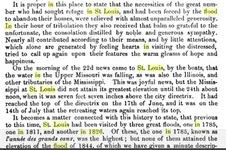
I attached JohnnyRev's doc on the St Louis flooding in 1826.
Here's where the flood theory falls apart for Giles Ward...
According to the video by Mysterious WV, Giles Ward was temporarily working in St Louis and returned about a year later after the possible encounter with TB. This would make it plausible that any record of meeting TB was not destroyed in a St. Louis flood in 1826 but rather transported back to Lynchburg.
Giles Ward died in 1851 so there is no reason for him not have sent the KEY to Robert Morriss in 1832.
Here's where the flood theory falls apart for Giles Ward...
According to the video by Mysterious WV, Giles Ward was temporarily working in St Louis and returned about a year later after the possible encounter with TB. This would make it plausible that any record of meeting TB was not destroyed in a St. Louis flood in 1826 but rather transported back to Lynchburg.
Giles Ward died in 1851 so there is no reason for him not have sent the KEY to Robert Morriss in 1832.
Attachments
I’ve been following your posts for anwhile and I really appreciate how much research you put into this. You dig deeper than most people do.
I’m trying to get a clearer sense of where you ultimately land. From what I’ve read, a lot of the analysis seems to rest on what could have happened or what was possible given the timelines and logistics. Are you working from the position that Thomas J. Beale was a real person and that the events largely unfolded the way the pamphlet describes? Or is the goal more about testing whether a coherent plaintext can still emerge from the ciphers under that framework?
The reason I’m asking is that I tend to see three broad camps in these discussions:
1. The Virginia narrative is essentially true — Beale and the party existed and the treasure is (or was) real.
2. The whole thing is a hoax, most likely put together by James B. Ward to sell pamphlets.
3. “Thomas J. Beale” is a pseudonym or cover name, and the papers contain deliberate misdirection so that only the intended heirs could eventually recover the cache.
I’m not trying to put your theory in a box — I’m just genuinely curious which of those (or what other position) you’re aiming toward with all the work you’ve done. Would love to hear how you see it.
I’m trying to get a clearer sense of where you ultimately land. From what I’ve read, a lot of the analysis seems to rest on what could have happened or what was possible given the timelines and logistics. Are you working from the position that Thomas J. Beale was a real person and that the events largely unfolded the way the pamphlet describes? Or is the goal more about testing whether a coherent plaintext can still emerge from the ciphers under that framework?
The reason I’m asking is that I tend to see three broad camps in these discussions:
1. The Virginia narrative is essentially true — Beale and the party existed and the treasure is (or was) real.
2. The whole thing is a hoax, most likely put together by James B. Ward to sell pamphlets.
3. “Thomas J. Beale” is a pseudonym or cover name, and the papers contain deliberate misdirection so that only the intended heirs could eventually recover the cache.
I’m not trying to put your theory in a box — I’m just genuinely curious which of those (or what other position) you’re aiming toward with all the work you’ve done. Would love to hear how you see it.
chalkoutline
Hero Member
I read the 1885 pamphlet with interest and set out to find TB using my genealogy background. I physically traveled to Fincastle,VA and found the will of Tavenor Beale father if TB Sr.I’ve been following your posts for anwhile and I really appreciate how much research you put into this. You dig deeper than most people do.
I’m trying to get a clearer sense of where you ultimately land. From what I’ve read, a lot of the analysis seems to rest on what could have happened or what was possible given the timelines and logistics. Are you working from the position that Thomas J. Beale was a real person and that the events largely unfolded the way the pamphlet describes? Or is the goal more about testing whether a coherent plaintext can still emerge from the ciphers under that framework?
The reason I’m asking is that I tend to see three broad camps in these discussions:
1. The Virginia narrative is essentially true — Beale and the party existed and the treasure is (or was) real.
2. The whole thing is a hoax, most likely put together by James B. Ward to sell pamphlets.
3. “Thomas J. Beale” is a pseudonym or cover name, and the papers contain deliberate misdirection so that only the intended heirs could eventually recover the cache.
I’m not trying to put your theory in a box — I’m just genuinely curious which of those (or what other position) you’re aiming toward with all the work you’ve done. Would love to hear how you see it.
My next stop was to Washington & Lee university to look at the remaining books of Liberty Hall Academy where TB jr would have benn educated. Prior to my trip asked to see a list of books from LHA.
When i arrived, they had a cart load of books ready for me and i spent the day reading and talking notes and pics.
There were two books on the cart i didn't request. When i paged through the first book from1795, i found a sketch of a mans face that looked just like me...see my profile picture. Written to the left of the face was the name "Thomas".
At that point i couldn't walk away.
Where do i fall?
I have tried to debunk the story but to no avail. Everything in the story seems possible but not plausible.
I studied the ciphes; specifically the alphabetical strings. Most think the strings indicate a hoax but since the story could be possible, i concluded the strings could be added protection to an easy to break book cipher by redacting key information to to location since the strwere intentionally inserted.
Every one who looks at the strings agree with this point.
So the only way to solve Cipher 1 is with the original KEY that didn't arrive.
The Beale Treasure video by MysteriousWV indicated Giles Ward, father of James B Ward, was a lawyer in st louis at the time when TB gave the KEY to his friend.
So if i were to continue my search, which im not, i would look for the original KEY but not in st louis but in Lynchburg where Giles Ward returned a few years later.


Featured Treasure Finds
Featured Treasure Finds
Similar threads

- Replies
- 218
- Views
- 20K

Users who are viewing this thread
Total: 1 (members: 0, guests: 1)















