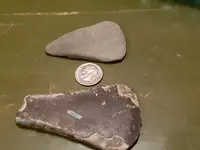
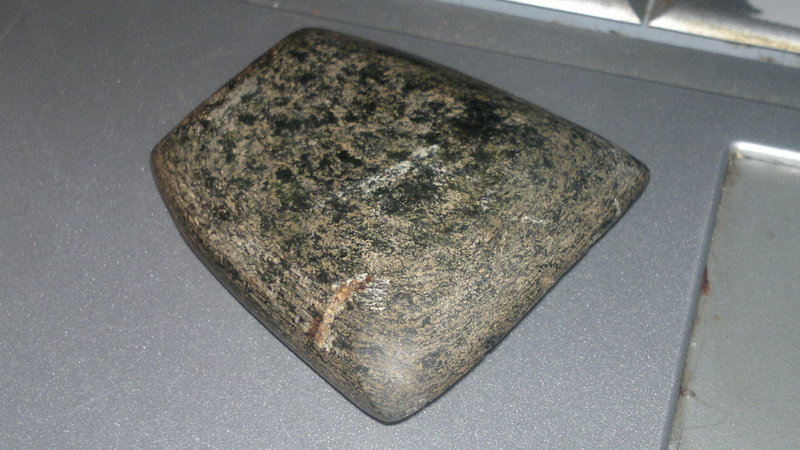
I see I got long-winded, here ... sorry.
Short version: The rock had flaws ... stone age folks knew their stones.
Long version:
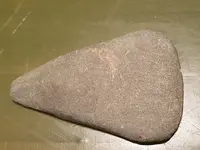
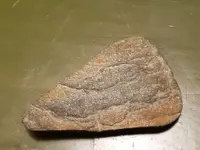
No chips ... no pecks ... must be grind
Grind work is hard to detect and analyze ... especially true in pictures.
Requires magnification and careful study.
So, I'm not offering an opinion, one way or another.
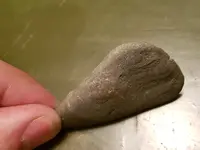
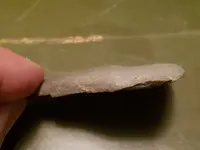
My observation, however, is taken from the 1st and 3rd picture.
The rock exhibits striations running parallel to the natural break on this rock.
(seeing one in each picture)
This rock breaks in a fracture plane manner ... it had a weak spot running right down the middle.
It wouldn't have been a good choice for making tools ... especially an axe.
Stone age folks knew stones.

When working with our local stones, I teach the students common flaws that occur in the rocks.
Before we put time into "working" the stones ... I teach them to smash them against other rocks, first.
We do this for any rocks that are known to have flaws in them.
We're on the river bars or at a quarry, so there is no loss ... leave the bad rock and bang on another.
No need hauling, working, and then using a tool that was doomed from the start.
This is especially true for tools requiring impacts.
Again, I can't offer an opinion here, other than I have a great respect for the ancients knowledge of stone, and this isn't a stone I would expect them to chose for a tool.
If this type stone is common in the creeks and rivers nearby, I'd expect them to chose a better one.
If this type stone is unheard of, in the area, ... then we add the possibility that it is a "manuport" ... brought in by man.
That would make it an artifact.
This isn't saying it's not a tool ... but only having pics to go by, I'd have to say the flawed nature of the rock, itself, gives me pause.