SoreKneesDayton said:
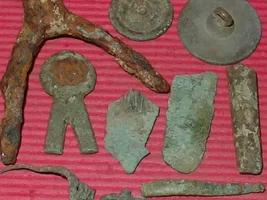
Jeff found this pin at the 1800s house in Yellow Springs Ohio last week.
All we have been able to find is that it was advertising David Bradley Manufacturing Co. who made the sulkys. But we have no info on the lapel pin or saddle pin. It is just under dime-sized. Looks like it may have been a french cuff button or saddle pin of some kind.
SKD for NO-computer-Jeff
Nice find! Here's some early history of the company..as per newspaper reports.............
According to the Alton Daily Telegraph of Alton, Illinois on 5 December 1882, a said, Robert Newton, complainant and the Furst & Bradley Manufacturing Company, defendants, are in the US District Court at Chicago over the patent of the original sulky plow claimed by Mr. Newton. The conclusion of the case was dissolved on the grounds that the "Clutch mechanism" was NOT an original invention, that it had been used upon wagons, hay rakes, etc...before it was ever applied to "Davenport's sulky plow."
The Cedar Rapids Evening Gazette of Cedar Rapids, Iowa on 24 September 1885 reports:
"Among the recent additions to Cedar Rapids in the way of manufacturing establishments, the Gazette takes great pleasure in calling attention to the Bradley Manufacturing Company, located at the corner of First Street and Eighth Avenue. They are at present, engaged in the manufacture of hay and fuel presses, but they are arragning to enlarge their business and include a manufactury for all kinds of material that require pressing and bailing. Among other articles we would name ------, tobacco, broomcorn, flax, cheese, moss, oil, lard, straw, cornstalks, weeds, etc., etc. One might naturally ask what weeds, cornstalks, etc., would be pressed for, but when he remembers that these things in compact shape make excellent and cheap fuel, the value of these presses will in a slight degree, be understood. They are bound to come into general use throughout the great northwest for the very reason that fuel is sure to be scarce before very many years, and with these presses, which one man can operate, they will be enabled to secure fuel, which is now a very expensive item, at an exceedingly small expenditure. The presses manufactured by the Bradley Manufacturing Company are simple and are not at all liable to get out of order. Anybody can work them, and the operation is perfect. It is such institutions as these that meet the various domanis of the northwest, that assist in the development of Cedar Rapids, and the more of them, the better. The nature of these presses is as is such that we prophesy that this will be one of the leading industries of the city before many years, and the fact that they are being made to the fullest capacity of the factory, while the demand cannot be supplied is clearly indicated that the more the presses are known the greater the demand wil be. The press was patented by Mr. W.W. Post. Mr. L.A. Bradley, who has been a resident of Cedar Rapids for the last twenty years, is President of the company, and that is a quarantee that the business willb e pushed for all there is in it and that it will be managed properly."
The Daily Review of Decatur, Illinois on 22 February 1894, reported the following:
OPEN TO A PROPOSITION
Manufacturing Enterprise That Seems To Be In Reach
It Employs 500 Men All The Year Around And Wants To Change Its Location -- Its Demands Seem To Be Reasonable -- A Committee Should Visit It
"A manufactoring concern that will work 500 men is looking for a location. Decatur can get the prize by going after it in the right way. The David Bradley Manufacturing Company of Chicago, manufacturers of farming implements, want to spread out. They want to get outside of Chicago. This is no jackleg watered stock company looking for money, but a business that a city can be proud of and will be benefited by in a substantial way. Bradstreet quotes them with a paid up stock of $800,000 and a surplus of $1,000,000. At their present plant, they are working 400 men. In their new plant, they expect to give work to 500 men........"
Homestead in Des Moines, Iowa on 17 May 1895 reports the following:
David Bradley Manufacturing Company's Removal from Chicago.
Farmers will be interested to learn of the removal of the David Bradley Manufacturing Company from Chicago to Bradley City (formerly North Kankakee), Illinois. The name Bradley has been seen for years, and is still to be found on hundreds and thousands of plows, cultivators, rakes, and other agricultural implements scattered over the West and Northwest, and in many foreign countries, and it has now been stamped upon a town about fifty miles south of the great western metropolis. Mr. Bradley, who has been a plow maker for over half a century, left New York in 1835 to come West; he helped to erect and start the first foundry built in Chicago, and was the first man to bring pig iron into that city. The main business of his foundry was to make plows, which was a step in advance of the then very common wooden moldboard plow. In 1854, a small factory was started by him on Canal Street, which was later removed to Randolph Street. The output increased rapidly until in 1860, larger quarters were purchased on North Jefferson Street, and additional space and buildings have been acquired since that time, until the establishment has reached its present magnitude. Early in Mr. Bradley's history, he was associated with Mr. Conrad Furst, under the name of Furst & Bradley, which was later incorporated as the Furst & Bradley Manufacturing Company. Subsequently, Mr. Bradley purchased Mr. Furst's interest, and changed the name of the corporation to the David Bradley Manufacturing Company, and branch houses are now located at Minneapolis, Minn; Council Bluffs, Iowa; and Kansas City, Mo.; with general agencies at varioius points throughout the country, extending to the Pacific coast. The removal to Bradley City was decided upon partly because of the inability to secure any further enlargement of quarters to the Chicago location, and because it was foundthat the shipping facilities of Bradley City are quite equal to Chicago, inasmuch entering Chicago can be had either over the Illinois Central or Indiana, Illinois, Ohio and Iowa railroads. The change in this location, we understand, will in no wise change the proprietorship or management of the corporation, the same policy which has heretofore led to its success being continued.
There's so much more out there...but that's it for now...fingers getting tired of typing...LOL
Annmarie