What's new

✅ SOLVED Sword or brush tool?

snaps

Sr. Member
Joined
May 6, 2009
Messages
460
Reaction score
564
Golden Thread
0
Location
West Virginia
Detector(s) used
Goldmaxx, Compass GSP, Garrett Infinium
Hello everyone,
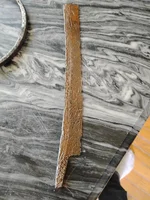
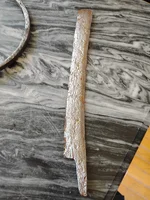
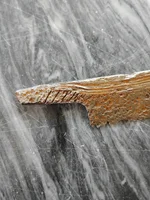
Had this guy relaxing at the vinegar spa for a week. It's about an inch an an eighth at the tang, tapering to an inch. Appears to have numbers or letters etched in, or I'm just seeing things. Thanks in advance for views and help!
 

Attachments

  • IMG_20260620_104112319.webp
    IMG_20260620_104112319.webp
    913.2 KB · Views: 159
  • IMG_20260620_104100625.webp
    IMG_20260620_104100625.webp
    1,018.8 KB · Views: 108
  • IMG_20260620_104052094.webp
    IMG_20260620_104052094.webp
    904 KB · Views: 104
Looks old for sure.
Could be a draw knife. Or fleshing knife.
Ah, ok, had a tang an handle on both ends, that's a possibility. Corn knife quite possible as well. This one does have a curve to it , where I don't see one in your pic of corn knife. Thanks guys!
 
Upvote 0
Any background on where found? Homesite, battlefield, none of the above? It’s definitely a cutting tool of some type, but what type, hard to say without context
 
Upvote 0
Any background on where found? Homesite, battlefield, none of the above? It’s definitely a cutting tool of some type, but what type, hard to say without context
Homesite that saw artillery action in civil war , found two shells there. Nothing else civil war, so can't say that soldiers were there, only that it was a target for rebel artillery.Lots of pewter tombacs, flatties, 1800s Homesite stuff
 
Upvote 0
Looks like a broken scythe
 
Upvote 0
Any background on where found? Homesite, battlefield, none of the above? It’s definitely a cutting tool of some type, but what type, hard to say without context
Homesite that saw artillery action in civil war , found two shells there. Nothing else civil war, so can't say that soldiers were there, only that it was a target for rebel artillery.Lots of pewter tombacs, flatties, 1800s Homesite stu
Does the "point" appear to be broken, or finished?
Broken for sure
 
Upvote 0
Ah, ok, had a tang an handle on both ends, that's a possibility. Corn knife quite possible as well. This one does have a curve to it , where I don't see one in your pic of corn knife. Thanks guys!

Some rough iron.
Looking stringy like wrought iron on it's spine /thick edge and showing bubbles on the thinner edge like cast.
Old work there and crude refinement. Nice. A metallurgist with a historical background might get enthused about it. Or at least toss out a date such work in the area was common. Perhaps too with a source of iron material from a nearest furnace. Though most homesteads probably saved what they could of iron brass and lead and precious steel somewhere around the forge regardless of it's source..
A forge was common on many homesteads and you worked with what you had. With what skill you had.
 
Upvote 0
The parallel lines on the tang may be for securing a wooden handle. The handle would have had a hole in it to be driven onto the tang.
The design has the looks of a froe, for splitting wood. One use of froes was to make shingles. Yours looks long enough for that purpose. The sharp edge of the froe was driven into the wood by blows of a wooden mallet on the top of the blade and then the blade was rocked to and fro (hence the name, I think) to split down through the wood.
 
Upvote 0
Some rough iron.
Looking stringy like wrought iron on it's spine /thick edge and showing bubbles on the thinner edge like cast.
Old work there and crude refinement. Nice. A metallurgist with a historical background might get enthused about it. Or at least toss out a date such work in the area was common. Perhaps too with a source of iron material from a nearest furnace. Though most homesteads probably saved what they could of iron brass and lead and precious steel somewhere around the forge regardless of it's source..
A forge was common on many homesteads and you worked with what you had. With what skill you had.
Great Info!
 
Upvote 0
The parallel lines on the tang may be for securing a wooden handle. The handle would have had a hole in it to be driven onto the tang.
The design has the looks of a froe, for splitting wood. One use of froes was to make shingles. Yours looks long enough for that purpose. The sharp edge of the froe was driven into the wood by blows of a wooden mallet on the top of the blade and then the blade was rocked to and fro (hence the name, I think) to split down through the wood.
Yea it's certainly stout enough for a tool like that
 
Upvote 0

Users who are viewing this thread

Back
Top Bottom