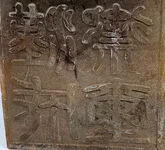
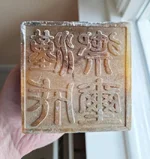
For what it’s worth, AI agrees with Mr. Nagy on three of the characters, but not the one he interprets as ‘róng’, relating to weaponry, arms or army. Noting that the characters are highly stylised, AI comments that:
“While the character you provided (戎, róng) looks similar to the one on the seal, the character actually present is 崇 (chóng). This specific seal is frequently found on modern reproductions or "museum-style" curios made from materials like Hetian jade or soapstone.”
The chóng character relates to something high or lofty (as for a mountain, for example), but also in the sense of something that is esteemed, honoured, respected or adored.
AI also notes that:
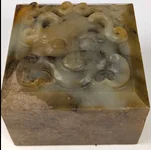
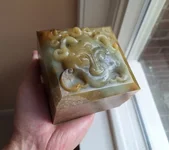
"During the Qin and Han Dynasties, 壐 (xi) was originally a general term for seals, but after Qin Shi Huang, it gradually became exclusively used by the emperor, while subjects used "印" (yin) or "章" (zhang)."
and
“Although primarily a title reserved for emperors after the Qin Dynasty, the character 壐 (xi) has been widely used on private seals with a royal style in antique-style or scholar's seals from the Qing Dynasty onwards” and “this style of seal is also frequently imitated or copied in modern seal carving, used as an artwork or personal seal.”