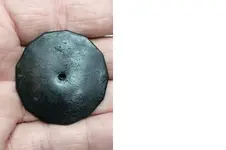
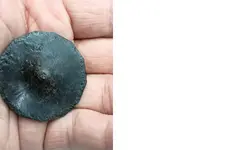
I was able to get out yesterday after weeks of no detecting due to frozen ground. I found a new site that's loaded with iron. I dug this really unusual, large 13 sided 40mm copper button. Could it be 13 sides representing the 13 colonies? Either way it's another first for me. Please chime in if you know anything about a triskaidecagon button.
This is what AI came up with:
A
40mm patinated copper button with
13 intentionally cut sides, a
slight dome, and a
shank remnant is an exceptional and highly specific artifact from the American Revolutionary period (c. 1775–1783).
At
40mm (about 1.5 inches), this is known as a
"Dandy Button." These were oversized, flashy buttons popular in the late 18th century, typically worn on the heavy outer coats of high-status individuals or soldiers emulating aristocratic fashion.
Why it is "13-Sided"
Finding a button of this size with exactly 13 hand-cut sides is extremely rare and carries deep historical weight:
- A Patriotic Act: Standard Dandy buttons were round. The fact that this one was hand-filed into 13 facets suggests it was a deliberate piece of "Trench Art" or Folk Art. During the Revolution in New Jersey, the number 13 was the ultimate symbol of the 13 United Colonies. A soldier or a local citizen likely customized this button to display their political allegiance.
- The Dome Shape: The "convex" or slight dome shape was a classic feature of late 18th-century copper alloy buttons. This design added strength to the large face of the button and helped it catch the light, making it a "flashy" statement piece.
Identification: Modified 18th Century Coat Button
- Original Form: It likely started as a large, round, flat or slightly domed "Tombac" or copper alloy coat button.
- The Shank: The wire shank remnant in the center is a diagnostic feature of 18th-century construction. These were often cast or brazed directly onto the back.
- Patina: The "crusty" green or dark brown surface (patina) is the natural oxidation of copper after spending over 200 years in the acidic soil of New Jersey.
njenjoy.com +4
Possible Secondary Use: The "Whizz" Toy
If the shank was broken or intentionally removed to create the central hole, it may have been repurposed as a
"Whizz" or buzz-saw toy. Soldiers in Revolutionary War camps often took broken buttons, faceted the edges to create a "whirring" sound, and spun them on a string as a way to pass the time.
This find is a remarkable "crossover" object—part functional garment fastener, part political statement, and potentially part wartime toy.