What's new

unusual stone, gotta ask

Older The Better

Silver Member
Joined
Apr 24, 2017
Messages
3,833
Reaction score
8,098
Golden Thread
0
Location
south east kansas
Detector(s) used
Whites Eagle Spectrum
Primary Interest:
All Treasure Hunting
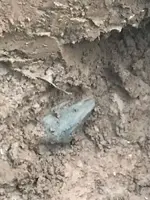
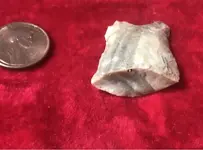
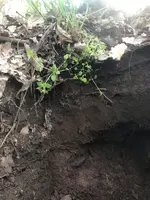
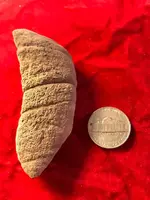
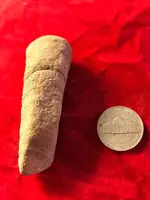
Found this today. It was floating in the dirt with a few flakes. As you can see not a particularly rocky spot.
ImageUploadedByTreasureNet.com1587005170.932962.webp
ImageUploadedByTreasureNet.com1587005196.752987.webp

I find lots of flakes and a handful of tools in that hole. So it’s definitely AMONG native artifacts, early archaic by my best guess. It is unlike the flat tabular sandstone, weathered and heated limestone and occasional chert river gravel that also comes up occasionally.
ImageUploadedByTreasureNet.com1587005488.369345.webp
ImageUploadedByTreasureNet.com1587005525.407022.webp
ImageUploadedByTreasureNet.com1587005555.175580.webp
ImageUploadedByTreasureNet.com1587005585.197683.webp
ImageUploadedByTreasureNet.com1587005616.198023.webp

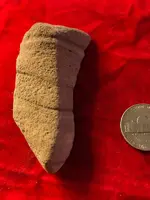
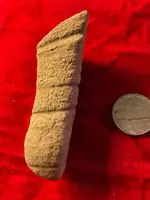
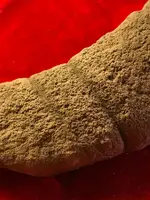
It’s got 3 bands going all the way around. I don’t see layers like differential weathering. It almost looks plummet like but it’s suspect it probably natural. Still I’ve never seen anything like it so could it just maybe be something?
 
Upvote 0
I vote natural. All of us would checked it out too.
 
I agree with newman man, natural.

Interesting lines. It looks like limestone to me.
 
Probably is natural but I’m having trouble coming up with how those lines would form... but same for a human use, not sure what purpose they would serve. Oh well woulda been great if someone recognized it as something but I guess it will go into the “Mother Nature does crazy things” category
 
I would theorize that as a sedimentary rock as the layers were put down that layer which now appears as a 'ring' or groove had some other mineral in the sedimentary makeup that has weathered out at a different rate over the thousands of years since it separated from the larger sedimentary layer and was encapsulated in the organic composition - dirt,clay and whatever.
 
I would theorize that as a sedimentary rock as the layers were put down that layer which now appears as a 'ring' or groove had some other mineral in the sedimentary makeup that has weathered out at a different rate over the thousands of years since it separated from the larger sedimentary layer and was encapsulated in the organic composition - dirt,clay and whatever.

Yes, this.
 
Natural, agree with dognose, if you look at the rings closely there is no sign of it being caused by man
 
I had ruled that out because the rock seems totally uniform but I suppose it could be something less obvious like a change in chemical composition I guess. But regardless I agree it’s probably natural but given the location it was worth looking into. Thanks to all for looking
 
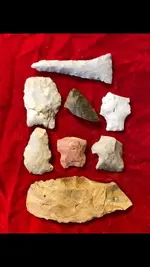
I think I’ve posted before but here are the tools from the same spot, still looking for a full one. But from the semi limited I’d, seems to be early archaic.

ImageUploadedByTreasureNet.com1587089193.247395.webp
ImageUploadedByTreasureNet.com1587089404.956481.webp
 

Users who are viewing this thread

Latest Discussions

Back
Top Bottom