63bkpkr
Silver Member
- Joined
- Aug 9, 2007
- Messages
- 4,078
- Reaction score
- 4,630
- Golden Thread
- 0
- Location
- Southern California
- Detector(s) used
- XLT, GMT, 6000D Coinmaster
- Primary Interest:
- All Treasure Hunting
- #1
Thread Owner
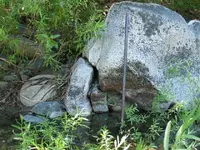
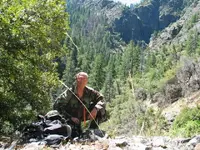
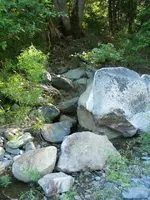
I've been working a site in the Sierras here in California, its just a bank side along a river with lots of boulders and is shown in the following picture.
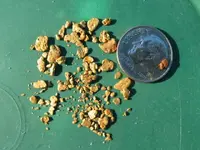
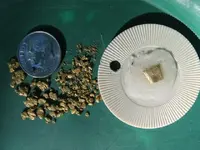
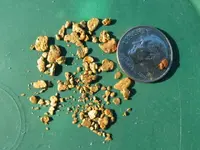
The first time there I'd just barely prepared the site for prospecting before I had to leave. I would collect a bucket of material, presort the heavies and fines, lay each out on the "beach" and checked them with a Whites GMT and when the machine beeped I panned that pile. Here is what I got the first time I was there, the GMT never missed or was wrong as I checked some no beep piles. Notice the likely 45 caliber slug and the smaller maybe 25 caliber slug along with the rocks which are all magnetic rocks. If lead of this size has settled here then possibly larger gold pieces would also have settled here.
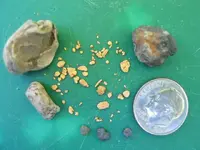
The second time there I could not bring the detector so I gathered the material, presorted and panned the heavies first as they go faster and then the fines which takes longer as there is just more of it and I'm slower at the fines. I was getting into a more productive section of the site as can be seen in the next picture of the amount I collected on the second time.
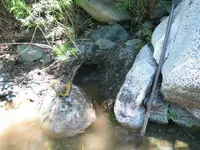
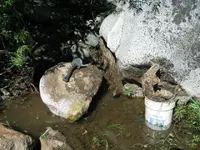
Presorting and panning were taking far too long especially as for panning I usually sit in the water as this is easier on my back but the water is 54 degrees F and with the weather cooling so I wanted to speed up the process. I bought and carried in a Keen A52 sluice. I prepared a location in the river by stacking rocks in a "V" pattern to help funnel the water into the flume at the top of the sluice. I then palyed with the angle of the sluice for the volume of water I had at that time. My first test was a fines pile that the GMT had said to sort but I'd not done it yet. The GMT was right as there was gold there and some nice gold at that, more flat nuggets. Alas, I've not had time to take pictures of the results of the third trip but there's more than from the second trip and the first trip combined.
So now we come to my question for all of you - Seeing the type of gold I'm going for, flat nuggets along with smaller to fine pieces, is the Keen sluice the best unit for this type of gold? Why I ask this question is that during the third trip, early one morning I started with a cleanup bucket of the material on the "floor" of the trench I had dug. After several scoops of roughly sorted material, the large stones had been removed, the riffles were starting to fill up and as I was about to dump another scoop I noticed a nice 1/4" diameter flat nugget had come to rest just before the black matting. I was trying to decide to dump the scoop or put the scoop back and do something about the nugget when the current fluctuated in the sluice and the nugget shot out the end of the sluice. I decreased the angle of the sluice but the riffles filled up even faster. I went to a more severe presorting method, taxing may back, but the riffles still filled up quickly which meant I was doing more sluice cleanups than I wanted or liked to do. So, am I using the right type of sluice? Am I doing something wrong to cause the riffles to fill up quickly with fines and lighter material (the big rocks just roll right on through the sluice even at the reduced angle)? I am NEW to the sluicing process and really do not know for sure how to properly work with a sluice, the current, the angle and other variables that I've not even thought of. I would appreciate your help and experience.
Thank you ahead of time for your assistance. Regards, 63bkpkr
The first time there I'd just barely prepared the site for prospecting before I had to leave. I would collect a bucket of material, presort the heavies and fines, lay each out on the "beach" and checked them with a Whites GMT and when the machine beeped I panned that pile. Here is what I got the first time I was there, the GMT never missed or was wrong as I checked some no beep piles
. Notice the likely 45 caliber slug and the smaller maybe 25 caliber slug along with the rocks which are all magnetic rocks. If lead of this size has settled here then possibly larger gold pieces would also have settled here.The second time there I could not bring the detector so I gathered the material, presorted and panned the heavies first as they go faster and then the fines which takes longer as there is just more of it and I'm slower at the fines. I was getting into a more productive section of the site as can be seen in the next picture of the amount I collected on the second time.
Presorting and panning were taking far too long especially as for panning I usually sit in the water as this is easier on my back but the water is 54 degrees F and with the weather cooling so I wanted to speed up the process. I bought and carried in a Keen A52 sluice. I prepared a location in the river by stacking rocks in a "V" pattern to help funnel the water into the flume at the top of the sluice. I then palyed with the angle of the sluice for the volume of water I had at that time. My first test was a fines pile that the GMT had said to sort but I'd not done it yet. The GMT was right as there was gold there and some nice gold at that, more flat nuggets. Alas, I've not had time to take pictures of the results of the third trip but there's more than from the second trip and the first trip combined.
So now we come to my question for all of you - Seeing the type of gold I'm going for, flat nuggets along with smaller to fine pieces, is the Keen sluice the best unit for this type of gold? Why I ask this question is that during the third trip, early one morning I started with a cleanup bucket of the material on the "floor" of the trench I had dug. After several scoops of roughly sorted material, the large stones had been removed, the riffles were starting to fill up and as I was about to dump another scoop I noticed a nice 1/4" diameter flat nugget had come to rest just before the black matting. I was trying to decide to dump the scoop or put the scoop back and do something about the nugget when the current fluctuated in the sluice and the nugget shot out the end of the sluice. I decreased the angle of the sluice but the riffles filled up even faster. I went to a more severe presorting method, taxing may back, but the riffles still filled up quickly which meant I was doing more sluice cleanups than I wanted or liked to do. So, am I using the right type of sluice? Am I doing something wrong to cause the riffles to fill up quickly with fines and lighter material (the big rocks just roll right on through the sluice even at the reduced angle)? I am NEW to the sluicing process and really do not know for sure how to properly work with a sluice, the current, the angle and other variables that I've not even thought of. I would appreciate your help and experience.
Thank you ahead of time for your assistance. Regards, 63bkpkr
 ?) So if I could get the water stopped or at least drained I might be able to work the floor. But first, what sluice is best and or how to use the A52 properly.

 i have the same sluice you do and it is very modified so i dont have to spend the time bucket classifying...and to make sure it catches the flood gold so prevelant in the overbuden in the local streams and rivers...........way to sample with the GMT i had one on loan for a while very close to my gm4 i miss the follow the black sand feature though. keep it up...your recovering more than most.
 .... once i start finding targets i"ll adjust my settings several different ways, mainly gain and vsat, locally i can rarely run my vsat on its lowest setting. if i run my vsat all the way i can up my gain a bit but, its usually at 4 or i get alot of ground noise alot of iron mineralization here.after any hunt i walk back out to my car with my gain up at like seven and vsat all the way walking and scanning pretty fast and i still find targets mostly pretty shallow though. i found a spot that where some one had been plinkink with a .22 that way i'd found the bullets 50 yrds down hill and on my way out i hit where whoever was standing and shooting cause i found a patch of .22 cases......so if vsat up loses some depth does the increase in gain with higher vsat gain alittle bit of that depth back?
 i dont want to steal the original thread as my main source of gold is sniping and sluicing, i just rarely get informative responses in my md posts so thanx for that
  one last thing i would love to find a copy of ZIP ZIP never even seen one....who has experience with a bigfoot coil or sierra max?
  ..... done sidetrackin now.