What's new

How to make a FLUID BED SLUICE that can be used in the stream and also with pumped in water.

DIDDLER

Greenie
Joined
Jun 8, 2025
Messages
12
Reaction score
24
Golden Thread
0
The sluice can be 24" long and 8" wide, OR ??? dimensions. Ease of Portability is a concern. The TRAP should be easily removable for cleaning or the entire sluice easy to clean out. Dimension drawings or pictures showing all parts are necessary.

The material of choice is aluminum (AL). The AL can be formed by bending, welding or soldering. PVC plumbing tubing with fittings work well for the plumbing in the Trap. The PVC tubing in the Trap can be sealed with JB Weld or other glue systems.

I hope that some of experienced gold prospectors who have made and are using their proven, efficient wet sluice, respond to this call for help.

I am a newbie to Gold Panning and also enjoys building the accessories that make gold prospecting possible. I live in Iowa where the gold size approaches the size of a single gold atom. On my first trip, the gold showed in sun light mixed with black sand, sniffed it out, couldn't find it in the bottle. I made a black sand separator with 6 powerful magnets. The black sand piles up on the magnets. Use a Brass wire brush to remove the black sand from the magnets. I made a Punch Plate Classifier that fits into a 5 gal. Pickle pail. A Poop Tube Sluice using Miners Moss and a chammy to catch gold and the Hand Dredge, with Gold-n-Sand valves. The Poop Tube Sluice will be mounted in a floating deer toboggan and the Hand Dredge will pump the creek bottom into the sluice. ??ARE WE HAVING FUN YET??
 
How to make a FLUID BED SLUICE that can be used in the stream and also with pumped in water.
tn_moved_over.gif
I moved ya from NEW MEMBER INTRODUCTIONS over to GOLD PROSPECTING FORUM > SLUICING for more exposure.

tn_notice.gif
NOTE: Forum NEW MEMBER INSTRODUCTIONS Description: New to TreasureNet? Introduce yourself to our community here! Welcome aboard and Happy Hunting!
 
Just thinking?? Has anyone designed or built a centrifugal sluice? With the correct rim design, the heavies should be captured and the lighter stuff thrown out of the spinning sluice. I see some spin the water to have the heavies climb up a center cone into a cup.

I am deep into building a Wet Sluice out of aluminum. The sluice can be used in a stream as well with a closed pump system. I am using aluminum braze to connect the pieces. The first build is the Trap. With the closed pump in mind, the normally blocked tubes will be connected together with a Ball Valve shut off. Connect the system to a pump, open the ball valve, plug off the stream intake end of the tubes and the system is thus converted from stream to closed pump system. This design for stream use will feature opening large Wings for the top side as well as opening large wings for the bottom that feeds the 3 tubes in the trap. It is hoped that if the stream lacks enough power to operate the sluice, opening the wings will greatly increase the flow/pressure both on the top and at the trap and the sluice will operate. If that fails, set the sluice to operate with a closed system, then feed in the material.

When finished, I will take pictures/post what I have built. The acid test will be running paydirt I purchased. .
 
Just thinking?? Has anyone designed or built a centrifugal sluice? With the correct rim design, the heavies should be captured and the lighter stuff thrown out of the spinning sluice. I see some spin the water to have the heavies climb up a center cone into a cup.

I am deep into building a Wet Sluice out of aluminum. The sluice can be used in a stream as well with a closed pump system. I am using aluminum braze to connect the pieces. The first build is the Trap. With the closed pump in mind, the normally blocked tubes will be connected together with a Ball Valve shut off. Connect the system to a pump, open the ball valve, plug off the stream intake end of the tubes and the system is thus converted from stream to closed pump system. This design for stream use will feature opening large Wings for the top side as well as opening large wings for the bottom that feeds the 3 tubes in the trap. It is hoped that if the stream lacks enough power to operate the sluice, opening the wings will greatly increase the flow/pressure both on the top and at the trap and the sluice will operate. If that fails, set the sluice to operate with a closed system, then feed in the material.

When finished, I will take pictures/post what I have built. The acid test will be running paydirt I purchased. .
Let us know how the sluice box works out. Some photos would help people follow what you are building.
 
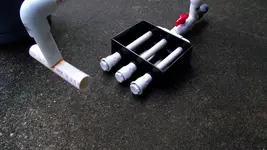
Wet sluice status report. The Trap is built 8"x6"x2.5" out of 1/8" thick aluminum. The pieces were Aluminum Brazed. Learning curve for aluminum brazing. The thicker the aluminum is, the harder it is to braze. First file a bevel on the sides to be brazed. Then, use a stainless steel wire brush and scrub then bevel and surrounding area. Tin the bevels on all the pieces. Jig the pieces together. Tack braze each piece in two spots per joint. After everything looks good, braze all the joints. When the braze stick melts, rub the stick in the seam to make a nice fillet.

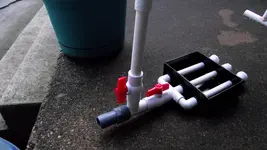
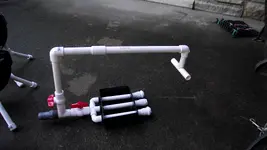
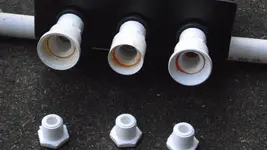
The Trap is designed to be driven by a pump or in a stream. Pump driven, the water enters the sluice thru the gray 1- 1/4" hoes fitting. There are two ball valves, see the red handle valves. The valve on the vertical pipe controls the water flow to wash the material into the screen and Trap. The horizontal valve controls the water flow into the three tubes. In this mode, the opposite end of the tubes are plugged with threaded in plugs. For stream use, the pumped in water intake tubing is removed.
The three plugs are removed and then horizontal valve is closed.

The plan for stream flow is to make the top have opening wings to direct water into the top to the screen and Trap. From reading the forum, the bottom will have large wings to gather more water. The water entry into the three tubes has a flared opening to gather more water.
 

Attachments

  • DSCF2449.webp
    DSCF2449.webp
    756 KB · Views: 90
  • DSCF2447.webp
    DSCF2447.webp
    573.5 KB · Views: 84
  • DSCF2433.webp
    DSCF2433.webp
    637.5 KB · Views: 93
  • DSCF2444.webp
    DSCF2444.webp
    406.5 KB · Views: 105
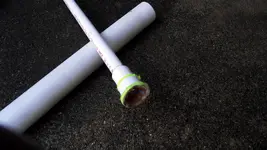
A better piston seal idea. The seal is a disk cut from a tennis ball. To make it work the following assy. is required. Take the Cap, drill a 1/4" hole and JB Weld a SS screw in the cap. the screw must be long enough to complete the assy. Take a nest size up Cap and drill a 1/4"hole. Take the tennis ball seal that is larger than the tube ID and push it onto the protruding screw. Tighten the nut and observe that the tennis ball seal is being pulled into the end cap. Tighten the screw until the seal is sufficiently cupped to slide easily in the tube, check for light leaks open seal/nut enough to close off the light. At this point, the ball's fuzz is riding on the tube's ID.
 

Attachments

  • DSCF2436.webp
    DSCF2436.webp
    804.3 KB · Views: 90
The bottom of a fluid bed doesn’t need a ton of water. The more the better on the top deck. I love fluid beds and run a Grizzly Goldtrap now. They aren’t made any longer so I can’t tell you how to find one. For your work building one, I can warn you that getting a fluidbed to catch fly poop gold consistently takes a lot of prototype testing…like a LOT!
 
I just built one for my subbie. Start on post #35. There is a thread on here somewhere that is pages and pages long discussion fluid beds that may be helpful.
 
Just thinking?? Has anyone designed or built a centrifugal sluice? With the correct rim design, the heavies should be captured and the lighter stuff thrown out of the spinning sluice. I see some spin the water to have the heavies climb up a center cone into a cup.

Like a Knelson concentrator? Basically a centrifugal sluice with hydraulic riffles.

When finished, I will take pictures/post what I have built. The acid test will be running paydirt I purchased. .

I have been looking at gold analogues to run instead of paydirt for testing such stuff and have recently discovered the existence of carbide bearings. Available from 0.3mm up and with a density of 15, they are as close to gold as you can get without spending serious dollars.

So you can buy a few thousand bearings of various sizes for a handful of dollars and use that instead of gold just for initial trials.

Yes, it's not as dense as gold, but it's close. Yes, they are spheres rather than odd shapes, but that allows them to be recovered from the test material with a cheap miller table (used in reverse) or standard classifiers. And what's more, the cheap carbide contains nickel which is slightly magnetic so could even be recovered with magnets.

Instead of working with dozens of bits of gold to test with, you could work with thousands of particles instead.
 

Users who are viewing this thread

Back
Top Bottom