What's new

Wellfleet Bay side beach find

'fleetian

Tenderfoot
Joined
Jan 5, 2019
Messages
7
Reaction score
19
Golden Thread
0
Location
Cape Cod
Primary Interest:
Beach & Shallow Water Hunting
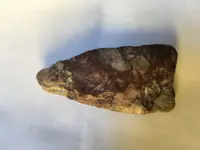
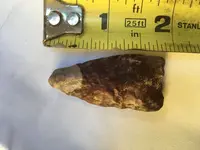
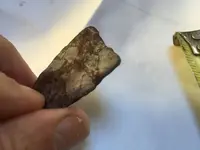
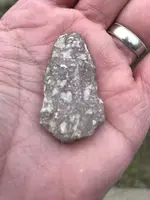
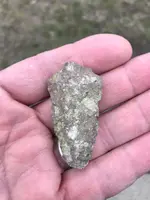
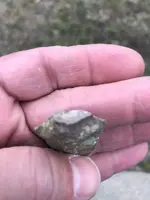
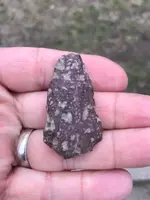
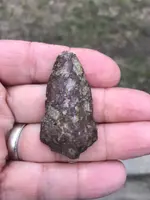
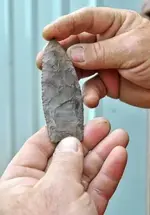
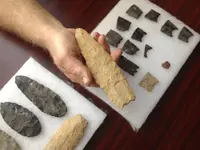
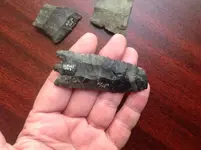
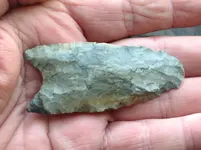
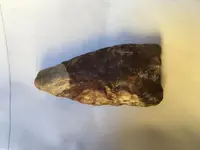
New here today. While collecting rocks for my garden on New Year's Day I found this point sitting on top of the sand at the bottom of an eroding coastal dune. A fun find and good luck, I thought.

I applied a thin coat of Renaissance wax to improve clarity. I suspect the stone is jasper but not conclusive. Cape Cod has a jumble of every kind of rock due to glacial formation, not to mention possible trade or travel between individual natives so I am left to speculate on where the stone is from geologically speaking.

I would appreciate any insight as to its era, age, or any other comments.

Thank you!
IMG_0805.webpIMG_0806.webpIMG_0808.webpIMG_0809.webp
 
Upvote 0
If you just go by the shape alone, it can be a Fox Creek Lanceolate, which is Middle Woodland.

I think Charles is spot on here. The Atlantic and New England states have a lot of lanceolate forms that aren't nearly as old as they look if you are used to seeing points from elsewhere.
 
Welcome to the forum!

I’ve seen this material and have found an artifact made of the same lithic in Bristol County. So I’ll address that first.

The material is a soft chalky rhyolite with very large whitish phenocrysts. It was probably ok for knapping, but not very durable. As it weathers very poorly. Which is why your triangle is getting a variety of identifications.
This is the piece (broken stemmed point) I found in Freetown, MA a few years ago:ImageUploadedByTreasureNet.com1555079434.171045.webpImageUploadedByTreasureNet.com1555079447.550061.webpImageUploadedByTreasureNet.com1555079460.487065.webpImageUploadedByTreasureNet.com1555079469.768999.webpImageUploadedByTreasureNet.com1555079479.671340.webp
I’ve never heard of rubbing an artifact with wax to bring out its color, but here’s the same piece with a little water on it: ImageUploadedByTreasureNet.com1555079767.706679.webpImageUploadedByTreasureNet.com1555079777.674863.webp
Now, concerning typology and age. We would have to know the type to get to the age. And, there’s the rub. I don’t think you will get a consensus based on the condition of the point.
It is too thick and chunky to be a Madison; and there are not enough familiar features to call it anything other than a weathered point.
It is an NA artifact. It is possibly a small knife (age is not attainable), a pre-form or unfinished spear point (possibly Archaic)

No one can state that it is likely a paleo piece.
 
Last edited:
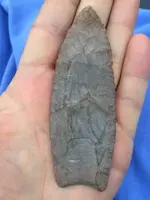
Nice point. Hard to tell from the pics, but looks like it could be fluted. They have definitely been found in NE. Here's mine from Northampton, MA.
clovis2.webp
 
Nice point. Hard to tell from the pics, but looks like it could be fluted. They have definitely been found in NE. Here's mine from Northampton, MA.
View attachment 1702951

Hi there Oxbow,
That’s quite a find. Was it dug? It’s hard to tell if that is a red stain on the tip, or if it’s part of the lithic.
Can you post more pictures?
We’d love to hear the background story of that Clovis.
 
Hi there Oxbow,
That’s quite a find. Was it dug? It’s hard to tell if that is a red stain on the tip, or if it’s part of the lithic.
Can you post more pictures?
We’d love to hear the background story of that Clovis.

It was a surface find. It's a pretty well known artifact at this point. Here's a link to a brief paper I wrote on it and the site: http://asaa-persimmonpress.com/doc/Evidence-Early-Clovis-Occupation-Middle-Connecticut-River.pdf

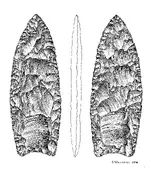
Ink Drawing-page-0.webp Steve Wallman's drawing of the point.

IMG_4018.webpDr. Gramly and I giving the point to the landowner.

clovis7.webp
 
Congratulations Oxbow! That is the rare surface find of a lifetime! And deserves it’s own post. And, that one is definitely fluted. There is excellent information in your article as well. Very interesting.
 
I was most fortunate to see oxbowbarefoot's incredible Clovis a few years back at our New England ASAA Meeting at the South Shore Science Center, in Norwell, Ma. To say Dr. Gramly was excited that day is an understatement. And BTW, the public is always welcome. Our next meeting will be in June.

I took this photo at our ASAA Meeting this past Saturday. The largest fluted point was excavated and found in two pieces, broken by farm equipment driving over its buried location. Unfinished, it is still the largest fluted point known from New England. These points are a bit later then the true Clovis oxbowbarefoot found:

IMG_2727.webp

Some photos of that large fluted point from Sugarloaf, taken at an earlier ASAA Meeting, and another fluted point from Sugarloaf with the channel flake reattached:

IMG_2724.webp

IMG_2725.webp

IMG_2726.webp

From my own collection, another post-Clovis fluted point, also Normanskill chert, and from the North River, Plymouth Co., Ma:

IMG_2723.webp
 
nice find.

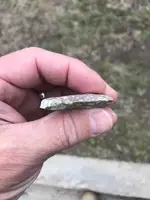
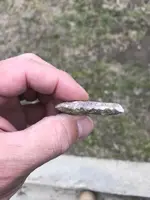
Can you show a few side profile images of it please? One from the rear so the cross section could be determined?


I looks to me like a stemmed point, used up and worn down to the stem.
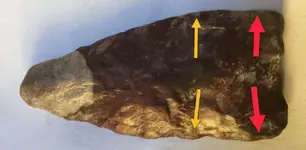
The yellow arrow point to the end of the stem area. Is there any grinding on the basal area where the arrows are pointing, more smooth than what the rest of the relic looks like.
2019-04-17_5-36-00.webp
 
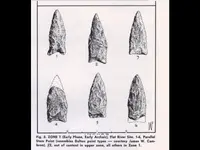
Here is a point type from southern New England, which, until relatively recently, had never been found in a dated context. And never received a type name. It has simply been called Parallel Stem by collectors and archaeologists alike. And presumed to be Early Archaic. But, in 1999, an example was found at the Sandy Hill Site, located on the Mashantucket Pequot Reservation in southeastern Ct, and with associated dates.

My friend and colleague, the late Jeff Boudreau, whose expanded New England typology guide, has become the typology bible for New England collectors(and most unfortunetly, is no longer available for purchase) suggested that Sandy Hill would be a logical type name for this point. This old illustration by William Fowler, shows a series of Parrallel Stem points from a site excavated in the 1950's by the old Narragansett Archaeological Society. At the Sandy Hill Site in Ct., the associated dates for this point type ranged from 9300-8500 BP.

To date, no type name has been erected, but the dates from Sandy Hill suggest Early Archaic.

IMG_2732.webp
 
Fleetian,

This point seems determined to be identified.

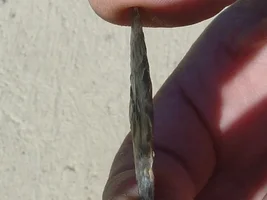
Can we see some photos of the point straight on, looking at the tip and of the sides to see its thickness and shape from a different angle?

Also, could we get a shot from the bottom?
 
Last edited:
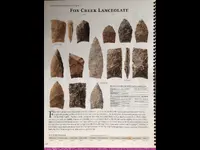
This thread dates from the beginning of January, 2019, so the OP may not be aware his point is still eliciting comments. Here are some New England Fox Creek Lanceolates, for comparison to the older type called Parallel Stem....

IMG_2737.webp

Although I originally suggested Fox Creek, they tend to be wider then the type we still call Parallel Stem. Unfortunetly, when there is an overlap in form, and the point is a surface find, and not excavated in a controlled dig, with at least relative context, it can be difficult to know for sure. These are just the limitations inherent in surface finds, and the finder is in the best position to know the nature of, and the type of points found at, the site in question.

Folks sometimes think typing surface finds is relatively easy. Well, sometimes it is. But, when you consider the limitations of typing points out of a datable context, and add in things like resharpening, or blade attrition, which can alter the "idealized form", it can get dicier. When a collector knows a site like the back of his/her hand, that can be the advantage needed to make the best educated guess. I created an online guide elsewhere in the forum universe, and I made mistakes. Typing is a lot harder then it may seem at first. After all, no two points are exactly alike.
 
Last edited:

Users who are viewing this thread

Latest Discussions

Back
Top Bottom