LL
"Could you imagine in your wildest dreams a receiver coil that conducts (not radiates) electrons inducing multiple frequencies through a SINGLE winding of copper wire around an axis?"
Well your wildest dreams have come true, some 100 hundred years ago of course. Audio transformers, both of the auto-transformer and isolation types conduct multiple frequencies at the same time. As well as the voice coils of typical loudspeakers & headphones in use today.
Which brings me to my next point. FBS & BBS are NOT frequency domain detectors, they are time domain detectors. All of these posts about multiple oscillators, and multiple receive circuits, is trying to take old "simple" single frequency knowledge base and apply it to time domain processing. It's NOT about frequency, it's about the inverse of frequency, time.
As clearly stated in this white paper:
http://www.minelab.com/consumer/xstandard/files/ML_08_007WhitePaper8.pdf
"Multi-frequency transmitting and receiving metal detectors have a signifi cant advantage in time constant discrimination, and to some extent ferrous discrimination capability, over the most common form of detector, the VLF detector. “VLF” stands for Very Low Frequency, and refers to the frequency of the single-frequency sine-waves that they transmit, usually at high pitched audio frequencies.
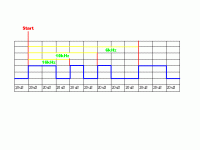
There are basically 2 types of “multi-frequency” detectors currently available for coin detection. Some transmit square waves, which is effectively a multi-frequency transmission. Minelab’s Sovereign, Excalibur and Explorer units use a
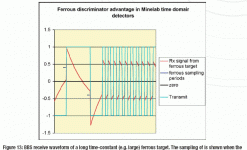
more advanced transmit signal consisting of multi-period rectangular waves, which gives more useful information (more frequencies, in effect) than square waves. The major advantage results from having several different frequency R signals. These can be used to more accurately determine time constants of targets because these different frequency R signals are not contaminated by soil mineralisation X signals, unlike the more common VLF detectors which use R and the mineralisation contaminated X channel to determine the target time constant. In essence, targets with short time constants produce larger high frequency R signals than low frequency R signals, whereas with long time constant targets, the low frequency R signals are larger than the high frequency R signals. Thus, the ratio of the low frequency R component to the high frequency R component gives a measure of the target time constant without interference from the large soil X component. In addition, it is possible to extract a better assessment of the ferrous/non-ferrous nature of a target using multi-period rectangular waves by measuring X when this target component is maximized during a particular period of the multi-period rectangular signal. No equivalent such period occurs in a VLF system. See Chapter 2.9 for more information on Minelab’s BBS and FBS ferrous target processing. This results in greater accuracy of
discrimination at greater depths."
And further:
"As stated, these metal detectors produce many transmit frequencies simultaneously (see fi gure 3). Thus, it is easy to extract high frequency, medium and low frequency components for accurate target time constant discrimination (see 1.1.3)."
Square wave transmission and processing provides a given number of odd harmonics as can be seen here:
http://www.allaboutcircuits.com/vol_2/chpt_7/2.html
Bruce Candy expanded on that capability by using multi-period rectangular waves. Therefore using a frequency domain instrument such as an oscilloscope you "could" measure the time from one rising edge to another of the various rectangular waves being transmitted, and via 1/T derive a frequency. And because there are multi-period rectangular waves you could come up with various "frequencies". But all of this misses the true nature of of how this detection system works. And those who know better are trying to obfuscate how this technology works by stating it only operates on certain frequencies.
It is more of a hybrid system that doesn't fit neatly into either category, a messy marrying of VLF and PI. It is like a PI system that doesn't need to turn off the transmit signal in order to make a measurement. And on top of that it is like a hybrid PI system that simultaneously transmits and processes pulses of various widths at the same time to better identify high & low conductivity targets. But PI's for the most part look at decay times, they haven't to this point been able to extract accurate identification information.
Bottom line, for years reading multiple forums, this system correctly identifies targets at depth in difficult soil better than any other consumer based detector technology available. The reported finds speak for themselves and it's why Explorers/E-tracs command the price they do. The market confirms that this technology is worth the price being paid for it. Otherwise they would sit in the warehouses and stop being manufactured.
MajorBeep