What's new

1752 Spanish Cob!

West Jersey Detecting

Gold Member
Joined
Oct 23, 2006
Messages
5,249
Reaction score
1,119
Golden Thread
1
Location
Philadelphia Area
🥇 Banner finds
1
Detector(s) used
Nokta Legend, Excalibur 1000/II (hybrid) , Teknetics T2 SE
Primary Interest:
Other
I don't post much, but I still read the posts here on a regular basis and still get out when I can.

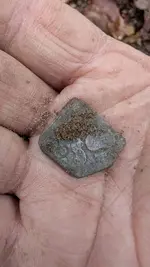
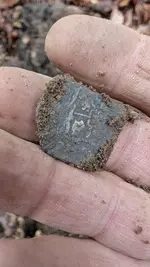
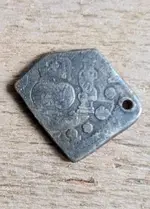
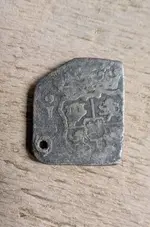
Last weekend I hit a well known detecting spot here in New Jersey, swinging my Minelab Manticore with the M15 coil. There aren't many signals, so I lowered the recovery speed down to 4 and raised the sensitivity up to 26 or 27 and put her in all metal mode using the high conductors setting. I dug the usual amounts of shotgun shells, but some of the the deep signals that sounded like shotgun shells turned out to be tombac buttons, thimbles and the usual stuff. After a few hours in the thorns and brambles I got a faint but repeatable chirp reading 91 at maximum depth, with the circular dot right on the center line of the Manticore. I dug an 8 or 9 inch plug, but there was nothing in the plug and the Garrett Carrot didn't pick up anything in the hole. I dug a bit deeper and still nothing in the plug, but the pinpointer picked up a strong, small target in the bottom corner of the hole, about 11 or 12 inches down. I took out the Lesche and carefully dug a small plug around the target. I pulled the rectangular metal piece from the hole and for a split second, based on its weight thought I had a piece of lead. Then I saw the castle and lion and it hit me!

I've identified this as a 1752 2 reale (6.38 grams) from the Guatemala mint (KM-10), which has been confirmed by an expert in Spanish colonials. Some doubters said it was a cut piece, but apparently these are actually stamped cobs, despite the nearly perfect rectangular shape.

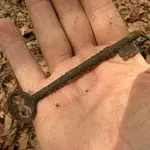
The key was a nice bonus!
 

Attachments

  • 682057712_18586342834058129_4276439812904194209_n.webp
    682057712_18586342834058129_4276439812904194209_n.webp
    138.1 KB · Views: 168
  • 680473416_10165181367679878_5762804968802344912_n.webp
    680473416_10165181367679878_5762804968802344912_n.webp
    135.8 KB · Views: 95
  • 680767714_10165175941394878_7586628911194606941_n.webp
    680767714_10165175941394878_7586628911194606941_n.webp
    139.1 KB · Views: 110
  • 679842649_10165176929349878_7720059829320891999_n.webp
    679842649_10165176929349878_7720059829320891999_n.webp
    284.1 KB · Views: 110
  • 680289129_10165176929179878_2033643832334707606_n.webp
    680289129_10165176929179878_2033643832334707606_n.webp
    204.6 KB · Views: 109
Upvote 32
"Some doubters said it was a cut piece, but apparently these are actually stamped cobs, despite the nearly perfect rectangular shape...."

For clarity's sake, a bit of info on these Guatemalan cobs, struck between 1733 - 1753. The blanks were hand cut, weighed, & trimmed from bars, & the design was hand-struck onto the coins, just as other Spanish cobs. The design on these Guatemalan cobs is the same design used on the machine milled Mexico City coins, starting in 1732. (Mexico city also struck some cobs in 1732-1733. After 1733, Mexico city mint only made machine milled coins. Lima, Peru, & Potosi, (Bolivia) continued cob production. The last Lima cob was struck in 1752. the last Potosi cob was struck in 1733.)
 
Very neat! Few people ever find anything like this. By 1752 Spain was becoming weak compared to how it had been in the 16th and 17th centuries. The British had attained a permenant foothold in the Caribbean when they captured Jamaica in 1655, 97 years prior to your coin. That spelled the end of Spanish/Portuguese hegemony in the New World.

By the mid-18th century raiding Spanish treasure ships was no longer the main objective of the British presence in the New World (as it had been in the time of Sir Walter Raleigh or Francis Drake in the 16th century) but it was certainly something they did, especially during times of war with Spain (which was often).

In 1743, just 9 years before your coin was struck, British Commodore George Anson attacked a Spanish treasure galleon en route to Manilla in the Pacific. It was the Nuestra Señora de Covadonga carrying over 1 million silver Peices of 8 and several thousand gold 8-escudo coins (the famed Spanish gold duobloons of legend).

The Commodore returned to England with this treasure and it was paraded through London, requiring several DOZEN wagons to carry it all to the royal mint. The treasure was melted down and recast into British coins. These coins were stamped "LIMA" to show they were made of metal stolen from Spain (Lima in Spanish-controled Peru is where the treasure came from).

By 1752 your silver coin would have been circulating in the colonies and potentially internationally alongside these coins. It was still the age of swashbuckling adventure on the high seas, but this time, wouldn't last much longer. The modern age was rapidly approaching. Less than 70 years later the age of the steam ships would begin, and the old pirate stories would fade into legend.

The fact we can still find artifacts from this distant time of adventure, such as you have demonstrated with this silver coin, is proof that the history isn't just legend. It did happen, and the treasures are still out there, waiting to continue their story into the present.
 
And that’s where the term “cob” comes from. Cut Off Bar. That’s what I was told at least. Is that true?
Todd, that's one explanation, & makes sense, but, it's not really known for certain why the term "cob" was applied to these coins. Another explanation, also sensible, is that the term is taken from the Old English term "cob", meaning 'a small bit of', or, 'a small piece of' (something larger)
Very neat! Few people ever find anything like this. By 1752 Spain was becoming weak compared to how it had been in the 16th and 17th centuries. The British had attained a permenant foothold in the Caribbean when they captured Jamaica in 1655, 97 years prior to your coin. That spelled the end of Spanish/Portuguese hegemony in the New World.

By the mid-18th century raiding Spanish treasure ships was no longer the main objective of the British presence in the New World (as it had been in the time of Sir Walter Raleigh or Francis Drake in the 16th century) but it was certainly something they did, especially during times of war with Spain (which was often).

In 1743, just 9 years before your coin was struck, British Commodore George Anson attacked a Spanish treasure galleon en route to Manilla in the Pacific. It was the Nuestra Señora de Covadonga carrying over 1 million silver Peices of 8 and several thousand gold 8-escudo coins (the famed Spanish gold duobloons of legend).

The Commodore returned to England with this treasure and it was paraded through London, requiring several DOZEN wagons to carry it all to the royal mint. The treasure was melted down and recast into British coins. These coins were stamped "LIMA" to show they were made of metal stolen from Spain (Lima in Spanish-controled Peru is where the treasure came from).

By 1752 your silver coin would have been circulating in the colonies and potentially internationally alongside these coins. It was still the age of swashbuckling adventure on the high seas, but this time, wouldn't last much longer. The modern age was rapidly approaching. Less than 70 years later the age of the steam ships would begin, and the old pirate stories would fade into legend.

The fact we can still find artifacts from this distant time of adventure, such as you have demonstrated with this silver coin, is proof that the history isn't just legend. It did happen, and the treasures are still out there, waiting to continue their story into the present.
Here's a picture of a British one schilling made from Commodore Anson's plunder of the Covadonga ... Note that "LIMA" is prominently stamped under Geo II's portrait ...
1745-lima-shilling-o-510x510.webp

.
 
And that’s where the term “cob” comes from. Cut Off Bar. That’s what I was told at least. Is that true?
Here's what I have read but no one really knows for certain it seems...

"Some experts believe (and there is some debate), that the word “cob” comes from the Spanish phrase “cabo de barra,” which means “end of the bar” – referring to the piece clipped off the end of a crudely poured silver or gold bar or strap."

 
If you want to see some cobs available today, here's a link to Dan Sedwick's Treasure Auction #40, starting NOV 5, 2026 ... https://sedwickcoins.com/pages/upcoming-auction ... Dan also has his past auctions, with prices realized, at this link : ... https://auction.sedwickcoins.com/auctionlist.aspx?dv=2 ... some pretty cool stuff is up for "grabs" ... but, you may need to rob a bank first .. lol ... while you're at it, visit his complete site ... https://sedwickcoins.com/ ... some good info there ... I get nothing for this promotion ... I've delt with Dan since 1996 ... honest guy, a world-recognized specialist in Spanish coinage / history ...
 
That's a really nice find we don't see every day, and you've also given a perfect description of finding a good target with the Manticore. All the classic indicators were there that you were digging something really good, leading you to be careful with that last plug around the deep target. You made a great recovery at that depth without scratching it, and I think the recovery might be more impressive than the actual coin. Thanks for sharing the story!
 

Users who are viewing this thread

Latest Discussions

Back
Top Bottom