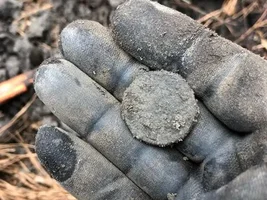
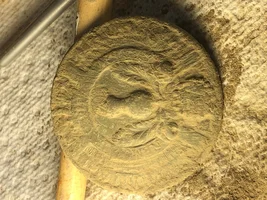
I know that people really like to think of the Civil War as being an 1861-1865 event, and in a way it was.
But, the Federal army stayed after the war for the period known as Reconstruction. This was also a very interesting time, and I wonder how many of the "post Civil War" military artifacts found in the South might actually be from that period.
"Military reconstruction
With the Radicals in control, Congress passed the Reconstruction Acts in 1867. The first Reconstruction Act placed ten Confederate states under military control, grouping them into five military districts:[40]
* First Military District: Virginia, under General John Schofield
* Second Military District: The Carolinas, under General Daniel Sickles
* Third Military District: Georgia, Alabama and Florida, under General John Pope
* Fourth Military District: Arkansas and Mississippi, under General Edward Ord
* Fifth Military District: Texas and Louisiana, under Generals Philip Sheridan and Winfield Scott Hancock
Tennessee was not made part of a military district (having already been readmitted to the Union), and therefore federal controls did not apply.
The ten Southern state governments were re-constituted under the direct control of the United States Army. One major purpose was to recognize and protect the right of African Americans to vote.[41] There was little or no combat, but rather a state of martial law in which the military closely supervised local government, supervised elections, and tried to protect office holders and freedmen from violence.[42] Blacks were enrolled as voters; former Confederate leaders were excluded for a limited period.[Foner 1988 p 274–5] No one state was entirely representative. Randolph Campbell describes what happened in Texas:[43]
The first critical step … was the registration of voters according to guidelines established by Congress and interpreted by Generals Sheridan and Charles Griffin. The Reconstruction Acts called for registering all adult males, white and black, except those who had ever sworn an oath to uphold the Constitution of the United States and then engaged in rebellion.… Sheridan interpreted these restrictions stringently, barring from registration not only all pre-1861 officials of state and local governments who had supported the Confederacy but also all city officeholders and even minor functionaries such as sextons of cemeteries. In May Griffin … appointed a three-man board of registrars for each county, making his choices on the advice of known scalawags and local Freedman's Bureau agents. In every county where practicable a freedman served as one of the three registrars.… Final registration amounted to approximately 59,633 whites and 49,479 blacks. It is impossible to say how many whites were rejected or refused to register (estimates vary from 7,500 to 12,000), but blacks, who constituted only about 30 percent of the state's population, were significantly overrepresented at 45 percent of all voters. [44]
All Southern states were readmitted to representation in Congress by the end of 1870, the last being Georgia. All but 500 top Confederate leaders were pardoned when President Grant signed the Amnesty Act of 1872."
---http://en.wikipedia.org/wiki/Reconstruction_era_of_the_United_States
Just a thought.
That is a great belt plate.


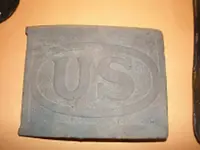
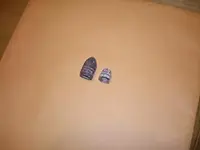
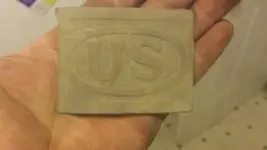
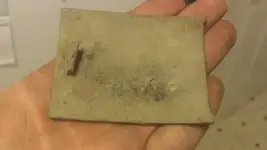


 That is really sweet that your plate turned out to be older than I thought
 ... Here's to many more hunts like the two this weekend


 and Welcome penniesmine
 I liked the video of you all down in South Carolina !! I see Jeff took the show on the road
 Find many more keepers, and have a real good time


 I've been all over in 2010! WV on 1/1 and now down here til next weekend! Got a plantation lined up for this week