What's new

21-07-2010/ Roman coins and more finds...

HISPAN

Gold Member
Joined
Mar 15, 2009
Messages
5,161
Reaction score
605
Golden Thread
0
Detector(s) used
WHITES MXT ,GARRET ACE150,GARRET SEA HUNT MARK II.
Primary Interest:
Metal Detecting
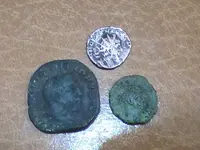
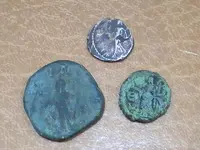
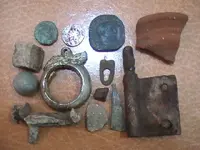
The soil is hard as concrete :( , several months ago has not rained and the fields are still unplowed ..... and the sun no truce. ( being the only relic hunter that is in the field at this time in my country) but in two hours find three Roman coins and some other things. ;D

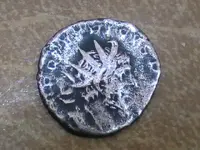
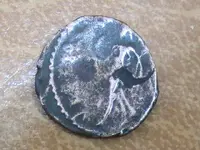
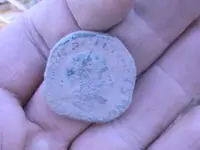
a Antininianus ... This silver coin introduced by Caracalla and worth twice the Denarius, but really only had about 1 1 / 2 of the silver in the denarius. Both Antoninianus and the dinar continued for some time until the penny was eliminated. Gradually, over the third century, the silver content of the fallen antoninianus

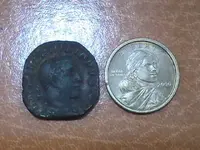
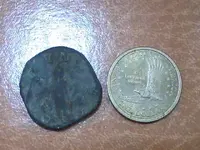
one Semis ... Bronze Roman coin of the first centuries of the empire.

a Sestercius ... The sestertius was the largest denomination of bronze in the ancient Roman Empire, and continued shrinking only gradually until the reign of Posthumus (usurper in the breakaway Gallic Empire, 259-258 AD), who coined the last sestertius .

Greetings to all !! :hello:
 

Attachments

  • 21-07-2010 066.webp
    21-07-2010 066.webp
    51.3 KB · Views: 562
  • 21-07-2010 067.webp
    21-07-2010 067.webp
    49.7 KB · Views: 541
  • 21-07-2010 074.webp
    21-07-2010 074.webp
    54.7 KB · Views: 544
  • 21-07-2010 076.webp
    21-07-2010 076.webp
    57.4 KB · Views: 537
  • 21-07-2010 081.webp
    21-07-2010 081.webp
    32 KB · Views: 549
  • 21-07-2010 084.webp
    21-07-2010 084.webp
    30.2 KB · Views: 555
  • 21-07-2010 045.webp
    21-07-2010 045.webp
    41.6 KB · Views: 558
  • 21-07-2010 060.webp
    21-07-2010 060.webp
    44 KB · Views: 544
  • 21-07-2010 085.webp
    21-07-2010 085.webp
    38.9 KB · Views: 553
  • 21-07-2010 039.webp
    21-07-2010 039.webp
    61.5 KB · Views: 547
  • 21-07-2010 037.webp
    21-07-2010 037.webp
    37.5 KB · Views: 544
  • 21-07-2010 044.webp
    21-07-2010 044.webp
    18.4 KB · Views: 536
Upvote 0
Impressive finds. I can only dream of finding some like this. :thumbsup:
 
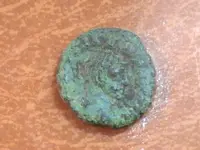
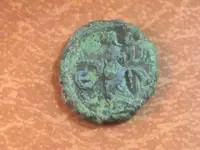
I am not sure that the coin in the fifth and sixth photos from the top is a semis. Looks more to me like a late third century bronze tetradrachm from Alexandria in Egypt. The provincial issues of Alexandria circulated almost exclusively in the Nile Valley, so this would be an unusal find for Spain.

For examples of the provincial issues of Alexandria in the late third century, go to www.vcoins.com, and then search "tetradrachm" with any of the following emperors: Aurelian, Probus, Carus, Carinus, Numerian, Diocletian, Maximian, Galerius and Constantius I. While I cannot make out the legend on the front of your coin, from the bust, I would start with Probus and Diocletian

BTW, these late third century Alexandrian tetradrachms are noteworthy for being thick, chunky coins.

artorius
 
artorius said:
I am not sure that the coin in the fifth and sixth photos from the top is a semis. Looks more to me like a late third century bronze tetradrachm from Alexandria in Egypt. The provincial issues of Alexandria circulated almost exclusively in the Nile Valley, so this would be an unusal find for Spain.

For examples of the provincial issues of Alexandria in the late third century, go to www.vcoins.com, and then search "tetradrachm" with any of the following emperors: Aurelian, Probus, Carus, Carinus, Numerian, Diocletian, Maximian, Galerius and Constantius I. While I cannot make out the legend on the front of your coin, from the bust, I would start with Probus and Diocletian

BTW, these late third century Alexandrian tetradrachms are noteworthy for being thick, chunky coins.

artorius

Sure you're right .... I was not sure at all for the thickness, but by the diameter of which most resembles is a (semi) the coin is extremely thick and small, tomorrow I will show more pictures and the exact weight of this coin. (now I'm working)
never seen such a Egypt /Roman period coin in my country .... deserves a more detailed study, and this would be the first in my collection.
Greetings! :notworthy:
 
Hi Hispan,

I think I found your Alexandrian coin. Take a look at the following link:

http://www.wildwinds.com/coins/ric/maximianus/milne_4939.jpg

I found this on the Wildwinds research site. To find the coin, go to www.wildwinds.com. Enter the site, and click on the link for coins that says "Imperial Coins by Ruler". Click on the "M" link, and scroll down to Maximianus. Click on that, and scroll down to Milne 4939. You will find the photo again, as well as a link for text.

Maximian ruled from 286-305 as a colleague of the Emperor Diocletian. The "E" on the reverse of your coin is the Greek letter for "5", which dates your coin to the fifth year of Maximian's reign (290-291 AD).

In the early years of the Roman Empire, extensive local issues were struck alongside the Imperial denominations. The coins of Alexandria were struck using Greek legends, continuing the Greek cultural tradition that commenced with the conquest of Egypt by Alexander the Great.

By the late third century, all of the local (provincial) issues had ceased except for the bronze tetradrachms of Alexandria. These last ceased to be issued after the mid 290s. Your coin is one of the latest examples of a once extensive array of Roman provincial coins.

It is pretty amazing that your coin ended up in Spain.

artorius
 
artorius said:
Hi Hispan,

I think I found your Alexandrian coin. Take a look at the following link:

http://www.wildwinds.com/coins/ric/maximianus/milne_4939.jpg

I found this on the Wildwinds research site. To find the coin, go to www.wildwinds.com. Enter the site, and click on the link for coins that says "Imperial Coins by Ruler". Click on the "M" link, and scroll down to Maximianus. Click on that, and scroll down to Milne 4939. You will find the photo again, as well as a link for text.

Maximian ruled from 286-305 as a colleague of the Emperor Diocletian. The "E" on the reverse of your coin is the Greek letter for "5", which dates your coin to the fifth year of Maximian's reign (290-291 AD).

In the early years of the Roman Empire, extensive local issues were struck alongside the Imperial denominations. The coins of Alexandria were struck using Greek legends, continuing the Greek cultural tradition that commenced with the conquest of Egypt by Alexander the Great.

By the late third century, all of the local (provincial) issues had ceased except for the bronze tetradrachms of Alexandria. These last ceased to be issued after the mid 290s. Your coin is one of the latest examples of a once extensive array of Roman provincial coins.

It is pretty amazing that your coin ended up in Spain.

artorius

YES !! You are the (Iniesta) of old coins! ...I've sent a message ....
 
The fun has begun :wink:
 
CRUSADER said:
The fun has begun :wink:
and ended in September while visiting his country. :headbang:
 
Great looking roman coins HISPAN :icon_sunny: :icon_sunny:

Your hunts always produce some very interesting finds and love the great pics of locations :hello2:
 

Users who are viewing this thread

Back
Top Bottom