Neanderthal
Bronze Member
A very rare "Woodpecker" relic.
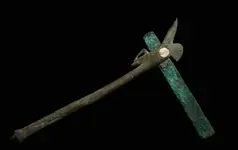
The recent woodpecker thread reminded me of this - another new addition to the museum. Woodpecker effigy axe. Found at the central (Craig) mound at Spiro, Oklahoma (Leflore Co). A wooden handled copper blade axe recovered from the Spiro Mound in 1935 by Kimbal A. McKenzie of the Pocola Mining Company. All the axes were found together in a cache in an open area free of any debris. This axe and approximately 28 other bird effigy wood handle axes with copper blades protruding through the open mouth beak were found wrapped in a woven mat container. All the axes were found together in a cache in an open area free of any debris. They were pried up and carried out of one of the tunnels by two diggers, Mr. Hobbs and Mr. K. A. McKenzie. They said the axes looked as though the original owners had just tossed them down in a pile. Most of the handles had been purposely broken (ceremonially killed). The cache contained more copper blades than wood handles. No satisfactory answer has been given why these bird-head effigy axes were created with the copper blade's longest portion and cutting end positioned coming from the back of the bird head. This carved effigy has been identified as either a Pileated or Ivory Billed Woodpecker, due to the red stained wood, large shell cutout eye, long beak and tongue design, and head crest. A high number of conch shell engravings establish the woodpecker as prominent Spiro design. The wood (believed to be Persimmon) was aided in its preservation in the dry tomb because of its association with copper salts. The copper blade on this axe is 9 and 1/2 inches long and the wood handle is 16 inches long. The cutting edge on this blade and another that I have personally examined exhibit blunt edges, indicating this artifact had a strictly ceremonial function. The thin, finely carved delicate wood handle would not endure sustained functional blows. The end of the handle is bell shaped flared with an adornment hole carved in the end of the bell, similar to the stone monolithic axes. No two woodpecker heads were carved the same way indicating that more freedom of artisitic impression was allowed on this Spiro artifact. There have been shell engravings found at Spiro that depict these axes being carried about the waist, perhaps dancing ceremoniously. No where else in the world have copper blade wood handle effigy axes of this type and style been found. This makes this artifact one of the rarest types known to American archaeology.
The recent woodpecker thread reminded me of this - another new addition to the museum. Woodpecker effigy axe. Found at the central (Craig) mound at Spiro, Oklahoma (Leflore Co). A wooden handled copper blade axe recovered from the Spiro Mound in 1935 by Kimbal A. McKenzie of the Pocola Mining Company. All the axes were found together in a cache in an open area free of any debris. This axe and approximately 28 other bird effigy wood handle axes with copper blades protruding through the open mouth beak were found wrapped in a woven mat container. All the axes were found together in a cache in an open area free of any debris. They were pried up and carried out of one of the tunnels by two diggers, Mr. Hobbs and Mr. K. A. McKenzie. They said the axes looked as though the original owners had just tossed them down in a pile. Most of the handles had been purposely broken (ceremonially killed). The cache contained more copper blades than wood handles. No satisfactory answer has been given why these bird-head effigy axes were created with the copper blade's longest portion and cutting end positioned coming from the back of the bird head. This carved effigy has been identified as either a Pileated or Ivory Billed Woodpecker, due to the red stained wood, large shell cutout eye, long beak and tongue design, and head crest. A high number of conch shell engravings establish the woodpecker as prominent Spiro design. The wood (believed to be Persimmon) was aided in its preservation in the dry tomb because of its association with copper salts. The copper blade on this axe is 9 and 1/2 inches long and the wood handle is 16 inches long. The cutting edge on this blade and another that I have personally examined exhibit blunt edges, indicating this artifact had a strictly ceremonial function. The thin, finely carved delicate wood handle would not endure sustained functional blows. The end of the handle is bell shaped flared with an adornment hole carved in the end of the bell, similar to the stone monolithic axes. No two woodpecker heads were carved the same way indicating that more freedom of artisitic impression was allowed on this Spiro artifact. There have been shell engravings found at Spiro that depict these axes being carried about the waist, perhaps dancing ceremoniously. No where else in the world have copper blade wood handle effigy axes of this type and style been found. This makes this artifact one of the rarest types known to American archaeology.
Attachments
Last edited:
Upvote
0