What's new

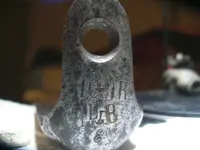
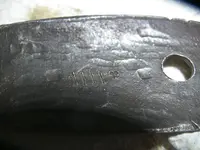
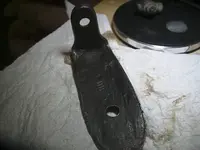
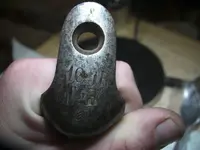
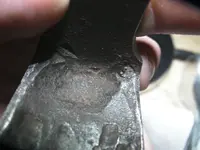
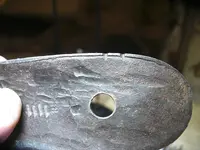
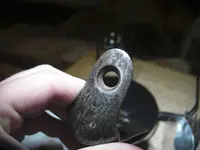
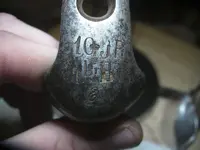
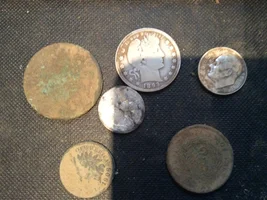
After a ton of Electrolysis baths cleaning and repeat..Identify this

Beeps in my sleep

Hero Member
Joined
Sep 6, 2013
Messages
786
Reaction score
1,090
Golden Thread
0
Location
Shippensburg, Pennsylvania
Detector(s) used
Whites 6000, Fisher F2, Garrett AT Pro, XP Deus
Primary Interest:
All Treasure Hunting
After quite a few long electrolysis baths, careful cleaning, having a friend help that specializes in cleaning up old things, I need to find out what these markings are. I can't find any info on Google. ( Note: One Electrolysis Machine died in the cleaning of this...moment of silence)

CAM_0854.webp CAM_0856.webp

CAM_0857.webp CAM_0858.webp

CAM_0859.webp CAM_0860.webp

CAM_0861.webp CAM_0862.webp
 
Looks like a butt plate to an old musket or blunderbust. Just a guess. HH
 
Upvote 0
I believe that we have some old firearms experts here and hopefully they will be able to help. Have you found other items where this was found? Sometimes putting an item into context with others helps to make an ID possible. It is probably British or French- you might check early armament records from those countries- if they are available.
 
Upvote 0
Awesome!

Assuming you found this in Pennsylvania at or near the same location as your other Civil War finds... this is a buttplate from a Springfield Model 1842.

Two countersunk screw holes, the straight spine, and the wide, round-nosed tang are indicators.

The later models were a combination of a recurved buttplate to better accommodate the shoulder, a narrow tang, and/or had the 3 screw pattern.

It could be from as early as a Springfield Model 1816, but without more info on your site, I'll assume.

Ok, I dug thru my library. I have a "Proof Bible" and a archive I put together of almost 1000 photographs of unique identifying marks found on Civil War Small Arms.

As soon as I can chase it down I will get back to you.
I'm pretty sure my Dad "borrowed" it last time he was at the house, haha!

Did you find the buttplate in the same area as you found the hammer?

If so, get back out there and find the lock plate!!!!! That has the definitive marks!
 
Last edited:
Upvote 0
It is a butt plate no doubt but no idea on the markings. I would ask over at the ALR froum a ton of knowleable people over there. Somone there might be able to tell you what the markings are. My guess would be unit and initals or something along those lines. Who knows.

AmericanLongRifles Forums - Index
 
Upvote 0
Awesome!

Assuming you found this in Pennsylvania at or near the same location as your other Civil War finds... this is a buttplate from a Springfield Model 1842.

Two countersunk screw holes, the straight spine, and the wide, round-nosed tang are indicators.

The later models were a combination of a recurved buttplate to better accommodate the shoulder, a narrow tang, and/or had the 3 screw pattern.

It could be from as early as a Springfield Model 1816, but without more info on your site, I'll assume.

Ok, I dug thru my library. I have a "Proof Bible" and a archive I put together of almost 1000 photographs of unique identifying marks found on Civil War Small Arms.

As soon as I can chase it down I will get back to you.
I'm pretty sure my Dad "borrowed" it last time he was at the house, haha!

Did you find the buttplate in the same area as you found the hammer?

If so, get back out there and find the lock plate!!!!! That has the definitive marks!


Yes it was in the area but not the exact same area. This area is loaded with history! Thank you! I can't wait to find out type of troop would of used this if it is indeed military :)
 
Upvote 0
Springfield? I'm the first to admit that I'm NOT a gun guy, but the mark on the zero looks like a British crown to me.

One more note - The "J" letter could easily be an "I" if this is an early to mid 19th C relic. Those letters were interchangeable back then. That's why there is no "J" street in Washington DC as it would have been too confusing.

DCMatt

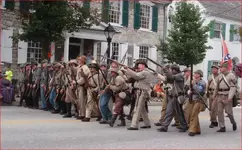
Beep - I didn't know you were in Ship. My CW reenactment unit has done the street battle there a number of times. I'll be in Gettysburg for the parade on Saturday.
 
Upvote 0
Springfield? I'm the first to admit that I'm NOT a gun guy, but the mark on the zero looks like a British crown to me.

One more note - The "J" letter could easily be an "I" if this is an early to mid 19th C relic. Those letters were interchangeable back then. That's why there is no "J" street in Washington DC as it would have been too confusing.

DCMatt


Beep - I didn't know you were in Ship. My CW reenactment unit has done the street battle there a number of times. I'll be in Gettysburg for the parade on Saturday.

Hey man! Yup I live in Ship. I posted a video from a few years back of the cannon going off for the March to Destiny. Any Idea where the cannon has been lately? Let me know if you do it this year. I would like to meet you. I will also try to film it in HD again this year. I won't be able to make it to Gettysburg because of work unfortunately. And I appreciate the help on the butt plate. I got no idea if it is civilian, or military or from what branch. I just know it took to much cleaning for me not to find out. In your CW reenactment for March to Destiny in Shippensburg, are you Confederate, or Union?
 
Upvote 0
are you Confederate, or Union?

13th Virginia Infantry, Company I (Confederate...)

We did the 2011 battle.

DCMatt
 

Attachments

  • ship2011.webp
    ship2011.webp
    133.2 KB · Views: 130
Upvote 0
13th Virginia Infantry, Company I (Confederate...)

We did the 2011 battle.

DCMatt


Very nice. THANK YOU for participating in this event for our town. I always love watching it. Without dedicated reenactors like yourself, we would not get to experience a replay of the history of the invasion of Shippensburg. Once again, Thank you so much.
 
Upvote 0
If the buttplate is from a Springfield Rifle, then why does it have a Crown after "10"? The markings on the buttplate also look more British than early U.S. markings! Could it be a buttplate for a British Baker Rifle or even earlier rifle from the Revolutionary War?


Frank
 
Last edited:
Upvote 0
If the buttplate is from a Springfield Rifle, then why does it have a Crown after "10"? The markings on the buttplate also look more British than early U.S. markings! Could it be a buttplate for a British Baker Rifle or even earlier rifle from the Revolutionary War?


Frank

Tejaas had a good point, when he was pointing out the way the plate was formed and how they later changed. I have no idea. Maybe it was from an earlier period and still in use? I know Confederates used whatever they could but I don't even know if this is military. For all I know this could be an old hunters butt plate that was personalized.
 
Last edited:
Upvote 0
This is for Beeps and DCMatt!

This is absolutely interesting. I am not saying "I am right, you are wrong" at all, but I'd like to state my facts! No offense to anyone!

1. If that was a crown proof, that would make this a P53 Enfield by default...Highly believable as it was the second most widespread small arm in the Civil War.

Except that isn't a P53 Buttplate.


2. That isn't a crown proof, it's a pressure flake from an overstrike or a corrosion spot. I'd bet my paycheck on it. Every crown proof has an accompanying numerical proof directly above and/or below the crown, whether or not it came from the London or Birmingham rifleworks.

Enfield/Tower lock plates have a standalone crown, but even it is drastically different.

3. Use of "I" and "J" interchangeably.

I am more than familiar with this logic, as it was actually introduced in the 1850's as the Playfair Cipher... However it was never actually utilized by Americans Until WW1.

The reason some cities choose to bypass "I" is due to the United States Postal Service having a hard time deciphering sloppy addresses, and can also be found in the way the current US Military utilizes a Julian Date Calendar.

Taking into account DCMatt's suggestion about "I" and "J" being used interchangeably, that would show the first line to read what I interpret as the "10th Infantry Regiment".

That works, because the 10th was out of Carlisle Barracks, which is like 20 minutes away from you in Shippensburg, Beeps!!! That is really a possibility I'd say!

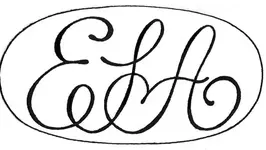
4. The "E" script at the bottom if the plate... No evidence in multiple Enfield Proof charts show that Enfield used a single "E".

However, Springfield Armory's master armorer, Erskine S. Allin, worked at the armory from 1829-1878, used the exact same font on his proof mark.

(See attached picture below.)

The "E" is identical, and there are known examples of variations of his Initials, first letter/full last name, etc...

So - maybe it IS a crown, Maybe the "L's" and "B" stand for London and Birmingham, and maybe it ISNT the 10th Infantry... Perhaps it's just a bunch of random stamped assembly proofs that mean nothing. Maybe it was re-arsenaled, or maybe it was a war capture...

But it ISN'T an ENFIELD buttplate!

Here's what has me wondering though... After the Springfield M1816-M1842, all the buttplates on military-issued arms evolved into a more contoured shape, maybe added a screw hole, and/or became brass...

So what if this is Revolutionary War era?!?! That's a whole other situation I'll let someone else dig into!

Again, no offense was meant to anyone, just enjoy brainstorming with those who partake in the conversation!

I'm always open to hearing another point of view!
 

Attachments

  • image-2300609528.webp
    image-2300609528.webp
    12.9 KB · Views: 101
Upvote 0
If the buttplate is from a Springfield Rifle, then why does it have a Crown after "10"? The markings on the buttplate also look more British than early U.S. markings! Could it be a buttplate for a British Baker Rifle or even earlier rifle from the Revolutionary War? Frank

I dug through my library, trying to find ANY other examples... I knocked Baker off the list right away with the buttplate construction... But I wanted to double check on the Lorenz. Same story there.

It screams early Springfield.

The font screams "The British are coming!" Haha!

Revolutionary War would be the alternative I'd accept as a 50/50... And if it is I hope a Revolutionary War expert will teach me something.
 
Upvote 0
The font style looks much older than Civil War to me. And it looks British. Tagging this to see how it shakes out.

I agree with you on the font!

I'm trying to play it safe and go off the buttplate variation.

What gets me second guessing though, is how a font can just be that... A font!

Remington and Westinghouse did American-built, Russian Contract Mosin Nagants in 1915-1918... Their proof marks, cartouches, and serials sometimes contained a healthy mix of English typeset fonts, Cyrillic, and Roman Numerals!
 
Upvote 0
Tejaas had a good point, when he was pointing out the way the plate was formed and how they later changed. I have no idea. Maybe it was from an earlier period and still in use? I know Confederates used whatever they could but I don't even know if this is military. For all I know this could be an old hunters butt plate that was personalized.

Whatever it was, American Revolution, Civil War, Etc...
It IS military. The only reason these buttplates get marked like this is for catalog, inventory, or issue... Even back then Uncle Sam (or her majesty) had to account for battlefield losses, captures, and statement of charges were issued! Haha

I had a direct descendent KIA with the 7th Texas Cavalry at the Second Battle Of Galveston... I have copies of the microfilm ledger page that show that after his death, the quartermaster DEDUCTED the price of his rifle, horse and saddle from his final pay issuance!
 
Upvote 0

Users who are viewing this thread

Back
Top Bottom