What's new

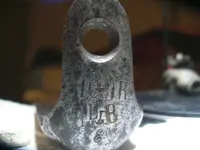
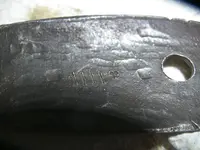
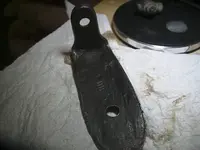
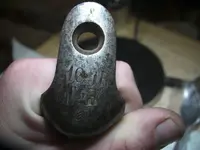
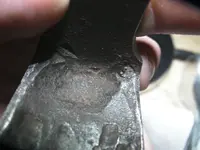
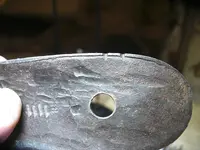
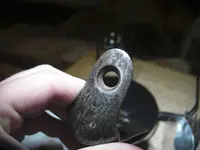
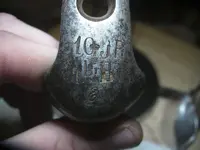
After a ton of Electrolysis baths cleaning and repeat..Identify this

Beeps in my sleep

Hero Member
Joined
Sep 6, 2013
Messages
786
Reaction score
1,090
Golden Thread
0
Location
Shippensburg, Pennsylvania
Detector(s) used
Whites 6000, Fisher F2, Garrett AT Pro, XP Deus
Primary Interest:
All Treasure Hunting
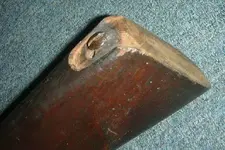
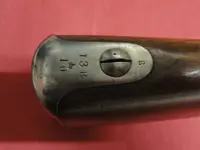
After quite a few long electrolysis baths, careful cleaning, having a friend help that specializes in cleaning up old things, I need to find out what these markings are. I can't find any info on Google. ( Note: One Electrolysis Machine died in the cleaning of this...moment of silence)

CAM_0854.webp CAM_0856.webp

CAM_0857.webp CAM_0858.webp

CAM_0859.webp CAM_0860.webp

CAM_0861.webp CAM_0862.webp
 
Any updates guys/gals? I looked at all the links sent and still cant match this. It is going to drive me nuts!

Haha until I get down to the ranch and get my "Bible"...

I'm going to stick with the "Springfield (M1816) M1842 buttplate that denotes the 10th Infantry Regiment out of Carlise Barracks, Pennsylvania" assumption.

Yes, a lot of us, myself included, agree that the font style does look more Revolutionary War era, but I've seen weirder. The M1842 was based off the M1816, the buttplates being identical... so maybe the proof dies were still being used after the American Revolution.

I'm trying to remain as factual as possible. That is a M1816/M1842 Buttplate, or else whatever Revolutionary flintlock it came off of is a perfect match to one!

That's all I got, when I get my proofs reference binder back I'll drop back by.

Adios!
 
Upvote 0
Tejaas, On the 1842 Springfield, on the tang of the butt plate, forward of the top screw, shouldn't there be a US. On this one
there is a P. I'm still looking.
 
Upvote 0
Tejaas, On the 1842 Springfield, on the tang of the butt plate, forward of the top screw, shouldn't there be a US. On this one there is a P. I'm still looking.

"US" proof on the buttplate was typical... Especially after '61 when the war kicked off.

The early models my research shows as "Hit Or Miss" seems as if some of the US proofs went on the buttplate, the others went UNDER the buttplate on the stock, or even were never applied to the buttplate, just the lockplate.
 
Upvote 0
Tejaas, On the 1842 Springfield, on the tang of the butt plate, forward of the top screw, shouldn't there be a US. On this one
there is a P. I'm still looking.

Thank you BosnMate! Could the P stand for Private?
 
Upvote 0
Thank you BosnMate! Could the P stand for Private?

The "P" proof, usually actually stood for "PROOF"!!!

You'll see a lot of late model war manufactured Springfields that don't have a "P" on the barrels or lock plates...

These rifles without it were "seconds". Usually meant a manufacture defect.

SIDENOTE - Here's a semi-boring, kinda-unrelated fact for firearms fans...

Many if not most military firearms around the world still displayed a "P" proof...

However at around 1907 the "P" took on the meaning of "Phosphate Treated", the first form of what you now know as "Parkerized" and then later "Passivated". All three simply being more advanced methods of element proofing firearms and other associated equipment.

These three similar, but different processes took the original oil quenching and gun bluing to improved corrosion resistance levels.
 
Last edited:
Upvote 0
Haha the "P" proof, usually actually stood for "PROOF"!!!


Well I feel intelligent lol! I appreciate all the help. I have a magnifying glass to it and still its driving me insane. Hope it isnt the Tnet "E" mystery haha
 
Upvote 0
Well I feel intelligent lol! I appreciate all the help. I have a magnifying glass to it and still its driving me insane. Hope it isnt the Tnet "E" mystery haha

Haha I'll tell ya brother, I for one appreciate the challenge.

You got a real interesting piece there!

My small arms addiction makes stuff like this PAINFUL.
As I seriously lose sleep over mysteries like this! Haha!

Whenever it's all said and done, and the puzzle is solved...
If you aren't going to keep it... Please consider donating it to your county historical society!

Things like this aren't usually worth a lot in terms of monetary value but the story they tell is priceless!
 
Upvote 0
After looking at the new pics, I have to agree with Tejaas that it looks like a Springfield butt plate.

But I STILL think that is a crown in the center. If there was other corrosion damage on the relic I might be able to dismiss. The condition of this piece is amazing and it is too coincidental for it to have one "crown shaped" rust spot exactly in the center. I also looked at as many M1816 & M1842 butt plates as I could find on the internet. None were stamped with a 'P'. Most were stamped with 'US'. Which begs the question, "Why would you need to proof a butt plate?" Again, I'm not a gun expert, but my impression is that precision parts were proofed.

So, all that said, could this be a butt plate from a Belgian knock-off of the Springfield? Did the young US government buy foreign made copies to supply the regular army? That might help explain the crown mark and the curly E. Any thoughts?


DCMatt
 
Upvote 0
U.S. Civil War era Belgian import rifled musket .69 caliber:

Military Antiques, WWI WWII Antiques and Collectibles | Military Antiques Museum 8796


This is an example of the style of weapons that both the Federal and Confederate armies were importing early on in the war. As the war broke out representatives from both the Federal and Confederate Governments flooded Europe looking for any weapons to import to the newly expanding armies. This Belgian example is the typical style that they found which closely resembles the U.S. M1842 Springfield musket.
Product35344.webp

Possible fit...

DCMatt
 
Upvote 0
DCMatt, I also think that's a crown with a number or letter below it. And the P bothers me, but I can't find another on the internet either. I'm certainly not an expert on proof marks, and have never thought the US on guns to be a proof mark, but rather to show ownership, like for instance, the US on the military model 1911. I have a Bridesburg contract Springfield rifled musket up stairs, and I'm going to have to get off me dead butt and go look at it. I know there is a P proof mark on the barrel of my 73 Springfield carbine. A Harpers Ferry butt plate has a notch for the patch box. My swag right now is it's off a Lorenz imported from Austria. The crown and the writing on the butt plate just doesn't look Springfield to me, but I've certainly been known to be wrong more'n once. I'm saying Lorenz and I don't even know if for sure that gun has an iron or brass butt plate. When Tejaas gets his records he might be able to shed more light.
 
Upvote 0
After looking at the new pics, I have to agree with Tejaas that it looks like a Springfield butt plate. But I STILL think that is a crown in the center. If there was other corrosion damage on the relic I might be able to dismiss. The condition of this piece is amazing and it is too coincidental for it to have one "crown shaped" rust spot exactly in the center.

I completely agree that this piece has very little deep corrosion and pitting uniformly on the surface of the plate... That's why I also mentioned in that previous posting it could be a pressure/stress flake from an over strike, etc!

Remember guys, this stuff was relatively brittle!
 
Upvote 0
I also looked at as many M1816 & M1842 butt plates as I could find on the internet. None were stamped with a 'P'. Most were stamped with 'US'. Which begs the question, "Why would you need to proof a butt plate?" Again, I'm not a gun expert, but my impression is that precision parts were proofed. t

This one is my fault!
I have a bad habit of using the term "proofmark" as a generic term for all Arsenal/Inspector/Assembly/property marks!

I'd have been better served using "stamp" or "hallmark" and avoiding the term "proof" to avoid confusion!

With that being said, the "precision" components (Barrels and Lock plates especially) were marked "P" for "Proof"... With the Springfields it was usually accompanied with a "V" and an Eagle.

In our example here, I believe the "P" to be an Assembly mark. All components of almost all military service rifles/muskets had these, and this is not just in regard to the Civil War...

The Swedish Mauser (M96) is a great example of this...
There is a tiny little crown on every single component, including the entire bolt subassembly components, trigger assembly components, even the cleaning rod head!
 
Upvote 0
DCMatt, I also think that's a crown with a number or letter below it. And the P bothers me, but I can't find another on the internet either. I'm certainly not an expert on proof marks, and have never thought the US on guns to be a proof mark, but rather to show ownership, like for instance, the US on the military model 1911. I have a Bridesburg contract Springfield rifled musket up stairs, and I'm going to have to get off me dead butt and go look at it. I know there is a P proof mark on the barrel of my 73 Springfield carbine. A Harpers Ferry butt plate has a notch for the patch box. My swag right now is it's off a Lorenz imported from Austria. The crown and the writing on the butt plate just doesn't look Springfield to me, but I've certainly been known to be wrong more'n once. I'm saying Lorenz and I don't even know if for sure that gun has an iron or brass butt plate. When Tejaas gets his records he might be able to shed more light.

As i stated above, i believe the "P" to be an assembly mark... My generic use of the term "proofmark" to also include arsenal/assembly/inspector/property marks didn't allow me to accurately convey my point, and I apologize!

"US" is indeed a mark indicating Federal Service conscription.

Firearms purchased FOR the confederacy BY the confederacy would lack the "US" identifier.

Firearms UTILIZED by the confederacy would display markings that endlessly varied... we all know that a confederate wouldn't pass on a Springfield M1861 laying on the field of battle!

Pennsylvania had a lot of confederate troop movement. We all know that!

Confederates for the majority supplied their own weaponry and "traded up" through various means at the first available chance. That is also well documented...

So if this is in fact a buttplate off a Springfield M1842, who's to say it wasn't a privately owned piece brought along from home when the owner went off to fight for the cause? That could explain the lack of a "US" marking, it never was federal property to begin with!

It could also be a Union army piece! Again, if it is a buttplate from a M1842 it's obviously pre-war... A whole lot of firearms were donated or leased to the federal army via military academies, home guards, and state militias. This could also explain the lack of a "US" mark... And quite frankly the slew of letter and number stamps on the plate would be consistent with company/rack/weapon numbers of these institutions.

Lastly, the possibility of this being from an Austrian Lorenz.

I mentioned this much earlier in this thread... GREAT suggestion!!!

I was quick to discount this however, as although the buttplates of a Lorenz and M1842 are near identical... This buttplate lacks the Kaiser Double Headed Eagle stamp that Vienna stamped in. And as I compared earlier to the Swedish M96, Vienna was notorious for stamping EVERY COMPONENT!

You may say "well, everyone knows that imported war contract purchased arms are known to be lacking a lot of the usual foreign-applied markings!"

The Lorenz was "scrubbed" before export from Austria... Namely most if the Lockplate stamps. But the Kaiser Eagle remained. Believe me or not, I quadruple checked my references.
 
Last edited:
Upvote 0
Tejaas, I don't disagree with you, just throwing out suggestions. It's one of those things that at the time everyone knew what it was, so nobody bothered to write it down, and now it's a head scratcher. I think your original idea about coming from Carlisle Barracks makes the most sense.
 
Upvote 0
Tejaas, I don't disagree with you, just throwing out suggestions. It's one of those things that at the time everyone knew what it was, so nobody bothered to write it down, and now it's a head scratcher. I think your original idea about coming from Carlisle Barracks makes the most sense.

Carlisle is not far from Shippensburg! I appreciate all the time that you BosnMate and Tejass are putting into helping me ID this. It really means a lot. You both are awesome and very full of knowledge!
 
Upvote 0
It's one of those things that at the time everyone knew what it was, so nobody bothered to write it down, and now it's a head scratcher.

Haha well put!

"Sometimes the greatest mysteries to us at present day, are the things that were trivial in their time."

With that being said, would ya care to offer some insight into Stonehenge, Easter Island, or crop circles? Haha!

I'm starting to think we will figure that out before we solve the mystery in regards to the origin of this buttplate!

Maybe Beeps was bored and fabbed this up in his garage! Haha!
 
Upvote 0
Haha well put!

"Sometimes the greatest mysteries to us at present day, are the things that were trivial in their time."

With that being said, would ya care to offer some insight into Stonehenge, Easter Island, or crop circles? Haha!


I'm starting to think we will figure that out before we solve the mystery in regards to the origin of this buttplate!

Maybe Beeps was bored and fabbed this up in his garage! Haha!


LOL, I have no fab skills whatsoever. I can't even make a bird house out of popsicle sticks haha. I do appreciate all the help though :icon_thumright:
 
Upvote 0
The buttplate looks very similar to the French Charleville musket buttplates. Cool that it is marked like that too. 10th Jaeger (riflemen) unit?

Steve

I'll start by saying I know practically nothing about old rifles but when I researched on google I came to the same conclusion that it is JR for Jaeger Regiment. And while I wasn't able to find anything exact there are some others out there that make me think it is worth exploring as an option.

The Werder rifle here with the Crown positioned on the 10 in much the same way.

Werder 1869

Also this comment here:

Werder Sporting Rifle? in Sporting Rifles and Other Old Guns Forum

The butt plate is marked 7JR with a backward script e under it.
 

Attachments

  • werder.webp
    werder.webp
    26.5 KB · Views: 96
Upvote 0
If it's a Jager, that dates it to the revolution. Certainly looks good in the photo, and you are probably onto something.
 
Upvote 0
I just just got back from Beear camp. I am gona email the pics to a couple people and post them on some of the gun maker foums.

 
Upvote 0

Users who are viewing this thread

Back
Top Bottom