What's new

Americain Indian Metal Artifacts - Has Anybody Picked up Them?

SuchMuch

Jr. Member
Joined
Jan 7, 2017
Messages
97
Reaction score
135
Golden Thread
0
Location
St.Petersburg
Detector(s) used
AKA Sorex Pro
Primary Interest:
Relic Hunting
Has anybody been lucky to pick up American Indian metal artifacts? How do they really look like?
I failed to find threads with subject finds... Pls point me where I can read about them?!

:hello:
 
Upvote 0
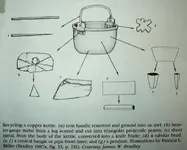
This is a good explanation of how kettle metal was utilized.....

P1120872.webp

This doesn't even scratch the surface as to how many unique items were made from kettle metal.
 
Iron points are mostly made from barrel hoops (strapping) and were made at fur trade posts/forts by traders or made by the Natives themselves.

These are all from one site.....

You can tell some of the Native made ones as they follow ancient styles that you would find with archaic copper.

This site only contained a few kettle points (at top of first photo) and the rest iron but luckily the soil was very kind to these.

Great collection of metal points Muddyhandz. :thumbsup:

In the Central Great Plains region I have found a number of iron points that were identifiable but not salvageable as they flaked and crumbled apart upon excavation, this is usually the case of most all iron points found on sites that are being farmed over, however points found on the same sites made of brass are most always in good condition. I hunt mostly agricultural ground and for this reason brass points make up the majority of my metal point finds. Well drained unbroken ground where I hunt will produce salvageable iron points but they oftentimes exhibit some serious pitting. The farther west you go the more arid it becomes and iron points can be found in much better condition, however, because they are made of iron their existence is still limited unless someone finds and preserves them. Unlike their chipped stone counterparts the iron arrow points which are not found and saved will eventually oxidize into a small unrecognizable piles of rusted particles.
 
Wow those are really cool...
The rolled ones are very interesting to me.
 
This site only contained a few kettle points (at top of first photo) and the rest iron…

Thanks a lot Muddyhandz. Now I'm going to have to dig every last iron signal I get. :angry3:
 
Last edited:
...and the bronze age in Europe was preceded by their own Copper age....
Yep, you'd certainly have to be 'literate' in copper, before bronze...I bet Otzi the Iceman could tell us a thing or two about the Chalcolithic Period (European Copper Age).
 
Iron points are mostly made from barrel hoops (strapping) and were made at fur trade posts/forts by traders or made by the Natives themselves.
I'm not even going to post what I got because it would take a long time but I did happen to take this photo a few weeks ago for a friend.
These are all from one site.....

View attachment 1425315

You can tell some of the Native made ones as they follow ancient styles that you would find with archaic copper.

View attachment 1425317

This site only contained a few kettle points (at top of first photo) and the rest iron but luckily the soil was very kind to these.
I've got more info to add to this thread at a later date.
Good topic! :thumbsup:
That's just a fantastic site collection, you're very lucky to be able to find those, as I'm sure you know.

Do you have any pics of the site and how deep are they found...surface?
 
Yep, you'd certainly have to be 'literate' in copper, before bronze...I bet Otzi the Iceman could tell us a thing or two about the Chalcolithic Period (European Copper Age).
Bronze age was everywhere except Americas.

Thanks everyone for sharing their finds! Has anybody found copper axes? I'm sure there should be larger copper items
 
Cool collection! :icon_thumright: I have one metal trade point (Montana), and one copper point that I found at John's village site in North Dakota.
 
Last edited:
Thanks for the interest! As for this site, most of it is in a cultivated field but there's some bush areas surrounding that had Native camps here and there.
There's about another 30 iron points (not photographed) from the plowed area that are more corroded, bent, or broken. Most of the points in the picture come from the bush area.
This post existed for a decade during the late 18th century and had very little modern activity outside of farming and hunting.
Of course in the early days of my sites, the nonferrous signals and bigger iron gets plucked out first and then I start digging almost everything as the site thins out.
I set my 1266X to accept all-metal but flip between the dual disc. to determine the size of iron artifacts.
In most cases, I can tell if the signal is different than a typical nail as these points will give a more expanded signal and most nails give a double blip but not always!
As I dig more of the less desirable signals, a deep iron point on it's edge (not flat) will sound similar to a nail.
I like to dig every signal at the Native camps as there's less nails (away from the post/fort) and everything has been worked. Even the nails have been modified for a special use.
Imagine all the stone lithics..... micro-blades, scrapers, awls, knives, saws, etc. converted into scrap metal versions. Even iron scrap trim bits have been utilized!
Sure the ability to flint knap almost disappeared by this period but that doesn't mean they didn't continue to fashion tools for every day purposes, they just used scrap metal.
Most Native made points were cut out of the scrap by taking a wedge/chisel and hammering out the shape with the back of a trade axe.
Then they used one of the most important tools (and under-rated) of the fur trade period.....a file to put an edge on blades or points and to finish it. They used a file to work on many different items.
The thing about fur trade collectors is that most focus on European made trade goods and overlook the amazing Native made tools and adornment that are often one of a kind pieces.
Although it's true they lost a lot of their ancient knowledge from assimilation, I have found comfort in digging up 18th century iron implements like these below, that are EXACTLY the same pattern as prehistoric copper points made thousand of years earlier......
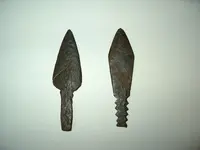

P1070412.webp

It's almost like that knowledge is embedded in their DNA!
Well, my two fingers are getting sore from all this typing. Lol. I'd love to show more of what I've been blabbing about again.
Cheers,
Dave.
 
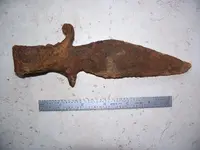
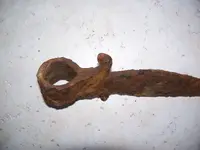
This object is called a spontoon and I believe it was traded into the possession of the NA during the fur trade era. I found it at a site where I have recovered many artifacts.


100_3175.webp 100_3176.webp
 
Cachefind09........That is a rare French Spontoon Tomahawk, not many of them were made compared to the blade and spike type. It is worthy of restoration or some way of removing the heavy rust. Great Find!
 
Cachefind09........That is a rare French Spontoon Tomahawk, not many of them were made compared to the blade and spike type. It is worthy of restoration or some way of removing the heavy rust. Great Find!

Thank you so much for the information Rege-Pa. So do you think this was used by the NA or by the European settlers? I don't really know if it can be restored because it is so deeply rusted into the metal and if you were to remove the rust there wouldn't be much left of it. I accidentally dropped it after picking it up and the bottom barb broke off when it hit the ground. That's how brittle it has become after spending all these years in the ground.
 
Cachefind09.........If you knew how many heads that hawk split you might have reserves on keeping it. It may have been carried by a French (Courrier du bois) a runner of the forest but most likely was carried by a Mingo or Shawnee brave who were allied with the French and would date from 1650 up to 1765 with the last battles of Pontiacs War.
Did you keep the barb that broke off? I would love to find one of those.
 
Cachefind09.........If you knew how many heads that hawk split you might have reserves on keeping it. It may have been carried by a French (Courrier du bois) a runner of the forest but most likely was carried by a Mingo or Shawnee brave who were allied with the French and would date from 1650 up to 1765 with the last battles of Pontiacs War.
Did you keep the barb that broke off? I would love to find one of those.


Again, thanks for the information Rege-Pa. I have often wondered about what such a tool like this would be used for. The Shawnee had a large presence in the area I live with the Shawnee village of Old Town and the site of the battle of George Rogers Clark being not too far away. The local high school here is named Shawnee and their mascot is the Shawnee warrior. I did try to find the barb when it broke off but it got last in the dirt. That would have been a good time to have a metal detector.
 
The thing about fur trade collectors is that most focus on European made trade goods and overlook the amazing Native made tools and adornment that are often one of a kind pieces.

Excellent point muddyhandz

Recycled European trade goods modified by the Native Americans to meet their needs are certainly more interesting and are seldom seen in collections.

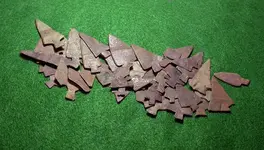
Many artifact hunters/collectors do not realize the actual rarity of the historic period metal points. They were made and used during a very short window of time and are much, much less common than stone arrow points. In the Great Plains region this window wasn’t much more than a hundred years long.

Speaking specifically of chipped stone arrow points, the bow was in use for well over a thousand years before the short lived metal points showed up. I have no clue what the ratio might be but there are a very large number of stone arrow points for every one Native-made metal arrow point.

If it wasn’t for my metal detector there would not be any in my collection as that is the only way I can find them. In the below image note the two metal points at the far right that were not finished.
 

Attachments

  • HistoricPoints2.webp
    HistoricPoints2.webp
    297.2 KB · Views: 94
Thanks SweepNbeep, I'm new to this sport but live in a place that makes it easy to while away the days with my detector on our little farm.
 
Love those unfinished arrowheads! Haven't seen any of those before. Very cool!
 
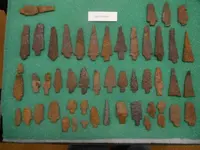
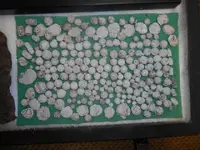
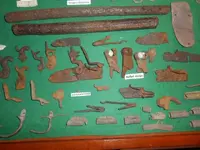
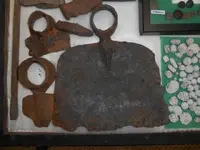
Just a few of the relics that I have found using a metal detector. The site is probably a small village from the 1850's to 1860's.DSCN0201.webpDSCN0207.webpDSCN0208.webpDSCN0206.webp
 

Users who are viewing this thread

Back
Top Bottom