What's new

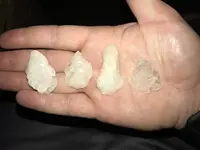
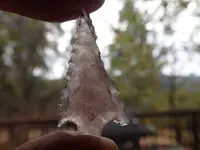
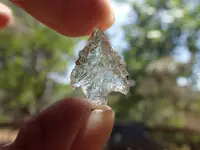
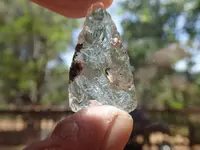
Are these quartz pieces hand worked?

CheathamHill

Full Member
Joined
Oct 10, 2009
Messages
246
Reaction score
46
Golden Thread
0
Found in a nice size North Georgia creek. It's just so hard to tell with quartz.

WEg0zpd.webp

Thanks for any help
 
Upvote 0
quartz is funny stuff

Found in a nice size North Georgia creek. It's just so hard to tell with quartz.

View attachment 1607636

Thanks for any help

I'm not an official archaeologist, but have worked as one for the USFS and three private firms, as one, for a total of 30+ yrs.

Quartz is funny stuff.
It can and does sometimes contain gold,
and in finer qualities of this material, you might find hand-formed
Projectile Points, made of the stuff. Beautiful to behold, and very likely,
highly prized by the guy who made it, like the one on the right.
See the parallel flakes, from the dorsal side of the point, down to the edge?
Man-made.
The other objects, I can't say sorry,..!
I am only going by what picture you supplied.
 
Thanks for the reply. I’m a novice so I’m not sure where to see the parallel flakes you speak of. I will post other angles of them soon so maybe someone can identify if they’ve been worked. Thanks again
 
Thanks for the reply. I’m a novice so I’m not sure where to see the parallel flakes you speak of. I will post other angles of them soon so maybe someone can identify if they’ve been worked. Thanks again
I have found quart point in GA. that stuff must be gruesome to work. I have never seen flakes on my points.
 
No, those are natural.:skullflag:
 
The profile or thickness is usually the best way to identify points made of that material.

Do they have a lenticular cross section? Do the sides meet to produce a more or less strait edge?
 
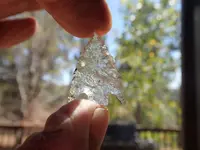
Just to dispell a common opinion, and not to judge the pieces I see here. Quartz is the most common lithic in my area. It is not at all difficult to see flaking on quartz. In the case of a quartz projectile, you just have to angle it in the light correctly, usually at a very oblique angle, to see the flaking. This makes it diificult to photograph the flaking, but it is not difficult to see the flaking if one simply angles the point in the light in order to see it. I just mention this because folks are always saying it's hard to see flaking on quartz artifacts, when in fact it's hard to photograph that flaking.
 
Just to dispell a common opinion, and not to judge the pieces I see here. Quartz is the most common lithic in my area. It is not at all difficult to see flaking on quartz. In the case of a quartz projectile, you just have to angle it in the light correctly, usually at a very oblique angle, to see the flaking. This makes it diificult to photograph the flaking, but it is not difficult to see the flaking if one simply angles the point in the light in order to see it. I just mention this because folks are always saying it's hard to see flaking on quartz artifacts, when in fact it's hard to photograph that flaking.

Couldn’t agree more , about 75% of my finds are made from quartz and like you said when held correctly in the light you can see the flaking quite well especially crystal quartz.
 
I think I probably still have trouble identifying flaking altogether.
Thanks for the responses.
So is that a 'no' for all of these?
 
Interesting finds.Congrats
 
Couldn’t agree more , about 75% of my finds are made from quartz and like you said when held correctly in the light you can see the flaking quite well especially crystal quartz.
I use natural light most of the time up against a window works great .
 

Attachments

  • P8041078.webp
    P8041078.webp
    75.4 KB · Views: 68
  • P6160878.webp
    P6160878.webp
    95.1 KB · Views: 98
  • P6160876.webp
    P6160876.webp
    117.2 KB · Views: 85
  • P7232251.webp
    P7232251.webp
    270.2 KB · Views: 73
Thanks seems it was used all over the country one of my favorite materials .
 

Users who are viewing this thread

Back
Top Bottom