Very nice finds.
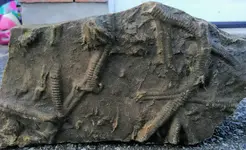
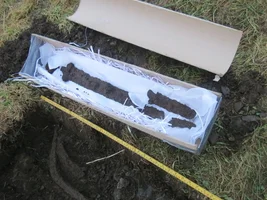
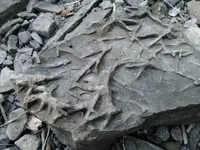
I would agree that the first specimen represents Arthrophycus traces and fits the reported morphologies for Arthrophycus alleghaniensis. The second specimen also looks like feeding traces of something but less convincingly Arthrophycus in the absence of the characteristic surface patterns. That may be simply because they have eroded away, or the traces may be from another organism.
AS you probably know if you have been researching your find, Cruziana ichnofossils like this are only characterised by their shape and form without complete knowledge of what animal produced them. As an ichnogenus, Arthrophycus is found in a number of locations on multiple continents and – although we have characterised them together based on their morphology – it’s likely that they do not all have the same ‘tracemaker’ as their origin.
What we can say in most cases is that they are consistent with having been produced by long-bodied and segmented animals from the ‘Ecdysozoa’ clade… which includes all animals that grow by moulting their exoskeleton such as arthropods, nematodes and several smaller phyla.
For A. alleghaniensis specifically, there is some very limited circumstantial evidence for the possible tracemaker arising from a previously unknown incomplete fossil arthropod found in association with the traces. It has been named Pleuralata spinosa and, apart from the segmented structure, we can say at least that the posterior end had long, curved spines. The head and appendages were not preserved.